
 A SCHOLARLY BOOK REPOSITORY
11 start with U start with U

Surrounding this material are chapters that provide context about the disputes among researchers about whether batterer intervention programs work (only a small number of batterers renounce their abuse) and chapters that address the reactions of partners to these stories. "When the Man You Love is Abusive" is designed to caution women not to be manipulated by accounts of change and to outline the stages men need to pass through in the long process of becoming accountable. "The Last Word: Voices of Survivors" ends the book with a focus group discussion in which former abuse victims and advocates respond candidly to the men's stories.

The story of Afro-Caribbean poet Norberto James Rawlings is one of migration, loss, adaptation, and reinvention that goes back for generations. Most well-known for “The Immigrants,” a poem about a Black minority community of Anglophone sugar plantation workers, Rawlings’s poetry has been performed, muralized, and celebrated in the Dominican Republic and beyond. While the principal themes in Norberto James’s early work is a concern for political justice and collective well-being, over time his work transcended the notoriety of his most famous poem. Bringing this selection of his work into English for the first time, this volume will expand the entry points into one of the most important Caribbean writers yet to punctuate the mainstream.

The abundance of laws and constitutional amendments that have cropped up in response are mirrored in Mexico's fragmented cultural production of the same period. Contemporary Mexican literature grapples with this splintered reality through non-linear stories from multiple perspectives, often told through shifts in time. The novels, such as Jorge Volpi's Una novela criminal [A Novel Crime] (2018) and Julián Herbert's La casa del dolor ajeno [The House of the Pain of Others] (2015) take multiple perspectives and follow non-linear plotlines; other examples, such as the very short stories in ¡Basta! 100 mujeres contra la violencia de género [Enough! 100 Women against Gender-Based Violence] (2013), present perspectives from multiple authors.
Few scholars compare cultural production and legal texts in situations like Mexico, where extreme violence coexists with a high number of human rights laws. Unlawful Violence measures fictional accounts of human rights against new laws that include constitutional amendments to reform legal proceedings, laws that protect children, laws that condemn violence against women, and laws that protect migrants and Indigenous peoples. It also explores debates about these laws in the Mexican house of representatives and senate, as well as interactions between the law and the Mexican public.

As the predominant form of birth control in Soviet society, abortion reflected key paradoxes of state socialism: women held formal equality but lacked basic needs such as contraceptives. With market reforms, Russians enjoyed new access to Western contraceptives and new pressures to postpone childbearing until economically self-sufficient. But habits of family planning did not emerge automatically—they required extensive physician retraining, public education, and cultural transformation. In Unmaking Russia’s Abortion Culture, author Michele Rivkin-Fish examines the creative strategies of Russians who promoted family planning in place of routine abortion. Rather than emphasizing individual rights, they explained family planning’s benefits to the nation—its potential to strengthen families and prevent the secondary sterility that resulted when women underwent repeat, poor-quality abortions. Still, fierce debates about abortion and contraceptives erupted as declining fertility was framed as threatening Russia’s demographic sovereignty.
Although Russian family planners embraced a culturally meaningful liberalism that would rationalize public policy and reenchant relations, nationalist opponents cast family planning as suspicious for its association with the individualistic, “child-free” West. This book tells the story of how Russian family planners developed culturally salient frameworks to promote the acceptability of contraceptives and help end routine abortion. It also documents how nationalist campaigns for higher fertility denounced family planning and ultimately dismantled its institutions. By tracing these processes, Unmaking Russia’s Abortion Culture demonstrates the central importance of reproductive politics in the struggle for liberalizing social change that preceded Russia’s 2022 descent into war, repression, and global marginalization.
The story is both personal and political. Author Emily Mendenhall, an anthropologist at Georgetown University, grew up in Okoboji, and her family still lives there. As the events unfolded, Mendenhall was in Okoboji, where she spoke formally with over 100 people and observed a community that rejected public health guidance, revealing deep-seated mistrust in outsiders and strong commitments to local thinking. Unmasked is a fascinating and heartbreaking account of where people put their trust, and how isolationist popular beliefs can be in America's small communities.
This book is the recipient of the 2022 Norman L. and Roselea J. Goldberg Prize from Vanderbilt University Press for the best book in the area of art or medicine.
The story is both personal and political. Author Emily Mendenhall, an anthropologist at Georgetown University, grew up in Okoboji, and her family still lives there. As the events unfolded, Mendenhall was in Okoboji, where she spoke formally with over 100 people and observed a community that rejected public health guidance, revealing deep-seated mistrust in outsiders and strong commitments to local thinking. Unmasked is a fascinating and heartbreaking account of where people put their trust, and how isolationist popular beliefs can be in America's small communities.
This book is the recipient of the 2022 Norman L. and Roselea J. Goldberg Prize from Vanderbilt University Press for the best book in the area of art or medicine.
Elderly ex-offenders are some of the most vulnerable and marginalized groups in Japan today, with high levels of poverty and homelessness, disability, mental health problems, and social isolation. Those with a history of incarceration and, by extension, their family, face stigma and discrimination that further erodes their ability to reintegrate and puts them at greater risk of reoffending. Unlike in any other country in the world, older people in Japan have a higher rate of reoffending than other age groups. In Unsettled Futures, author Jason Danely argues that we cannot dismiss these individuals merely as deviants; rather, their circumstances reveal deep contradictions in the overlapping terrain of welfare and punishment, and the precarity that forecloses on possibilities for older people to build a good life.
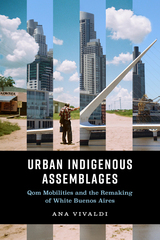
Over the past two decades, Latin American politicians and activists have reckoned with their nations’ histories of racism, forced displacement of native peoples, and inequality by acknowledging Indigenous communities as peoples preexisting the modern states. In Argentina—a nation long fixated on presenting itself as “white” and “European”—this shift has been dramatic. After decades of erasure and racism toward Indigenous peoples, Argentinian civil society is identifying Indigenous groups as not just an element from the past, but as nations central to the country’s culturally plural and multiracial identity.
In Urban Indigenous Assemblages, Ana Vivaldi considers how Argentina’s urban Indigenous population fits into this recent political and social movement. To do this, she focuses on how the Qom Indigenous people—whose traditional territories are in northern Argentina—have moved to Buenos Aires, made homes in shantytowns alongside other migrants, and remade urban space by building Indigenous lives in the city. Starting from a Qom barrio in Greater Buenos Aires, Vivaldi traces how Qom peoples’ travels to rural communities and movement across the city create complex networks and produce an urban life always in connection to other places. She argues that urban racialized indigeneities represent sites of contradictory relations visible and invisible to state actors and hypervisible to development agencies, as the Qom are expected to prove their authenticity and remove themselves from important relationships with nonwhite neighbors to access rights and recognition.
Based on eighteen months of fieldwork, this book analyzes the historical process that created the barrio: the constant remaking of this Indigenous space in interaction with state institutions and NGOs, the links between the barrio and northern Argentina through travels “far out” to rural communities in the Chaco, and the expansion of “Indigenous territories” beyond bounded location.

READERS
Browse our collection.
PUBLISHERS
See BiblioVault's publisher services.
STUDENT SERVICES
Files for college accessibility offices.
RECENTLY PUBLISHED



UChicago Accessibility Resources
home | accessibility | search | about | contact us
BiblioVault ® 2001 - 2026
The University of Chicago Press