
 A SCHOLARLY BOOK REPOSITORY
4 start with U start with U
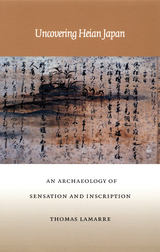
Combining a pathbreaking visual analysis of the calligraphy with which this poetry was transcribed, a more traditional textual analysis, and a review of the politics of the period, LaMarre presents a dramatically new view of Heian poetry and culture. He challenges the assumption of a cohesive “national imagination,” seeing instead an early Japan that is ethnically diverse, territorially porous, and indifferent to linguistic boundaries. Working through the problems posed by institutionalized notions of nationalism, nativism, and modernism, LaMarre rethinks the theories of scholars such as Suzuki Hideo, Yoshimoto Takaaki, and Komatsu Shigemi, in conjunction with theorists such as Derrida, Karatani, Foucault, and Deleuze. Contesting the notion that speech is central to the formation of community, Uncovering Heian Japan focuses instead on the potential centrality of the more figural operations of poetic practice.
Specialists in Japanese history and culture as well as scholars working in other areas of cultural criticism will find that this book enriches their understanding of an early Japan that has exerted so much influence on later concepts of what it means to be Japanese.

What does it mean, and take, to repay the unrepayable?
Unrepayable Debt explores belated attempts to reckon with the savage plundering of labor and life under the Japanese empire. Located within global conversations on reparations for colonialism and slavery, and centered on slave labor lawsuits brought by Chinese victims seeking overdue justice in Japanese courts, Yukiko Koga traces a sea change in the legal sphere propelled by an unprecedented transnational redress movement. The lawsuits exposed not only the original violence but also a structure of transitional injustice etched onto the unmaking of the Japanese empire, which left victims silenced and unredressable for decades.
Challenging the idea of reckoning as a discrete event that brings closure through settlements, apology, or compensation, Koga’s ethnography details the slow and messy intergenerational work of reconciliation on the ground. The book shows how the re-pairing of severed relations, separated by lineages of victimhood and perpetration, lies at the core of repair. By bringing to the surface the prolonged and entangled processes of decolonization and deimperialization, Unrepayable Debt compels a rethinking of what redress, repair, and reconciliation mean, how they are practiced, and where accountability lies.
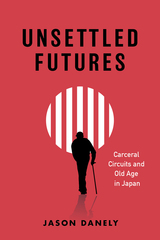
Elderly ex-offenders are some of the most vulnerable and marginalized groups in Japan today, with high levels of poverty and homelessness, disability, mental health problems, and social isolation. Those with a history of incarceration and, by extension, their family, face stigma and discrimination that further erodes their ability to reintegrate and puts them at greater risk of reoffending. Unlike in any other country in the world, older people in Japan have a higher rate of reoffending than other age groups. In Unsettled Futures, author Jason Danely argues that we cannot dismiss these individuals merely as deviants; rather, their circumstances reveal deep contradictions in the overlapping terrain of welfare and punishment, and the precarity that forecloses on possibilities for older people to build a good life.
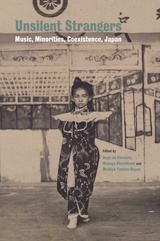
This collection of essays on the music of migrant minorities in and from Japan examines the central role music plays in the ongoing adjustment, conciliation, and transformation of newcomers and “hosts” alike. It is the first academic text to address musical activities across a range of migrant groups in Japan––particularly those of Tokyo and its neighboring areas and the first to juxtapose such communities with those of Japanese emigrants as ethnic minorities elsewhere. It presents both archival and fieldwork-based case studies that highlight music in the dynamics of encounter and attempted identity-making, under a unifying framework of migration.
The 2019 introduction of a new “Specified Skilled Worker” visa category marked the beginning of Japan’s “new immigration era,” led by the slogan of tabunka kyosei, or “multicultural coexistence.” The contributors to this volume analyze the concept itself and the many problems around realizing this ideal through ethnographic accounts of current minorities, including South Indians, Brazilians, Nepalis, Filipinos, Iranians, and Ainu domestic migrants. This volume will be of interest to ethnomusicologists, students of the cultures of migrant communities, and those engaged with cultural change and diversity in Japan and East Asia.
READERS
Browse our collection.
PUBLISHERS
See BiblioVault's publisher services.
STUDENT SERVICES
Files for college accessibility offices.
RECENTLY PUBLISHED






UChicago Accessibility Resources
home | accessibility | search | about | contact us
BiblioVault ® 2001 - 2026
The University of Chicago Press