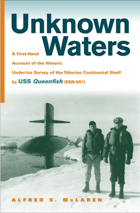
front cover of Unknown Waters
Unknown Waters
A First-Hand Account of the Historic Under-Ice Survey of the Siberian Continental Shelf by USS Queenfish (SSN-651)
Alfred S. McLaren
University of Alabama Press, 2008

“A first-person view of submarine under-ice operations that appears in very few other works.”  —Gary E. Weir, author of Rising Tide: The Untold Story of the Russian Submarines that Fought the Cold War 

Unknown Waters tells the story of the brave officers and men of the nuclear attack submarine USS Queenfish (SSN-651), who made the first survey of an extremely important and remote region of the Arctic Ocean. The unpredictability of deep-draft sea ice, shallow water, and possible Soviet discovery, all played a dramatic part in this engrossing 1970 voyage.

Covering 3,100 miles over a period of some 20 days at a laborious average speed of 6.5 knots or less, the attack submarine carefully threaded its way through innumerable underwater canyons of ice and over irregular seafloors, at one point becoming entrapped in an “ice garage.” Only cool thinking and skillful maneuvering of the nearly 5,000-ton vessel enabled a successful exit.


[more]

front cover of The UP Saga
The UP Saga
Susan M. Martin
National University of Singapore Press, 2003
Histories of the plantations sector in Malaysia have largely focused on the rubber industry and on the rise and fall of big British-owned colonial enterprises. But since independence, the sector has entered a new phase of spectacular growth founded on the oil palm. This volume offers a radically different history of a firm which spans both eras. The fascinating story of United Plantations Berhad (UP) highlights a Scandinavian-founded firm that evolved along quite different lines from the normal models of British imperial business. Tracing the company’s origins before the First World War, it describes the crisis years of economic depression and Japanese occupation then on to the years of spectacular growth which has lasted since the time of the Emergency and Merdeka right up to the present day. The success of this firm - based not just on an extraordinary combination of agricultural, engineering and marketing innovation but also on the company’s engagement and commitment to its local environment - provides a glowing example of a partnership between Europeans and Asians which has benefited both sides.
[more]

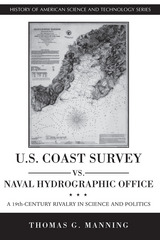
front cover of U.S. Coast Survey vs. Naval Hydrographic Office
U.S. Coast Survey vs. Naval Hydrographic Office
A 19th-Century Rivalry in Science and Politics
Thomas G. Manning
University of Alabama Press, 1988
Examines a crucial phase of the relations of science and politics in the post-Civil War period
 
[more]

front cover of The USS Wisconsin
The USS Wisconsin
A History of Two Battleships
Richard H. Zeitlin
Wisconsin Historical Society Press, 1988

Battleships were instrumental in America’s rise to world dominance at the end of the 19th century. Two battleships in particular, the U.S.S. Wisconsin BB-9 and BB-64, participated in wars and conflicts around the globe, demonstrating America’s strength and technological power. The keel of the BB-9 was laid down on the eve of the Spanish-American War, and she sailed with the Great White Fleet on its famous world voyage of 1907-1909. Representing a major advance in American naval technology, the Wisconsin both demonstrated American strength in the Pacific and served as the setting for peace talks between Panama and Colombia when the former gained independence in 1903. Recommissioned during World War I as a training ship, the BB-9 was then decommissioned in 1920. More than twenty years later, on December 7, 1943, the fast battleship Wisconsin (BB-64) was launched in response to Japan’s attack on Pearl Harbor. The BB-64 served in the Pacific to the end of World War II and again in the Korean War. One of the Iowa- class battleships, the BB-64 was one of the fastest and sleekest on the ocean. In 1988, she was refitted and recommissioned for yet another tour of duty. This is the story of two proud vessels and their role in American naval and diplomatic history.

[more]


Send via email Share on Facebook Share on Twitter