
 A SCHOLARLY BOOK REPOSITORY
113 books about Older people and 3
start with U
113 books about Older people and 3
113 books about Older people
3 start with U start with U
3 start with U start with U

Universal Coverage of Long-Term Care in the United States
Can We Get There from Here?
Douglas A. Wolfe
Russell Sage Foundation, 2013
As millions of baby boomers retire and age in the coming years, more American families will confront difficult choices about the long-term care of their loved ones. The swelling ranks of the disabled and elderly who need such care—including home care, adult day care, or a nursing home stay—are faced with a strained, inequitable and expensive system. How will American society and policy adapt to this demographic transition? In Universal Coverage of Long-Term Care in the United States, editors Nancy Folbre and Douglas Wolf and an expert group of care researchers assess the current U.S. long-term care policies and exercise what can be learned from other countries facing similar care demands. After the high-profile suspension of the Obama Administration’s public long-term insurance program in 2011, Robert Hudson and Howard Gleckman provide concrete suggestions for lowering the cost and improving the quality of long-term care coverage in America. In a deeply personal and empirically rigorous analysis, family care expert Carol Levine draws crucial lessons from her experience as a caregiver for her ailing husband. She sheds light on the often fraught interactions that occur between the formal care system and family caregivers and analyzes how public policy can best support long-term family care. The volume next examines recent reforms in other developed countries and finds valuable lessons for American policy-makers. Contributors David Bell and Alison Bowes discuss the provision of personal care services in Scotland, which have been publicly financed since 2002. Their analysis shows that the new program reduced costs improved efficiency and allowed more recipients to receive care. The volume assesses the political and institutional prospects for moving towards a truly universal long-term care system in the United States. Robyn Stone provides a sobering overview of the formal, paid long-term care workforce in America, which is in crisis due to increasing demand and a shortage of qualified workers. Economist Leonard Burman focuses on public finances of the long-term care system, which will come under increasing strain as more Americans rely on Medicaid to pay for their long-term care. In the volume’s concluding chapter, Folbre and Wolf summarize criticisms of existing long-term care policies and outline particular reforms that can move the United States toward a universal system of long-term care insurance. Universal Coverage of Long-Term Care in the United States provides an essential resource on how to improve the long-term care sector in America and helps advance the national debate on this pressing topic. This volume is available for free download on the Foundation’s website, as are the volume’s individual chapters.
[more]
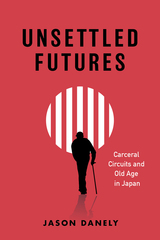
Unsettled Futures
Carceral Circuits and Old Age in Japan
Jason Danely
Vanderbilt University Press, 2024
There are two prevailing myths about Japanese society: first, that it has a successful elderly welfare system and second, that it has a successful criminal justice system. Both of these myths reinforce a social imaginary where cultural values of family and community harmony make extensive state intervention unnecessary. Yet not only are both of these myths and their arguments deeply flawed, but they also obscure the more troubling reality that institutions of welfare and punishment in Japan are co-extensive, both keeping Japan’s growing population of “excess” older people contained and controlled rather than providing ways for them to integrate and flourish.
Elderly ex-offenders are some of the most vulnerable and marginalized groups in Japan today, with high levels of poverty and homelessness, disability, mental health problems, and social isolation. Those with a history of incarceration and, by extension, their family, face stigma and discrimination that further erodes their ability to reintegrate and puts them at greater risk of reoffending. Unlike in any other country in the world, older people in Japan have a higher rate of reoffending than other age groups. In Unsettled Futures, author Jason Danely argues that we cannot dismiss these individuals merely as deviants; rather, their circumstances reveal deep contradictions in the overlapping terrain of welfare and punishment, and the precarity that forecloses on possibilities for older people to build a good life.
Elderly ex-offenders are some of the most vulnerable and marginalized groups in Japan today, with high levels of poverty and homelessness, disability, mental health problems, and social isolation. Those with a history of incarceration and, by extension, their family, face stigma and discrimination that further erodes their ability to reintegrate and puts them at greater risk of reoffending. Unlike in any other country in the world, older people in Japan have a higher rate of reoffending than other age groups. In Unsettled Futures, author Jason Danely argues that we cannot dismiss these individuals merely as deviants; rather, their circumstances reveal deep contradictions in the overlapping terrain of welfare and punishment, and the precarity that forecloses on possibilities for older people to build a good life.
[more]

Unsettled Labors
Migrant Care Work in Palestine/Israel
Rachel H. Brown
Duke University Press, 2024
In Unsettled Labors, Rachel H. Brown explores the overlooked labor of migrant workers in Israel’s eldercare industry. Brown argues that live-in eldercare in Palestine/Israel, which is primarily done by migrant workers, is an often invisible area where settler colonialism is reproduced culturally, economically, and biologically. Situating Israeli labor markets within a longer history of imperialism and dispossession of Palestinian land, Brown positions migrant eldercare within the resulting tangle of Israeli laws, policies, and social discourses. She draws from interviews with caretakers, public statements, court documents, and first-hand fieldwork to uncover the inherently contradictory nature of elder care work: the intimate presence of South and Southeast Asian workers in the home unsettles the idea of the Israeli home as an exclusively Jewish space. By paying close attention to the comparative racialization of migrant workers, Palestinians, asylum seekers, and Mizrahi and Ashkenazi settlers, Brown raises important questions of labor, social reproduction, displacement, and citizenship told through the stories of collective care provided by migrant workers in a settler colonial state.
[more]
READERS
Browse our collection.
PUBLISHERS
See BiblioVault's publisher services.
STUDENT SERVICES
Files for college accessibility offices.
RECENTLY PUBLISHED



UChicago Accessibility Resources
home | accessibility | search | about | contact us
BiblioVault ® 2001 - 2025
The University of Chicago Press