front cover of Unclenching Our Fists
Unclenching Our Fists
Abusive Men on the Journey to Nonviolence
Sara Elinoff Acker
Vanderbilt University Press, 2013
This book features eleven first-person stories of men from diverse class and racial backgrounds who have made a long-term commitment to end their physical and emotional abuse and controlling behaviors. These men speak frankly about the abuse they inflicted on their families, what it took to get them to face themselves, and how they feel about the damage they have caused. All participated in violence intervention programs, some for as long as ten years. To put a face on violence and to encourage activism for reform, most of the eleven have allowed their photos and real names to be used in the book.


Surrounding this material are chapters that provide context about the disputes among researchers about whether batterer intervention programs work (only a small number of batterers renounce their abuse) and chapters that address the reactions of partners to these stories. "When the Man You Love is Abusive" is designed to caution women not to be manipulated by accounts of change and to outline the stages men need to pass through in the long process of becoming accountable. "The Last Word: Voices of Survivors" ends the book with a focus group discussion in which former abuse victims and advocates respond candidly to the men's stories.

[more]

front cover of Under Construction
Under Construction
Making Homeland Security at the Local Level
Kerry B. Fosher
University of Chicago Press, 2008
In the aftermath of the 9/11 terrorist attacks, security became the paramount concern of virtually everyone involved in governing the United States. While the public’s most enduring memories of that time involved the actions of the Bush administration or Congress, the day-to-day reality of homeland security was worked out at the local level. Kerry B. Fosher, having begun an anthropological study of counterterrorism in Boston a few months prior to the attacks, thus found herself in a unique position to observe the formation of an immensely important area of government practice.
 
Under Construction goes behind the headlines and beyond official policy to describe the human activities, emotions, relationships, and decisions that shaped the way most Americans experienced homeland security. Fosher’s two years of fieldwork focused on how responders and planners actually worked, illuminating the unofficial strategies that allowed them to resolve conflicts and get things done in the absence of a functioning bureaucracy. Given her unprecedented access, Fosher’s account is an exceptional opportunity to see how seemingly monolithic institutions are constructed, maintained, and potentially transformed by a community of people.
[more]

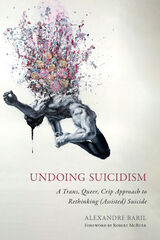
front cover of Undoing Suicidism
Undoing Suicidism
A Trans, Queer, Crip Approach to Rethinking (Assisted) Suicide
Alexandre Baril
Temple University Press, 2023
In Undoing Suicidism, Alexandre Baril argues that suicidal people are oppressed by what he calls structural suicidism, a hidden oppression that, until now, has been unnamed and under-theorized. Each year, suicidism and its preventionist script and strategies reproduce violence and cause additional harm and death among suicidal people through forms of criminalization, incarceration, discrimination, stigmatization, and pathologization. This is particularly true for marginalized groups experiencing multiple oppressions, including queer, trans, disabled, or Mad people. 
 
Undoing Suicidism questions the belief that the best way to help suicidal people is through the logic of prevention. Alexandre Baril presents the thought-provoking argument that supporting assisted suicide for suicidal people could better prevent unnecessary deaths. Offering a new queercrip model of (assisted) suicide, he invites us to imagine what could happen if we started thinking about (assisted) suicide from an anti-suicidist and intersectional framework. 
 
Baril provides a radical reconceptualization of (assisted) suicide and invaluable reflections for academics, activists, practitioners, and policymakers.
 
[more]

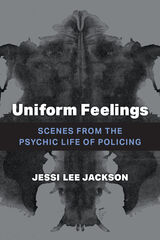
front cover of Uniform Feelings
Uniform Feelings
Scenes from the Psychic Life of Policing
Jessi Lee Jackson
University of Michigan Press, 2022
In Uniform Feelings, American studies scholar and abolitionist psychotherapist Jessi Lee Jackson reads policing as a set of emotional and relational practices in order to shed light on the persistence of police violence.  Jackson argues that psychological investments in U.S. police power emerge at various sites: her counseling room, manuals for addressing bias, museum displays, mortality statistics, and memorial walls honoring fallen officers.  Drawing on queer, feminist, anticolonial, and Black engagements with psychoanalysis to think through U.S. policing—and bringing together a mix of clinical case studies, autotheory, and ethnographic research—the book moves from the individual to the institutional. Jackson begins with her work as a psychotherapist working across the spectrum of relationships to policing, and then turns to interrogate carceral psychology—the involvement of her profession in ongoing state violence.  Jackson orbits around two key questions: how are our relationships shaped by proximity to state violence, and how can our social worlds be transformed to challenge state-sanctioned violence?
[more]


Send via email Share on Facebook Share on Twitter