logo for The Institution of Engineering and Technology
Ultrawideband Radar Measurements
Analysis and processing
L.Y. Astanin
The Institution of Engineering and Technology, 1997
Interest in the applications of ultrawideband (UWB) radar systems is increasing rapidly all over the world. This is evident from the number of monographs recently published on the subject and from the many papers presented at international conferences on the general problems involved in UWB radar and on its promising new applications. Conventional (classical) methods seem to have exhausted their potential and studies in the field are undergoing a profound change. This book presents some of the novel approaches to radar system analysis now being investigated.
[more]

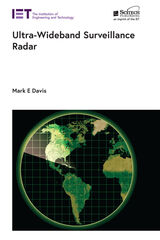
front cover of Ultra-Wideband Surveillance Radar
Ultra-Wideband Surveillance Radar
Mark E. Davis
The Institution of Engineering and Technology, 2021
Ultra-Wideband Surveillance Radar is an emerging technology for detecting and characterizing targets and cultural features for military and geosciences applications. To characterize objects near and under severe clutter, it is necessary to have fine range and cross range resolution. The resultant wide bandwidth classifies the systems as ultra-wideband, requiring special treatment in system technology and frequency allocation.
[more]

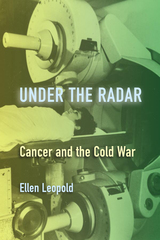
front cover of Under the Radar
Under the Radar
Cancer and the Cold War
Leopold, Ellen
Rutgers University Press, 2008
At the end of the Second World War, a diagnosis of cancer was a death sentence. Sixty years later, it is considered a chronic disease rather than one that is invariably fatal. Although survival rates have improved, the very word continues to evoke a special terror and guilt, inspiring scientists and politicians to wage war against it.

In Under the Radar, Ellen Leopold shows how nearly every aspect of our understanding and discussion of cancer bears the imprint of its Cold War entanglement. The current biases toward individual rather than corporate responsibility for rising incidence rates, research that promotes treatment rather than prevention, and therapies that can be patented and marketed all reflect a largely hidden history shaped by the Cold War. Even the language we use to describe the disease, such as the guiding metaphor for treatment, "fight fire with fire," can be traced back to the middle of the twentieth century.

Writing in a lucid style, Leopold documents the military, governmental, industrial, and medical views of radiation and atomic energy to examine the postwar response to cancer through the prism of the Cold War. She explores the role of radiation in cancer therapies today, using case studies and mammogram screening, in particular, to highlight the surprising parallels. Taking into account a wide array of disciplines, this book challenges our understanding of cancer and how we approach its treatment.
  • Examines the postwar response to cancer through the prism of the Cold War
  • Goes beyond medical science to look at the influence of Cold War policies on the way we think about cancer today
  • Links the experience of postwar cancer patients with the broader evolution of what have become cancer industries
  • Traces the history of human-made radiation as a state-sponsored environmental toxin

[more]

front cover of Under the Radar
Under the Radar
Tracking Western Radio Listeners in the Soviet Union
R. Eugene Parta
Central European University Press, 2022

Western democracy is currently under attack by a resurgent Russia, weaponizing new technologies and social media. How to respond? During the Cold War, the West fought off similar Soviet propaganda assaults with shortwave radio broadcasts. Founded in 1949, the US-funded Radio Free Europe/Radio Liberty broadcast uncensored information to the Soviet republics in their own languages. About one-third of Soviet urban adults listened to Western radio. The broadcasts played a key role in ending the Cold War and eroding the communist empire.

R. Eugene Parta was for many years the director of Soviet Area Audience Research at RFE/RL, charged among others with gathering listener feedback. In this book he relates a remarkable Cold War operation to assess the impact of Western radio broadcasts on Soviet listeners by using a novel survey research approach. Given the impossibility of interviewing Soviet citizens in their own country, it pioneered audacious interview methods in order to fly under the radar and talk to Soviets traveling abroad, ultimately creating a database of 51,000 interviews which offered unparalleled insights into the media habits and mindset of the Soviet public. By recounting how the “impossible” mission was carried out, Under the Radar also shows how the lessons of the past can help counter the threat from a once and current adversary.

[more]

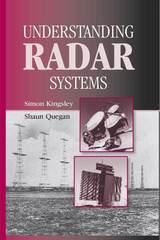
front cover of Understanding Radar Systems
Understanding Radar Systems
Simon Kingsley
The Institution of Engineering and Technology, 1999
What is radar? What systems are currently in use? How do they work? Understanding Radar Systems provides engineers and scientists with answers to these critical questions, focusing on actual radar systems in use today. It's the perfect resource for those just entering the field or a quick refresher for experienced practitioners. The book leads readers through the specialized language and calculations that comprise the complex world of modern radar engineering as seen in dozens of state-of-the-art radar systems. The authors stress practical concepts that apply to all radar, keeping math to a minimum. Most of the book is based on real radar systems rather than theoretical studies. The result is a valuable, easy-to-use guide that makes the difficult parts of the field easier and helps readers do performance calculations quickly and easily.
[more]


Send via email Share on Facebook Share on Twitter