front cover of Vehicle of Influence
Vehicle of Influence
Building a European Car Market
Roland Stephen
University of Michigan Press, 2000
This study examines a crucial period in European integration, ending in the early 1990s, when significant progress was made towards the dream of a unified European market. It shows how European automakers were part of these changes and how their influence within the institutions of the European Union (EU) yielded a wide range of policy compromises governing a single European car market.
The book begins by reviewing the history of the EU and the logic of regional free trade, and goes on to develop a political explanation for the kinds of changes that actually occurred. The author argues that European automakers enjoyed a privileged place in the political arena, albeit one much transformed by the new institutions of the EU. Therefore, these firms often significantly influenced regional policy outcomes. The argument is applied to policymaking in the important areas of environmental regulation, trade, subsidies, and anti-trust regulation.
This work lies at the intersection of business, economics, and political science and is of interest to both experts and non-specialists with an interest in the tremendous economic and political changes brought about by the creation of a united Europe and, more generally, by the worldwide process of regional economic integration. Academics, professionals, businessmen, and leaders in government all have something to learn from the way in which firms and governments combined to build the largest car market in the world.
Roland Stephen is Assistant Professor in the Department of Political Science, North Carolina State University.

[more]

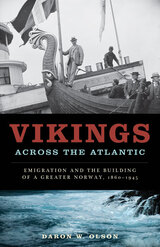
front cover of Vikings across the Atlantic
Vikings across the Atlantic
Emigration and the Building of a Greater Norway, 1860-1945
Daron W. Olson
University of Minnesota Press, 2013

Around the year 1000 a Viking ship landed on the Atlantic coast of what would one day be North America. Nearly a millennium later, on June 7, 1945, Norway’s King Haakon VII returned from exile under guard of the American Ninety-ninth—or “Viking”—Battalion. In Vikings across the Atlantic, Daron W. Olson reveals how these two moments form narrative poles for the vision of a Greater Norway that expanded the boundaries of the Norwegian nation.

Looking at matters of religion, literature, media, and ethnicity, Olson explores how Norwegian Americans’ myths about themselves changed over time in relation to a broader Anglo-American culture, while at the same time influencing and being influenced by the burgeoning national culture of their homeland. Beginning in the 1920s, homeland Norwegian identity-makers framed the concept of the Greater Norway, which viewed the Norwegian nation as having two halves: Norwegians who resided in the homeland and those who had emigrated from Norway, especially those in America. Far from being merely symbolic, this idea, Olson shows, was actually tested by the ordeal of World War II, when Norwegians the world over demonstrated their willingness to sacrifice and even die for the Greater Norway.

In its transnational approach, Olson’s book brings a new perspective to immigrant studies and theories of nationalism; Vikings across the Atlantic depicts the nation as a larger community in which membership is constructed or imagined, a status of belonging defined not by physical proximity but through qualities such as culture and shared traditions.

[more]


Send via email Share on Facebook Share on Twitter