
 A SCHOLARLY BOOK REPOSITORY
5 start with V start with V
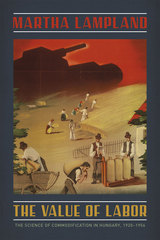
Lampland trains her eye on the scientific claims of modern economic modeling, using Hungary’s unique vantage point to show how theories, policies, and techniques for commodifying agrarian labor that were born in the capitalist era were adopted by the socialist regime as a scientifically designed wage system on cooperative farms. Paying attention to the specific historical circumstances of Hungary, she explores the ways economists and the abstract notions they traffic in can both shape and be shaped by local conditions, and she compellingly shows how labor can be commodified in the absence of a labor market. The result is a unique account of economic thought that unveils hidden but necessary continuities running through the turbulent twentieth century.

“An incisive history of the venture-capital industry.”
—New Yorker
“An excellent and original economic history of venture capital.”
—Tyler Cowen, Marginal Revolution
“A detailed, fact-filled account of America’s most celebrated moneymen.”
—New Republic
“Extremely interesting, readable, and informative…Tom Nicholas tells you most everything you ever wanted to know about the history of venture capital, from the financing of the whaling industry to the present multibillion-dollar venture funds.”
—Arthur Rock
“In principle, venture capital is where the ordinarily conservative, cynical domain of big money touches dreamy, long-shot enterprise. In practice, it has become the distinguishing big-business engine of our time…[A] first-rate history.”
—New Yorker
VC tells the riveting story of how the venture capital industry arose from America’s longstanding identification with entrepreneurship and risk-taking. Whether the venture is a whaling voyage setting sail from New Bedford or the latest Silicon Valley startup, VC is a state of mind as much as a way of doing business, exemplified by an appetite for seeking extreme financial rewards, a tolerance for failure and experimentation, and a faith in the promise of innovation to generate new wealth.
Tom Nicholas’s authoritative history takes us on a roller coaster of entrepreneurial successes and setbacks. It describes how iconic firms like Kleiner Perkins and Sequoia invested in Genentech and Apple even as it tells the larger story of VC’s birth and evolution, revealing along the way why venture capital is such a quintessentially American institution—one that has proven difficult to recreate elsewhere.

A Financial Times Best Economics Book of the Year
“An essential and insightful analysis of the history of economic inequality urgently relevant today…a groundbreaking work, bound to influence the economics profession and our worldview.” —LSE Review of Books
“A history of the changing ways economists have broached the subject [of inequality] since the French Revolution…[Milanovic] describes how Western economists were in thrall to an unholy combination of extremely simplistic assumptions and extremely complex mathematical models.” —New York Times
“A timely book that brings the weight of the past to bear on one of the most pressing issues of our time…Milanovic is a clear and direct writer, unafraid of making strong judgements and with an idiosyncratic eye for detail. That makes for original, and sometimes amusingly wry, revelations.” —Literary Review
“How do you see income distribution in your time, and how and why do you expect it to change?” Branko Milanovic imagines posing this question to six of history’s most influential economists. Probing the works of these key thinkers in the context of their lives, Milanovic charts the evolution of the concept of inequality across the centuries. We cannot speak of inequality in general, he argues: any analysis of it is inextricably linked to a particular time and place.
Visions of Inequality takes us from François Quesnay, for whom social classes were prescribed by law, through Adam Smith, David Ricardo, and Karl Marx, who saw class as a purely economic category determined by one’s relation to the means of production. Later, Vilfredo Pareto reconceived class in terms of elites versus the rest, while Simon Kuznets saw inequality arising from the urban-rural divide. Milanovic further explores why inequality receded from scholarship during the Cold War, before gaining renewed attention in economics today.
An invaluable intellectual genealogy, Visions of Inequality brings nuanced insight to a hotly contested idea.
READERS
Browse our collection.
PUBLISHERS
See BiblioVault's publisher services.
STUDENT SERVICES
Files for college accessibility offices.
RECENTLY PUBLISHED







UChicago Accessibility Resources
home | accessibility | search | about | contact us
BiblioVault ® 2001 - 2026
The University of Chicago Press