
 A SCHOLARLY BOOK REPOSITORY
348 books about Human Rights and 5
start with V
348 books about Human Rights and 5
348 books about Human Rights
5 start with V start with V
5 start with V start with V
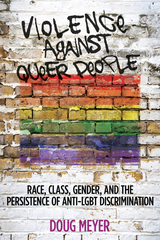
Violence against Queer People
Race, Class, Gender, and the Persistence of Anti-LGBT Discrimination
Meyer, Doug
Rutgers University Press, 2015
Received a 2016 Stonewall Book Award – Israel Fishman Non-Fiction Award Honor Book from the American Library Association
Selected as one of “The Best of the Best from the University Presses: Books You Should Know About” at the 2016 ALA Annual Conference
Violence against lesbians and gay men has increasingly captured media and scholarly attention. But these reports tend to focus on one segment of the LGBT community—white, middle class men—and largely ignore that part of the community that arguably suffers a larger share of the violence—racial minorities, the poor, and women. In Violence against Queer People, sociologist Doug Meyer offers the first investigation of anti-queer violence that focuses on the role played by race, class, and gender.
Drawing on interviews with forty-seven victims of violence, Meyer shows that LGBT people encounter significantly different forms of violence—and perceive that violence quite differently—based on their race, class, and gender. His research highlights the extent to which other forms of discrimination—including racism and sexism—shape LGBT people’s experience of abuse. He reports, for instance, that lesbian and transgender women often described violent incidents in which a sexual or a misogynistic component was introduced, and that LGBT people of color sometimes weren’t sure if anti-queer violence was based solely on their sexuality or whether racism or sexism had also played a role. Meyer observes that given the many differences in how anti-queer violence is experienced, the present media focus on white, middle-class victims greatly oversimplifies and distorts the nature of anti-queer violence. In fact, attempts to reduce anti-queer violence that ignore race, class, and gender run the risk of helping only the most privileged gay subjects.
Many feel that the struggle for gay rights has largely been accomplished and the tide of history has swung in favor of LGBT equality. Violence against Queer People, on the contrary, argues that the lives of many LGBT people—particularly the most vulnerable—have improved very little, if at all, over the past thirty years.
Selected as one of “The Best of the Best from the University Presses: Books You Should Know About” at the 2016 ALA Annual Conference
Violence against lesbians and gay men has increasingly captured media and scholarly attention. But these reports tend to focus on one segment of the LGBT community—white, middle class men—and largely ignore that part of the community that arguably suffers a larger share of the violence—racial minorities, the poor, and women. In Violence against Queer People, sociologist Doug Meyer offers the first investigation of anti-queer violence that focuses on the role played by race, class, and gender.
Drawing on interviews with forty-seven victims of violence, Meyer shows that LGBT people encounter significantly different forms of violence—and perceive that violence quite differently—based on their race, class, and gender. His research highlights the extent to which other forms of discrimination—including racism and sexism—shape LGBT people’s experience of abuse. He reports, for instance, that lesbian and transgender women often described violent incidents in which a sexual or a misogynistic component was introduced, and that LGBT people of color sometimes weren’t sure if anti-queer violence was based solely on their sexuality or whether racism or sexism had also played a role. Meyer observes that given the many differences in how anti-queer violence is experienced, the present media focus on white, middle-class victims greatly oversimplifies and distorts the nature of anti-queer violence. In fact, attempts to reduce anti-queer violence that ignore race, class, and gender run the risk of helping only the most privileged gay subjects.
Many feel that the struggle for gay rights has largely been accomplished and the tide of history has swung in favor of LGBT equality. Violence against Queer People, on the contrary, argues that the lives of many LGBT people—particularly the most vulnerable—have improved very little, if at all, over the past thirty years.
[more]
Violent Exceptions
Children's Human Rights and Humanitarian Rhetorics
Wendy S. Hesford
The Ohio State University Press, 2021
Violent Exceptions turns to the humanitarian figure of the child-in-peril in twenty-first-century political discourse to better understand how this figure is appropriated by political constituencies for purposes rarely to do with the needs of children at risk. Wendy S. Hesford shows how the figure of the child-in-peril is predicated on racial division, which, she argues, is central to both conservative and liberal logics, especially at times of crisis when politicians leverage humanitarian storytelling as a political weapon. Through iconic images and stories of child migrants, child refugees, undocumented children, child soldiers, and children who are victims of war, terrorism, and state violence, Violent Exceptions illustrates how humanitarian rhetoric turns public attention away from systemic violations against children’s human rights and reframes this violence as exceptional—erasing more gradual forms of violence and minimizing human rights potential to counteract these violations and the precarious conditions from which they arise.
[more]

Violent Exceptions
Children's Human Rights and Humanitarian Rhetorics
Wendy S. Hesford
The Ohio State University Press, 2021
Violent Exceptions turns to the humanitarian figure of the child-in-peril in twenty-first-century political discourse to better understand how this figure is appropriated by political constituencies for purposes rarely to do with the needs of children at risk. Wendy S. Hesford shows how the figure of the child-in-peril is predicated on racial division, which, she argues, is central to both conservative and liberal logics, especially at times of crisis when politicians leverage humanitarian storytelling as a political weapon. Through iconic images and stories of child migrants, child refugees, undocumented children, child soldiers, and children who are victims of war, terrorism, and state violence, Violent Exceptions illustrates how humanitarian rhetoric turns public attention away from systemic violations against children’s human rights and reframes this violence as exceptional—erasing more gradual forms of violence and minimizing human rights potential to counteract these violations and the precarious conditions from which they arise.
[more]
Voices from the "Jungle"
Stories from the Calais Refugee Camp
Calais Writers
Pluto Press, 2017
Often called the Calais Jungle, the refugee camp in Northern France epitomises for many the suffering, uncertainty, and violence that characterizes the lives of many refugees in Europe today. Migrants from ravaged countries, such as Syria, Sudan, Afghanistan, and Eritrea, arrive by the hundreds every day hoping for sanctuary from their war-torn homelands and a chance to settle in Europe. Going beyond superficial media reports, Voices from the “Jungle” gives voice to the unique individuals living in the camp—people who have made the difficult journey from devastated countries simply looking for peace.
In this moving collection of individual testimonies, Calais refugees speak directly in powerful and vivid stories, offering their memories up with stunning honesty. They tell of their childhood dreams and struggles for education; the genocides, wars, and persecution that drove them from home; the simultaneous terror and strength that filled their extraordinary journeys; the realities of living in the Calais refugee camp; and their deepest hopes for the future.
Through their stories, these refugees paint a picture of a different kind of Jungle—a powerful sense of community that has grown despite evictions and attacks and a solidarity that crosses national and religious boundaries. Interspersed with photos taken by the camp's inhabitants, taught by award-winning photographers Gideon Mendel and Crispin Hughes, original artwork by inhabitants, and powerful poems, Voices from the “Jungle” must be read by anyone seeking to understand the human consequences of our current world crisis.
In this moving collection of individual testimonies, Calais refugees speak directly in powerful and vivid stories, offering their memories up with stunning honesty. They tell of their childhood dreams and struggles for education; the genocides, wars, and persecution that drove them from home; the simultaneous terror and strength that filled their extraordinary journeys; the realities of living in the Calais refugee camp; and their deepest hopes for the future.
Through their stories, these refugees paint a picture of a different kind of Jungle—a powerful sense of community that has grown despite evictions and attacks and a solidarity that crosses national and religious boundaries. Interspersed with photos taken by the camp's inhabitants, taught by award-winning photographers Gideon Mendel and Crispin Hughes, original artwork by inhabitants, and powerful poems, Voices from the “Jungle” must be read by anyone seeking to understand the human consequences of our current world crisis.
[more]
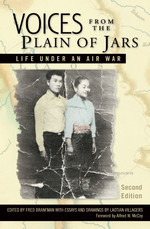
Voices from the Plain of Jars
Life under an Air War
Edited by Fred Branfman with essays and drawings by Laotian villagers; Foreword by Alfred W. McCoy
University of Wisconsin Press, 2013
During the Vietnam War the United States government waged a massive, secret air war in neighboring Laos. Two million tons of bombs were dropped on one million people. Fred Branfman, an educational advisor living in Laos at the time, interviewed over 1,000 Laotian survivors. Shocked by what he heard and saw, he urged them to record their experiences in essays, poems, and pictures. Voices from the Plain of Jars was the result of that effort.
When first published in 1972, this book was instrumental in exposing the bombing. In this expanded edition, Branfman follows the story forward in time, describing the hardships that Laotians faced after the war when they returned to find their farm fields littered with cluster munitions—explosives that continue to maim and kill today.
When first published in 1972, this book was instrumental in exposing the bombing. In this expanded edition, Branfman follows the story forward in time, describing the hardships that Laotians faced after the war when they returned to find their farm fields littered with cluster munitions—explosives that continue to maim and kill today.
[more]
READERS
Browse our collection.
PUBLISHERS
See BiblioVault's publisher services.
STUDENT SERVICES
Files for college accessibility offices.
RECENTLY PUBLISHED


UChicago Accessibility Resources
home | accessibility | search | about | contact us
BiblioVault ® 2001 - 2026
The University of Chicago Press