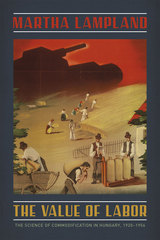
front cover of The Value of Labor
The Value of Labor
The Science of Commodification in Hungary, 1920-1956
Martha Lampland
University of Chicago Press, 2016
At the heart of today’s fierce political anger over income inequality is a feature of capitalism that Karl Marx famously obsessed over: the commodification of labor. Most of us think wage-labor economics is at odds with socialist thinking, but as Martha Lampland explains in this fascinating look at twentieth-century Hungary, there have been moments when such economics actually flourished under socialist regimes. Exploring the region’s transition from a capitalist to a socialist system—and the economic science and practices that endured it—she sheds new light on the two most polarized ideologies of modern history.
            Lampland trains her eye on the scientific claims of modern economic modeling, using Hungary’s unique vantage point to show how theories, policies, and techniques for commodifying agrarian labor that were born in the capitalist era were adopted by the socialist regime as a scientifically designed wage system on cooperative farms. Paying attention to the specific historical circumstances of Hungary, she explores the ways economists and the abstract notions they traffic in can both shape and be shaped by local conditions, and she compellingly shows how labor can be commodified in the absence of a labor market. The result is a unique account of economic thought that unveils hidden but necessary continuities running through the turbulent twentieth century. 
 
[more]

front cover of Victim of History
Victim of History
Cardinal Mindszenty, a biography
Margit Balogh
Catholic University of America Press, 2022
“Victim of history,” “a martyr from behind the Iron Curtain,” “the Hungarian Gandhi” – these are just some of the epithets which people used to describe Cardinal Mindszenty, archbishop of Esztergom, who was the last Hungarian prelate to use the title of prince primate. Today, Mindszenty has been forgotten in most countries except for Hungary, but when he died in 1975, he was known all over the world as a symbol of the struggle of the Catholic Church against communism. Cardinal Mindszenty held the post of archbishop of Esztergom from 1945 until 1974, but during this period of almost three decades he served barely four years in office. The political police arrested him on December 26, 1948, and the Budapest People’s Court subsequently sentenced him to life imprisonment. Based on the Stalinist practice of show trials, one of the accusations against Mindszenty, referring to his legitimist leanings, was his alleged attempt to re-establish Habsburg rule in Hungary. He regained freedom during the 1956 revolution but only for a few days. He was granted refuge by the US Embassy in Budapest between November 4, 1956 –September 28, 1971. In the fifteen years he spent at the American embassy enormous changes took place in the world while his personality remained frozen into the past. When in 1971 Pope Paul VI received the Hungarian foreign minister, he called Mindszenty “the victim of history”. His last years were spent free at last, but far away from his homeland. In Hungary, the Catholic believers eagerly await his beatification.
[more]


front cover of The Visual World of the Hungarian Angevin Legendary
The Visual World of the Hungarian Angevin Legendary
Béla Zsolt Szakács
Central European University Press, 2016
Dispersed in two continents, four countries and six collections; many of its pages were cropped, cut into four, or lost forever; its history, origin, commissioner and audience are obscure; still, in its fragmented state it presents fifty-eight legends in abundant series of images, on folios fully covered by miniatures, richly gilded, using only one side of the fine parchment; a luxurious codex worthy of a ruler; a unique iconographic treasury of medieval legends; one of the most significant manuscripts of the medieval Hungarian Kingdom – these are all what we call the Hungarian Angevin Legendary.
[more]


Send via email Share on Facebook Share on Twitter