
 A SCHOLARLY BOOK REPOSITORY
17 start with V start with V
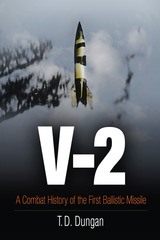
In August 1944, Londoners thought the war might be over by Christmas. But on September 8, 1944, in the London suburb of Chiswick, a thunderous double-boom was heard followed by a huge plume of black smoke rising high into the air. Several minutes later another explosion rocked the earth near Epping. There had been no warnings, no drone of aircraft above, just sudden devastation. "Operation Penguin," the V-2 offensive, had begun. The A-4 rocket, better known as the V-2, Vergeltungswaffen Zwei, or "Vengeance Weapon 2," was the first ballistic missile to be used in combat. Soaring over 50 miles high at supersonic speeds, the V-2 would strike its target within 5 minutes of launching. Once in the air its deadly warhead was unstoppable. The ancestor of all Cold War and modern day ballistic missiles, as well as the rockets used for space exploration, the V-2 could not win the war for Germany—it was too expensive, too complicated, too inaccurate, and its warhead was too small—but its unprecedented invulnerability and influence on Allied planning made the V-2 and the advancements it represented the ultimate war prize, and British, American, and Soviet forces scrambled to seize German rocket technology along with its scientists and engineers. In V-2: A Combat History of the First Ballistic Missile, T. D. Dungan relies on an unparalleled collection of original documents, unpublished photographs, and accounts from those who were there to provide a complete description of the V-2 program, the missile's use in combat, and the race to capture its secrets.
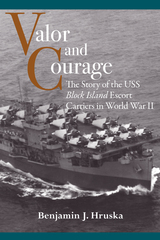
Recounts the stories of the USS Block Island CVE 21 and CVE 106 and their crews, many of whom served on both ships in the Atlantic and Pacific theatres.
In Valor and Courage: The Story of the USS Block Island Escort Carriers in World War II Benjamin Hruska explores the history and commemoration of the USS Block Island—or, more properly, the Block Islands, as two escort carriers bore that name during WWII. The first, CVE 21, bears the distinction of having been the only American aircraft carrier sunk in the Atlantic Theatre after being torpedoed by a German U-boat off the coast of North Africa.
Of the CVE 21’s 957 crew members, six sailors were killed and eighteen injured in the strike, and four of the Block Island’s fighter pilots were lost later in the day searching for a safe place to land their planes. When the CVE 106 was commissioned to replace its predecessor, Captain Massie Hughes successfully persuaded the Navy to keep the CVE 21’s crew together in manning the new ship. After resurrection as the CVE 106, the Block Island was assigned to the Pacific theater where it fought until the end of the war. The saga of these two ships and the crew that navigated two very different theaters of war offers a unique lens on naval strategy and engineering as it evolved during WWII, especially as pertains to the escort carrier class—generally underappreciated both in naval studies and in public memory.
Using archival materials, dozens of oral histories, primary sources, and official records, Hruska traces the life of the Block Island from the CVE 21’s construction through its missions in the Atlantic, its work as an antisubmarine hunter, its destruction, and the lasting impact of those experiences on its crew. Hruska’s study juxtaposes traditional military history with an examination of the acts of remembrance and commemoration by veterans who served on the escort carriers, how those practices evolved over time, and how the meanings of personal wartime experiences and memories gradually shifted throughout that process.

A Roman commander’s comprehensive history of Rome.
The histories of Velleius Paterculus chronicle the story of Rome and Roman culture from the fall of Troy to AD 30. Although his work’s title, proem, and opening chapters are lost along with the narrative from Romulus to the Battle of Pydna in 168 BC, Velleius provides much valuable information, especially about the reigns of Augustus and Tiberius (30 BC–AD 37), for which he provides our only extant historical depiction by a contemporary witness. Velleius was also an active participant: after service under both emperors as a military tribune in Thrace, Macedonia, Greece, and Asia Minor and as a cavalry officer and legatus in Germany and Pannonia, he joined Tiberius at his triumph in AD 12 and became praetor in 15, after which he seems to have retired from public life except for meetings of the senate.
Much like his near-contemporaries Cornelius Nepos (LCL 467) and Valerius Maximus (LCL 492, 493), Velleius adopted for his work a condensed and selective format, but his style is richly literary and he allows himself to digress when themes or topics seem especially interesting or significant: these include literature, rhetoric, culture, chronology, and dating, as well as individual Roman towns, colonies, and provinces, about which he was richly informed through firsthand familiarity with Rome and much of the empire along a vast arc that stretched from the Elbe to the Euphrates.
This edition of Velleius Paterculus, which replaces that of F. W. Shipley, offers a new translation, ample annotation, and a freshly edited text.
This text is an eyewitness account of the crucial first five years of the War of Candia (1645–1669), also known as the Cretan War and Fifth Ottoman-Venetian War: the war between the Republic of Venice and her allies against the Ottoman Empire and the Barbary States. It is a primary source for the longest Mediterranean conflict of the early modern age.
Composed by Emmanuel Mormori, a hitherto obscure Greek Cretan nobleman, the text is accompanied by an extensive introduction focusing on the author, who appears to have been a Venetian intelligence agent in Ottoman-conquered Chania (in Crete), and, for a period of five years, became key to the Venetian war effort. The volume includes a dossier of documents illuminating this figure, culled from the collections of the State Archive of Venice.
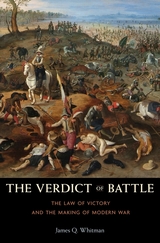
Today, war is considered a last resort for resolving disagreements. But a day of staged slaughter on the battlefield was once seen as a legitimate means of settling political disputes. James Whitman argues that pitched battle was essentially a trial with a lawful verdict. And when this contained form of battle ceased to exist, the law of victory gave way to the rule of unbridled force. The Verdict of Battle explains why the ritualized violence of the past was more effective than modern warfare in bringing carnage to an end, and why humanitarian laws that cling to a notion of war as evil have led to longer, more barbaric conflicts.
Belief that sovereigns could, by rights, wage war for profit made the eighteenth century battle’s golden age. A pitched battle was understood as a kind of legal proceeding in which both sides agreed to be bound by the result. To the victor went the spoils, including the fate of kingdoms. But with the nineteenth-century decline of monarchical legitimacy and the rise of republican sentiment, the public no longer accepted the verdict of pitched battles. Ideology rather than politics became war’s just cause. And because modern humanitarian law provided no means for declaring a victor or dispensing spoils at the end of battle, the violence of war dragged on.
The most dangerous wars, Whitman asserts in this iconoclastic tour de force, are the lawless wars we wage today to remake the world in the name of higher moral imperatives.
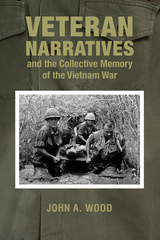
In the decades since the Vietnam War, veteran memoirs have influenced Americans’ understanding of the conflict. Yet few historians or literary scholars have scrutinized how the genre has shaped the nation’s collective memory of the war and its aftermath. Instead, veterans’ accounts are mined for colorful quotes and then dropped from public discourse; are accepted as factual sources with little attention to how memory, no matter how authentic, can diverge from events; or are not contextualized in terms of the race, gender, or class of the narrators.
Veteran Narratives and the Collective Memory of the Vietnam War is a landmark study of the cultural heritage of the war in Vietnam as presented through the experience of its American participants. Crossing disciplinary borders in ways rarely attempted by historians, John A. Wood unearths truths embedded in the memoirists’ treatments of combat, the Vietnamese people, race relations in the United States military, male-female relationships in the war zone, and veterans’ postwar troubles. He also examines the publishing industry’s influence on collective memory, discussing, for example, the tendency of publishers and reviewers to privilege memoirs critical of the war. Veteran Narratives is a significant and original addition to the literature on Vietnam veterans and the conflict as a whole.
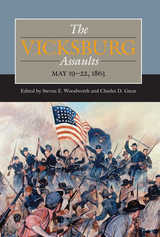
But due to difficult terrain, strong defenses, and uncoordinated movements, the quick triumph Grant desired was unattainable. On the afternoon of May 19, with little rest, preparation, or reconnaissance, Union forces charged the Confederate lines only to be repulsed. A respite between the assaults allowed both sides to reinforce their positions. Early on May 22 the Union artillery sought to soften the stronghold’s defenses before the general attack, but despite the Union forces’ preparation, the fighting proved even more disorganized and vicious. Again Grant failed to move Pemberton. Not wanting to risk more soldiers in a third attack, Grant conceded to the necessity of laying siege. Confederate morale climbed as the Southerners realized they had held their ground against an overwhelming force.
Editors Steven E. Woodworth and Charles D. Grear have assembled five captivating essays that examine Grant’s unsuccessful assaults against Confederate defensive lines around Vicksburg. Ranging from military to social history, the essays further historical debates on prominent topics, such as the reactions of Midwesterners to the first failures of Grant’s Vicksburg campaign. Two essays from opposing sides analyze the controversial decisions surrounding the Railroad Redoubt, the site of the bloodiest fighting on May 22. Another investigates how the tenacity of Texan reinforcements forced Union soldiers to abandon their gains.
Peppered with first-hand observations and bolstered by an impressive depth of research, this anthology is an invitingly written account and comprehensive assessment. By zeroing in on the two assaults, the contributors offer essential clarity and understanding of these important events within the larger scope of the Civil War’s Vicksburg Campaign.
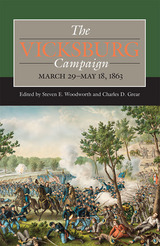
Ulysses S. Grant’s ingenious campaign to capture the last Confederate stronghold on the Mississippi River was one of the most decisive events of the Civil War and one of the most storied military expeditions in American history. The ultimate victory at Vicksburg effectively cut the Confederacy in two, gave control of the river to Union forces, and delivered a devastating blow from which the South never fully recovered. Editors Steven E. Woodworth and Charles D. Grear have assembled essays by prominent and emerging scholars, who contribute astute analysis of this famous campaign’s most crucial elements and colorful personalities.
Encompassed in this first of five planned volumes on the Vicksburg campaign are examinations of the pivotal events that comprised the campaign’s maneuver stage, from March to May of 1863. The collection sheds new light on Grant’s formidable intelligence network of former slaves, Mississippi loyalists, and Union spies; his now legendary operations to deceive and confuse his Confederate counterparts; and his maneuvers from the perspective of classic warfare. Also presented are insightful accounts of Grant’s contentious relationship with John A. McClernand during the campaign; interactions between hostile Confederate civilians and Union army troops; and the planning behind such battles as Grierson’s Raid, Port Gibson, Raymond, Jackson, Champion Hill, and Big Black River Bridge.
A study of American attempts to come to terms with the legacy of the Vietnam War, this book highlights the central role played by Vietnam veterans in shaping public memory of the war.
Tracing the evolution of the image of the Vietnam veteran from alienated dissenter to traumatized victim to noble warrior, Patrick Hagopian describes how efforts to commemorate the war increasingly downplayed the political divisions it spawned in favor of a more unifying emphasis on honoring veterans and promoting national “healing.”
In Vietnam, the American government vowed to win the “hearts and minds” of the people. On the other side, among those who led and sympathized with the insurgents, the term “people's war” gained a wide currency. Yet while much has been written about those who professed to speak for the Vietnamese population, we know surprisingly little about the everyday life of the peasants who made up the bulk of the country's inhabitants. This book illuminates that subject. Drawing on a wide range of sources, including interviews conducted by the Rand Corporation with informants from My Tho Province in the Mekong Delta, David Hunt brings to light the daily experience of villagers in the midst of war and revolution.
The peasants of southern Vietnam were neither onlookers nor mere victims as fighting raged throughout their country. From the “concerted uprising” in 1959–1960 to the Tet Offensive of 1968, the revolutionary movement they created was in fact the driving force within the war. Known as the “Viet Cong” to their adversaries, the rebels called themselves the “Liberation Front.” They demanded an end to landlordism and an egalitarian distribution of the means of subsistence as well as a democratization of relations between town and countryside, parents and children, men and women. They hoped the Vietnamese people would achieve a fuller sense of their place in the world and of the power they possessed to fashion their own destinies, without reliance on supernatural forces.In the first half of the book, Hunt analyzes this cultural revolution. As fighting spread and became more destructive, especially after the U.S. escalation in 1965, villagers were driven from their homes, the rural infrastructure collapsed, and customary notions of space and time lost purchase on an increasingly chaotic world. In the second half of the book, Hunt shows how peasants, who earlier had aspired to a kind of revolutionary modernism, now found themselves struggling to survive and to cope with the American intruders who poured into My Tho, and how they managed to regroup and spearhead the Tet Offensive that irrevocably altered the course of the war.
A source of enduring fascination, the Vikings are the most famous raiders of medieval Europe. Despite the exciting and compelling descriptions in the Icelandic sagas and other contemporary accounts that have fueled this interest, we know comparatively little about Viking age arms and armor as compared to weapons from other historical periods. We know even less about how the weapons were used. While the sagas provide few specific combat details, the stories are invaluable. They were written by authors familiar with the use of weapons for an audience that, likewise, knew how to use them. Critically, the sagas describe how these weapons were wielded not by kings or gods, but by ordinary men, as part of their everyday lives. Viking Weapons and Combat Techniques provides an introduction to the arms and armor of the people who lived in Northern Europe during the Viking age, roughly the years 793–1066. Using a variety of available sources, including medieval martial arts treatises, and copiously illustrated with images of historical artifacts, battle sites, and demonstrations of modern replicas of Viking weapons, the author and his colleagues at Hurstwic (a Viking-age living history organization) and at the Higgins Armory Sword Guild have reconstructed the combat techniques of the Viking age and what is known about the defensive and offensive weapons of the time in general. Throughout, the author corrects some popular misconceptions about Viking warriors and warfare, such as the belief that their combat techniques were crude and blunt rather than sophisticated. In addition, the book provides an overview of Viking history and culture, focusing on the importance of weapons to the society as well as the Vikings’ lasting impact on Europe through their expeditions of trade and exploration.
In chilling detail, Hasegawa describes the weapons proposed and prepared for use during the war and introduces the people behind the concepts. Although many of the ideas for chemical weapons had a historical precedent, most of the suggested agents were used in industry or medicine, and their toxicity was common knowledge. Proponents, including a surprisingly high number of civilian physicians, suggested a wide variety of potential chemical weapons—from liquid chlorine in artillery shells to cayenne pepper solution sprayed from fire engines. Some weapons advocates expressed ethical qualms, while others were silent on the matter or justified their suggestions as necessary under current circumstances.
As Hasegawa explains, bureaucrats in the war departments of both armies either delayed or rejected outright most of these unusual weapons, viewing them as unneeded or unworkable. Nevertheless, many of the proposed armaments presaged the widespread use of chemical weapons in the twentieth and twenty-first centuries. For example, while Civil War munitions technology was not advanced enough to deliver poison gas in artillery shells as some advocates suggested, the same idea saw extensive use during World War I. Similarly, forms of an ancient incendiary weapon, Greek fire, were used sparingly during the Civil War and appeared in later conflicts as napalm bombs and flamethrowers.
Especially timely with today’s increased chemical threats from terrorists and the alleged use of chemical agents in the Syrian Civil War, Villainous Compounds: Chemical Weapons and the American Civil War reveals the seldom-explored chemical side of Civil War armaments and illuminates an underappreciated stage in the origins of modern chemical warfare.
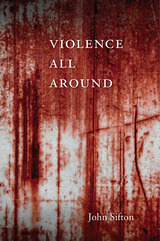
A human rights lawyer travels to hot zones around the globe, before and after the September 11 attacks, to document abuses committed by warlords, terrorist groups, and government counterterrorism forces. Whether reporting on al Qaeda safe houses, the mechanics of the Pentagon’s smartest bombs, his interviews with politicians and ordinary civilians, or his own brush with death outside Kabul, John Sifton wants to help us understand violence—what it is, and how we think and speak about it.
For the human rights community, the global war on terror brought unprecedented challenges. Of special concern were the secret detention centers operated by the CIA as it expanded into a paramilitary force, and the harsh treatment of prisoners throughout Iraq and Afghanistan. In drafting legal memoranda that made domestic prosecution for these crimes impossible, Sifton argues, the United States possessed not only the detainees but the law itself. Sifton recounts his efforts to locate secret prisons and reflects on the historical development of sanctioned military or police violence—from hand-to-hand combat to the use of drones—and the likelihood that technology will soon enable completely automated killing.
Sifton is equally concerned to examine what people have meant by nonviolent social change, and he asks whether pure nonviolence is ever possible. To invoke rights is to invoke the force to uphold them, he reminds us. Ultimately, advocates for human rights can only shame the world into better behavior, and their work may involve advocating the very violence they deplore.

The askari, African soldiers recruited in the 1890s to fill the ranks of the German East African colonial army, occupy a unique space at the intersection of East African history, German colonial history, and military history.
Lauded by Germans for their loyalty during the East Africa campaign of World War I, but reviled by Tanzanians for the violence they committed during the making of the colonial state between 1890 and 1918, the askari have been poorly understood as historical agents. Violent Intermediaries situates them in their everyday household, community, military, and constabulary roles, as men who helped make colonialism in German East Africa.
By linking microhistories with wider nineteenth-century African historical processes, Michelle Moyd shows how as soldiers and colonial intermediaries, the askari built the colonial state while simultaneously carving out paths to respectability, becoming men of influence within their local contexts.
Through its focus on the making of empire from the ground up, Violent Intermediaries offers a fresh perspective on African colonial troops as state-making agents and critiques the mythologies surrounding the askari by focusing on the nature of colonial violence.
Winner of the Helen and Howard Marraro Prize
A Times Literary Supplement Book of the Year
“Perhaps the greatest study ever written of Renaissance political thought.”
—Jeffrey Collins, Times Literary Supplement
“Magisterial…Hankins shows that the humanists’ obsession with character explains their surprising indifference to particular forms of government. If rulers lacked authentic virtue, they believed, it did not matter what institutions framed their power.”
—Wall Street Journal
“Puts the politics back into humanism in an extraordinarily deep and far-reaching way…For generations to come, all who write about the political thought of Italian humanism will have to refer to it; its influence will be…nothing less than transformative.”
—Noel Malcolm, American Affairs
“[A] masterpiece…It is only Hankins’s tireless exploration of forgotten documents…and extraordinary endeavors of editing, translation, and exposition that allow us to reconstruct—almost for the first time in 550 years—[the humanists’] three compelling arguments for why a strong moral character and habits of truth are vital for governing well. Yet they are as relevant to contemporary democracy in Britain, and in the United States, as to Machiavelli.”
—Rory Stewart, Times Literary Supplement
“The lessons for today are clear and profound.”
—Robert D. Kaplan
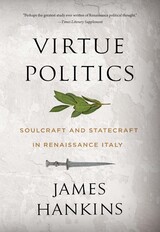
Convulsed by a civilizational crisis, the great thinkers of the Renaissance set out to reconceive the nature of society. Everywhere they saw problems. Corrupt and reckless tyrants sowing discord and ruling through fear; elites who prized wealth and status over the common good; religious leaders preoccupied with self-advancement while feuding armies waged endless wars. Their solution was at once simple and radical. “Men, not walls, make a city,” as Thucydides so memorably said. They would rebuild the fabric of society by transforming the moral character of its citizens. Soulcraft, they believed, was a precondition of successful statecraft.
A landmark reappraisal of Renaissance political thought, Virtue Politics challenges the traditional narrative that looks to the Renaissance as the seedbed of modern republicanism and sees Machiavelli as its exemplary thinker. James Hankins reveals that what most concerned the humanists was not reforming institutions so much as shaping citizens. If character mattered more than laws, it would have to be nurtured through a new program of education they called the studia humanitatis: the precursor to our embattled humanities.
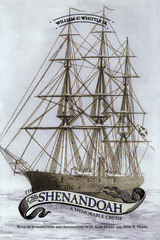
The only Confederate ship to circumnavigate the globe
The Confederate cruiser Shenandoah was the last of a group of commerce raiders deployed to prey on Union merchant ships. Ordered to the Pacific Ocean to “greatly damage and disperse” the Yankee whaling fleet in those waters, the Shenandoah’s successful pursuit of her quarry compared favorably with the exploits of the more celebrated Alabama and Florida but has never been as well known because it coincided with the war’s end and the Confederacy’s downfall. It was, however, one of the best documented naval expeditions—from England to the Indian Ocean, Australia and the South Pacific, the Bering Sea, San Francisco, and finally to port in Liverpool—during the Civil War.
The ship’s log and Captain James Waddell’s notes are well preserved, and a number of the Shenandoah’s officers kept detailed journals of the entire voyage. One of the most significant journals, by Lieutenant William Whittle, is presented here, with annotations from other journals, the official records and logs, and newspaper accounts of the Shenandoah’s activities, together bringing to life the history of this remarkable voyage.
READERS
Browse our collection.
PUBLISHERS
See BiblioVault's publisher services.
STUDENT SERVICES
Files for college accessibility offices.
RECENTLY PUBLISHED




UChicago Accessibility Resources
home | accessibility | search | about | contact us
BiblioVault ® 2001 - 2026
The University of Chicago Press