front cover of Violent Affections
Violent Affections
Queer Sexuality, Techniques of Power, and Law in Russia
Alexander Sasha Kondakov
University College London, 2022
An inciteful analysis of the affective rhetoric surrounding Russian anti-LGBTQ violence.

Passed in 2013, Russia’s “gay propaganda” law cemented the nation’s anti-LGBTQ sentiment into legal rhetoric that has since emboldened countless instances of violence against queer people. Based on an analysis of over three hundred criminal cases of anti-queer violence in Russia before and after the introduction of the law, Violent Affections shows how violent acts are framed in emotional language by perpetrators during their criminal trials, thus uncovering the techniques of power that work to translate emotions into violence against queer people. Utilizing an original methodology of studying legal memes, this book argues that individual affective states are directly connected to the political and legislative violence aimed at policing queer lives. Alexander Sasha Kondakov expands upon two sets of interdisciplinary literature–queer theory and affect theory–in order to conceptualize what is referred to as neo-disciplinary power. The book traces how affections circulate from body to body as a kind of virus, eventually enabling the turn from a memetic response to violent action.
[more]

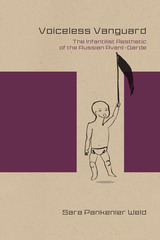
front cover of Voiceless Vanguard
Voiceless Vanguard
The Infantilist Aesthetic of the Russian Avant-Garde
Sara Pankenier Weld
Northwestern University Press, 2014
Winner, 2015 International Research Society in Children's Literature (IRSCL) Book Award 

Voiceless Vanguard: The Infantilist Aesthetic of the Russian Avant-Garde offers a new approach to the Russian avant-garde. It argues that central writers, artists, and theorists of the avant-garde self-consciously used an infantile aesthetic, as inspired by children’s art, language, perspective, and logic, to accomplish the artistic renewal they were seeking in literature, theory, and art. It treats the influence of children’s drawings on the Neo-Primitivist art of Mikhail Larionov, the role of children’s language in the Cubo-Futurist poetics of Aleksei Kruchenykh, the role of the naive perspective in the Formalist theory of Viktor Shklovsky, and the place of children’s logic and lore in Daniil Kharms’s absurdist writings for children and adults. This interdisciplinary and cultural study not only illuminates a rich period in Russian culture but also offers implications for modernism in a wider Western context, where similar principles apply.


[more]


Send via email Share on Facebook Share on Twitter