front cover of Violence and Peace
Violence and Peace
From the Atomic Bomb to Ethnic Cleansing
Pierre Hassner
Central European University Press, 1997
Building a bridge between political philosophy and the analysis of current affairs, as well as between the author's personal experience and the collective dramas of the twentieth century, Pierre Hassner stresses two major features of our time: the decline of interstate war as a realistic prospect, and the increase in domestic and transnational violence.
[more]

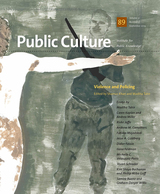
front cover of Violence and Policing
Violence and Policing
Madiha Tahir and Shamus Khan, special issue editors
Duke University Press
Contributors to this special issue examine the discourse and practices of policing, providing insights into how policing transforms societal relationships and develops and maintains order. Identifying parallels between police and military power, contributors argue that policing is more than merely the practice of the institution of the police but is the violence work of maintaining a specific social order. Topics covered in the essays include “speculative policing,” which attempts to control not only the present but also uncertain futures; the inextricable relation between anti-Blackness and the violence of the law; the role of police in US politics; French policing of ethno-racial minorities; the relationship between police body cameras and gender equity; and a Brazilian “exceptional prison,” which houses police who have broken the law.

Contributors. Kim Shayo Buchanan, Samira Bueno, Andrew M. Carruthers, Didier Fassin, Ilana Feldman, Phillip Atiba Goff, Jesse A. Goldberg, Rivke Jaffe, Caren Kaplan, Shamus Khan, Andrea Miller, Fatima Mojaddedi, Stuart Schrader, Madiha Tahir, Michelle C. Velasquez-Potts, Graham Denyer Willis
[more]


logo for University College London
Violent Extremism
A Handbook of Risk Assessment and Management
Edited by Caroline Logan, Randy Borum, and Paul Gill
University College London, 2023
A practical study of the prevention of violent extremism.

Violent extremism has galvanized public fear and attention. Driven by their concerns, the public has pushed for law enforcement and mental health systems to prevent attacks rather than just respond to them after they occur. The prevention process requires guidance for practitioners and policymakers on how best to identify people who may be at risk, to understand and assess the nature and function of the harm they may cause, and to manage them to mitigate or prevent harm. Violent Extremism provides such guidance.

Over ten chapters, prepared by leading experts, this handbook illuminates the nature of violent extremism and the evolution of prevention-driven practice. Authors draw on the literature and their experience to explain which factors might increase (risk factors) or decrease (protective factors) risk, how those factors might operate, and how practitioners can prepare risk formulations and scenario plans that inform risk management strategies to prevent violent extremist harm.

Each chapter is crafted to support thoughtful, evidence-based practice that is transparent, accountable, and ultimately defensible. Written for an international audience, the volume will be of interest to law enforcement and mental health professionals, criminal justice and security personnel, as well as criminologists, policymakers, and researchers.
 
[more]

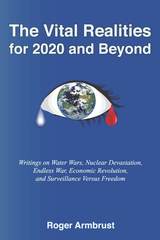
front cover of The Vital Realities for 2020 and Beyond
The Vital Realities for 2020 and Beyond
Writings on Water Wars, Nuclear Devastation, Endless War, Economic Revolution, and Surveillance Versus Freedom
Roger Armbrust
Parkhurst Brothers, Inc., 2019
This collection of writings by journalist Roger Armbrust focuses on national and international public policy concerns. Armbrust is particularly concerned with water resource policy, both nationally and internationally, the increasing likelihood of nuclear war, given the proliferation of nuclear powers and the destruction of nuclear treaties. Armbrust is concerned that the USA seems to be at war somewhere nearly always, a condition that enhances the power of the military-industrial complex in this country and abroad. Economic instability exacerbated by mounting public and private debt is another of his recurring themes. The continuum of government-and corporate efforts to stifle sustainable economic progress of poorer peoples leads to social instability worldwide.
 
[more]


Send via email Share on Facebook Share on Twitter