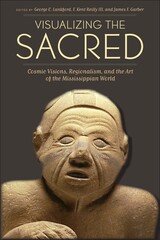
front cover of Visualizing the Sacred
Visualizing the Sacred
Cosmic Visions, Regionalism, and the Art of the Mississippian World
Edited by George E. Lankford, F. Kent Reilly III, and James F. Garber
University of Texas Press, 2011

The prehistoric native peoples of the Mississippi River Valley and other areas of the Eastern Woodlands of the United States shared a complex set of symbols and motifs that constituted one of the greatest artistic traditions of the pre-Columbian Americas. Traditionally known as the Southeastern Ceremonial Complex, these artifacts of copper, shell, stone, clay, and wood were the subject of the groundbreaking 2007 book Ancient Objects and Sacred Realms: Interpretations of Mississippian Iconography, which presented a major reconstruction of the rituals, cosmology, ideology, and political structures of the Mississippian peoples.

Visualizing the Sacred advances the study of Mississippian iconography by delving into the regional variations within what is now known as the Mississippian Iconographic Interaction Sphere (MIIS). Bringing archaeological, ethnographic, ethnohistoric, and iconographic perspectives to the analysis of Mississippian art, contributors from several disciplines discuss variations in symbols and motifs among major sites and regions across a wide span of time and also consider what visual symbols reveal about elite status in diverse political environments. These findings represent the first formal identification of style regions within the Mississippian Iconographic Interaction Sphere and call for a new understanding of the MIIS as a network of localized, yet interrelated religious systems that experienced both continuity and change over time.

[more]

logo for Harvard University Press
The Vital South
How Presidents are Elected
Earl Black and Merle Black
Harvard University Press, 1992

Once again a southern governor has shown Democrats the road to the White House. As a native southerner, President Bill Clinton has the opportunity to rebuild Democratic strength in the region. For the Republicans, carrying the entire South still remains a crucial imperative.

The Vital South is the first book to chronicle the massive shift of southern electoral power to Republican presidential candidates, while also showing how Democrats can again become competitive in the region. Deftly combining political narrative, in-depth analysis, and telling anecdotes, this book will be a definitive source on southern presidential politics for years to come.

[more]

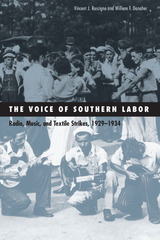
front cover of Voice Of Southern Labor
Voice Of Southern Labor
Radio, Music, And Textile Strikes, 1929-1934
Vincent J. Roscigno
University of Minnesota Press, 2004

Vividly shows how music united striking workers

The 1934 strike of southern textile workers, involving nearly 400,000 mill hands, remains perhaps the largest collective mobilization of workers in U.S. history. How these workers came together in the face of the powerful and coercive opposition of management and the state is the remarkable story at the center of this book.

The Voice of Southern Labor chronicles the lives and experiences of southern textile workers and provides a unique perspective on the social, cultural, and historical forces that came into play when the group struck, first in 1929, and then on a massive scale in 1934. The workers’s grievances, solidarity, and native radicalism of the time were often reflected in the music they listened to and sang, and Vincent J. Roscigno and William F. Danaher offer an in-depth context for understanding this intersection of labor, politics, and culture. The authors show how the message of the southern mill hands spread throughout the region with the advent of radio and the rise of ex–mill worker musicians, and how their sense of opportunity was further bolstered by Franklin D. Roosevelt’s radio speeches and policies.

[more]


Send via email Share on Facebook Share on Twitter