
 A SCHOLARLY BOOK REPOSITORY
7 start with V start with V

Selected as one of “The Best of the Best from the University Presses: Books You Should Know About” at the 2016 ALA Annual Conference
Violence against lesbians and gay men has increasingly captured media and scholarly attention. But these reports tend to focus on one segment of the LGBT community—white, middle class men—and largely ignore that part of the community that arguably suffers a larger share of the violence—racial minorities, the poor, and women. In Violence against Queer People, sociologist Doug Meyer offers the first investigation of anti-queer violence that focuses on the role played by race, class, and gender.
Drawing on interviews with forty-seven victims of violence, Meyer shows that LGBT people encounter significantly different forms of violence—and perceive that violence quite differently—based on their race, class, and gender. His research highlights the extent to which other forms of discrimination—including racism and sexism—shape LGBT people’s experience of abuse. He reports, for instance, that lesbian and transgender women often described violent incidents in which a sexual or a misogynistic component was introduced, and that LGBT people of color sometimes weren’t sure if anti-queer violence was based solely on their sexuality or whether racism or sexism had also played a role. Meyer observes that given the many differences in how anti-queer violence is experienced, the present media focus on white, middle-class victims greatly oversimplifies and distorts the nature of anti-queer violence. In fact, attempts to reduce anti-queer violence that ignore race, class, and gender run the risk of helping only the most privileged gay subjects.
Many feel that the struggle for gay rights has largely been accomplished and the tide of history has swung in favor of LGBT equality. Violence against Queer People, on the contrary, argues that the lives of many LGBT people—particularly the most vulnerable—have improved very little, if at all, over the past thirty years.
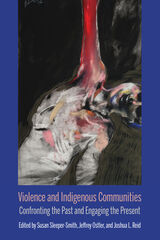
In contrast to past studies that focus narrowly on war and massacre, treat Native peoples as victims, and consign violence safely to the past, this interdisciplinary collection of essays opens up important new perspectives. While recognizing the long history of genocidal violence against Indigenous peoples, the contributors emphasize the agency of individuals and communities in genocide’s aftermath and provide historical and contemporary examples of activism, resistance, identity formation, historical memory, resilience, and healing. The collection also expands the scope of violence by examining the eyewitness testimony of women and children who survived violence, the role of Indigenous self-determination and governance in inciting violence against women, and settler colonialism’s promotion of cultural erasure and environmental destruction.
By including contributions on Indigenous peoples in the United States, Canada, the Pacific, Greenland, Sápmi, and Latin America, the volume breaks down nation-state and European imperial boundaries to show the value of global Indigenous frameworks. Connecting the past to the present, this book confronts violence as an ongoing problem and identifies projects that mitigate and push back against it.



2023 Outstanding Book Award, National Association for Ethnic Studies
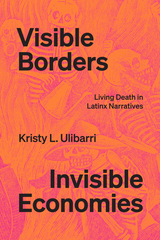
A thorough examination of the political and economic exploitation of Latinx subjects, migrants, and workers through the lens of Latinx literature, photography, and film.
Globalization in the United States can seem paradoxical: free trade coincides with fortification of the southern border, while immigration is reimagined as a national-security threat. US politics turn aggressively against Latinx migrants and subjects even as post-NAFTA markets become thoroughly reliant on migrant and racialized workers. But in fact, there is no incongruity here. Rather, anti-immigrant politics reflect a strategy whereby capital uses specialized forms of violence to create a reserve army of the living, laboring dead.
Visible Borders, Invisible Economies turns to Latinx literature, photography, and films that render this unseen scheme shockingly vivid. Works such as Valeria Luiselli’s Tell Me How It Ends and Alex Rivera’s Sleep Dealer crystallize the experience of Latinx subjects and migrants subjugated to social death, their political existence erased by disenfranchisement and racist violence while their bodies still toil in behalf of corporate profits. In Kristy L. Ulibarri’s telling, art clarifies what power obscures: the national-security state performs anti-immigrant and xenophobic politics that substitute cathartic nationalism for protections from the free market while ensuring maximal corporate profits through the manufacture of disposable migrant labor.
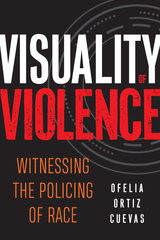
Addressing the frequently ignored experiences of Asian and Native Americans, among others, in its comparative undertaking, Visuality of Violence exceeds intersectional mapping to uniquely charge the spectacle of racial violence as a foundational practice in its continued presence in contemporary society. Cuevas argues that the visual presentations of the racial body throughout history requires a reckoning and acknowledgement of the material and legal effects of the images, narratives, and practices used to maintain hegemonic racial order and inequality.
In holding a theoretical mirror to history, Visuality of Violence reveals liberal mythical reliance on the ideals of western law and its rationalities as the location of justice and freedom, thereby presenting its readers with a new understanding in the quest for peace and liberation.
In the series Critical Race, Indigeneity, and Relationality
READERS
Browse our collection.
PUBLISHERS
See BiblioVault's publisher services.
STUDENT SERVICES
Files for college accessibility offices.
RECENTLY PUBLISHED






UChicago Accessibility Resources
home | accessibility | search | about | contact us
BiblioVault ® 2001 - 2026
The University of Chicago Press