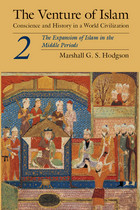
front cover of The Venture of Islam, Volume 2
The Venture of Islam, Volume 2
The Expansion of Islam in the Middle Periods
Marshall G. S. Hodgson
University of Chicago Press, 1977
A sweeping work of history that the New Yorker says "demonstrates how history should be written"

The Venture of Islam has been honored as a magisterial work of the mind since its publication in early 1975. In this three-volume study, illustrated with charts and maps, Hodgson traces and interprets the historical development of Islamic civilization from before the birth of Muhammad to the middle of the twentieth century. This work grew out of the famous course on Islamic civilization that Hodgson created and taught for many years at the University of Chicago.

In the second work of this three-volume set, Hodgson investigates the establishment of an international Islamic civilization through about 1500. This includes a theoretical discussion of cultural patterning in the Islamic world and the Occident.
 
[more]

front cover of Video Game Art Reader
Video Game Art Reader
Volume 2
Tiffany Funk
Amherst College Press, 2018
This volume of VGAR critically analyzes video game art as a means of survival. Though “survival strategy” exists as a defined gaming genre, all video games—as unique, participatory artworks—model both individual and collaborative means of survival through play. Video games offer opportunities to navigate both historical and fictional conflicts, traverse landscapes devastated by climate change or nuclear holocaust, and manage the limited resources of individuals or even whole civilizations on earth and beyond. They offer players a dizzying array of dystopian scenarios in which to build and invent, cooperate with others (through other players, NPCs, or AI) to survive another day. Contributors show how video games focus attention, hone visuospatial skills, and shape cognitive control and physical reflexes and thus have the power to participate in the larger context of radical, activist artworks that challenge destructive hegemonic structures as methods of human conditioning, coping, and creating.

Contributions by Anna Anthropy , Andrew Bailey, Michael Anthony DeAnda, Luisa Salvador Dias, Tiffany Funk, Elizabeth LaPensée, Treva Michelle Legassie, Michael Paramo, and Martin Zeilinger.
[more]

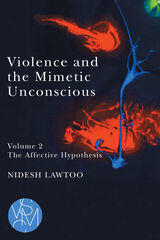
front cover of Violence and the Mimetic Unconscious, Volume 2
Violence and the Mimetic Unconscious, Volume 2
The Affective Hypothesis
Nidesh Lawtoo
Michigan State University Press, 2023
Representations of violence have subliminal contagious effects, but what kind of unconscious captures this imperceptible affective dynamic in the digital age? In volume two of a Janus-faced diagnostic of the cathartic and contagious effects of (new) media violence, Nidesh Lawtoo traces a genealogy of a long-neglected, embodied, relational, and highly mimetic unconscious that, well before the discovery of mirror neurons, posited mirroring reactions as a via regia to a phantom ego. Rather than being the product of a solipsistic discovery, the unconscious turns out to have haunted philosophers, psychologists, and artists for a long time. This book proposes a genealogy of untimely philosophical physicians that goes from Plato to Nietzsche, Bernheim to Féré, Freud to Bataille, Arendt to Girard, affect theory to the neurosciences. In their company, Lawtoo promotes the transdisciplinary field of mimetic studies by reevaluating the unconscious actions and reactions of homo mimeticus. As a new theory of mimesis emerges, Violence and the Mimetic Unconscious offers a searching diagnosis as to why the pathos of (new) media violence—from film to video games, police murders to the storming of the U.S Capitol—continues to cast a material shadow on the present and future.  
[more]



Send via email Share on Facebook Share on Twitter