
 A SCHOLARLY BOOK REPOSITORY
216 scholarly books by Tupelo Press and 10
start with W
216 scholarly books by Tupelo Press and 10
216 scholarly books by Tupelo Press
10 start with W start with W
10 start with W start with W

Walking Backwards
Lee Sharkey
Tupelo Press, 2016
Walking Backwards examines resistance to violence and repression through evocations of contemporary events and conversations with poets and artists whose voices arise from the Holocaust. Employing a remarkable variety of formal strategies— lyrics, parables, testimony, paratactic narratives and re-castings of Torah stories, inter-leavings with other texts—these poems offer a complex vantage on cultural erasure and persistence. Sharkey conjures a simultaneous present to reclaim a heritage expressed by gaps and silencing. Paul Celan, Nelly Sachs, and the Yiddish language poets Abraham Sutzkever and Peretz Markish become contemporaries, as her words mingle with theirs to bear the weight of the unspoken. “What have we come for,” the poet asks, “to sleep where the dead slept in the bed of our absence?” What redemption she finds is in language.
[more]
We Are Changed to Deer at the Broken Place
Kelly Weber
Tupelo Press, 2022
One could certainly say that Kelly Weber’s debut collection, We Are Changed to Deer at the Broken Place, depicts a non-binary experience that does not receive nearly enough representation in the literary landscape. While such an assertion would be factual, this kind of reading would underestimate Weber’s poetic gifts and the full range of the philosophical implications for her work. Weber writes, “What pulls a woman like me / out here alone, they want to know?” As she teases out possible answers to this question, Weber reveals—with remarkable lyricism and grace—the danger, richness, and multiplicity housed within solitary experience and within the individual subject. Adriana Cavererro, the famed scholar of vocal expression, once noted that thought itself is a collective endeavor, made possible by a shared cultural imagination. Weber reveals self as world, self as community in poems that situate an inherited tradition in conversation with postmodern innovation and undertheorized, urgently important concepts of identity. This is an unforgettable first book.
[more]
The Well Speaks of Its Own Poison
Maggie Smith
Tupelo Press, 2015
Selected by Kimiko Hahn as a winner of the 2012 Dorset Prize, Maggie Smith’s poems question whether the realms of imagination and story can possibly be safe.This house at the end of the street isn’t all that it appears to be, as Smith’s verses design a dark mythical landscape hidden between the picket fences. In “The List of Dangers”, she writes, “The sun was a saw blade,/a yellow circle with teeth. Terrible birds with plumage/of fire scorched whatever they touched: The black/mailbox opened its mouth to the black street”. This is a world unwelcome to the children that play in it, whether they know it or not. The vivid imagery and colors of any old neighborhood fill the pages with life, giving Smith’s work an ominous relatability. Her stories leave us grasping at who said what and, more importantly, where the line between fairy tale and horror story really lies.
[more]

Westminster West
Chard deNiord
Tupelo Press, 2025
This collection bears witness to ecstasy and grief through persona. By inhabiting the voices of Adam and Eve, Abelard and Heloise, etc., deNiord reveals the enduring alterity contained within the self.
Westminster West traverses the worlds of here and beyond. Chard deNiord divines “the everydayness of the mystery . . . in which being and making poetry are the same.” From posthumous correspondence between Abelard and Heloise to such poems as “Skywriting Over The Rockies,” “With A Bone In My Heart,” and “I Call Out To You,” this collection betrays a mortal charge, bearing witness to what Emily Dickinson called “each ecstatic moment/ to which we must an anguish pay” and which Aridjis in his defiance of death calls “dust in love.”
Ambitious and masterful, deNiord renders such ancient subject matter as love, betrayal, landscape, loss, grief, aging, and ecstasy new throughout Westminster West. He transforms the echo chamber of futility, silence, and failure by aspiring to cross over to “the other,” whatever it may be, a stone or cloud or lover or garment, or cancerous lung, with a “negative capability” that allows it, no matter its identity, to speak memorably in a way that transcends simple definition and ultimately any personal connection to it.
Westminster West is divided into three sections that complement each other in their archetypal themes which range historically, mythologically, and cathectically. The poems in the first section imagine correspondences and dialogues between couples, including Heloise and Abelard, Adam and Eve, Gilgamesh and Enkidu, Odysseus and Calypso, a widower and his deceased wife in the time of Covid, and a lovesick husband in the air above the Rocky Mountains and his beloved on the ground. The second section also features love poems but focuses on more instructional and metaphysical themes that vary from metaphorical pedagogy on the topic of sex to “the harsh advice of loss” to the memory of a young couple’s transcendent, romantic walk by a river. Section three moves away from love poems to mortal and environmental themes, including elegies, pastorals, and a concluding confessional credo on the bittersweet reality of poetry’s irony and blessing.
Westminster West traverses the worlds of here and beyond. Chard deNiord divines “the everydayness of the mystery . . . in which being and making poetry are the same.” From posthumous correspondence between Abelard and Heloise to such poems as “Skywriting Over The Rockies,” “With A Bone In My Heart,” and “I Call Out To You,” this collection betrays a mortal charge, bearing witness to what Emily Dickinson called “each ecstatic moment/ to which we must an anguish pay” and which Aridjis in his defiance of death calls “dust in love.”
Ambitious and masterful, deNiord renders such ancient subject matter as love, betrayal, landscape, loss, grief, aging, and ecstasy new throughout Westminster West. He transforms the echo chamber of futility, silence, and failure by aspiring to cross over to “the other,” whatever it may be, a stone or cloud or lover or garment, or cancerous lung, with a “negative capability” that allows it, no matter its identity, to speak memorably in a way that transcends simple definition and ultimately any personal connection to it.
Westminster West is divided into three sections that complement each other in their archetypal themes which range historically, mythologically, and cathectically. The poems in the first section imagine correspondences and dialogues between couples, including Heloise and Abelard, Adam and Eve, Gilgamesh and Enkidu, Odysseus and Calypso, a widower and his deceased wife in the time of Covid, and a lovesick husband in the air above the Rocky Mountains and his beloved on the ground. The second section also features love poems but focuses on more instructional and metaphysical themes that vary from metaphorical pedagogy on the topic of sex to “the harsh advice of loss” to the memory of a young couple’s transcendent, romantic walk by a river. Section three moves away from love poems to mortal and environmental themes, including elegies, pastorals, and a concluding confessional credo on the bittersweet reality of poetry’s irony and blessing.
[more]
Weston's Unsent Letters to Modotti
Chad Parmenter
Tupelo Press, 2015
Snowbound Chapbook Award, chosen by Kathleen Jesme
"Weston's Unsent Letters to Modotti inhabits the fluid space between history and imagination," says Kathleen Jesme. "Parmenter's extended persona poem deftly investigates the named but uncommunicated, that which is unfinished, unsent, unlived. Weston exists only as an eye behind the photographic lens, and is unable to fully inhabit the rest of the world, or to send the letters he writes to his sometime model and lover."
"Weston's Unsent Letters to Modotti inhabits the fluid space between history and imagination," says Kathleen Jesme. "Parmenter's extended persona poem deftly investigates the named but uncommunicated, that which is unfinished, unsent, unlived. Weston exists only as an eye behind the photographic lens, and is unable to fully inhabit the rest of the world, or to send the letters he writes to his sometime model and lover."
[more]
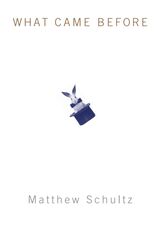
What Came Before
Matthew Schultz
Tupelo Press, 2020
This quirky book of essays explores subjects as diverse as the death of Moses, the special relationship between gay men and cats, and the afterlife with a light and understanding touch.
[more]
What Could Be Saved
Bookmatched Novellas & Stories
Gregory Spatz
Tupelo Press, 2019
At the heart of What Could Be Saved is the culture of the violin world—its beauty, myth-making, magic, romance and deceit, as well as its history and ethos of perfection at any cost. In stories and novellas matched end-to-end like the twinned or “bookmatched” pieces of tonewood that separately comprise a violin, What Could Be Saved winds its way through the hopes and dreams of builders, dealers and players caught up in the violin trade, a trade that is so unlike any other in the world. From the story of a young man who refuses to follow in his father’s footsteps as a violin builder, to the magical realism of the story told in the point of view of forgotten, abused and ordinary violins, What Could Be Saved transports you into the world of the violin, compelling you to witness its most tragic, comic and thoroughly human dramas. Blending viewpoints and storytelling techniques, including magical and psychological realism, moving from novella to story and back again, there is a sustained musicality that thrums through these beautiful, almost dream-like tales. Spatz’s language is precise and powerful, his fiction elegantly wrought. A book that echoes long after its music ends.
[more]
Why Misread A Cloud
Emily Carlson
Tupelo Press, 2022
“In brief paragraphs that are neither prose nor prose poems, we meet a witness. A speaker who is not in her country of origin. A woman living in the air of violence. Militarization. And very occasionally, a mundane gesture–adding sugar to tea. The spareness creates a poetics that is, at once, elegantly stark and akin to journalism. We read between the lines because what is unsaid, makes this a poetry of image and association. What was once a broom for sweeping a kitchen, is used by a woman to sweep propaganda leaflets off the street. I find myself engaged in a place–to a place, really–where there are ballistic helmets. Yes, strange and strangely familiar. This is how art and dreams work: with the familiarity of knowing and the disassociation that can allow insight.”
— from the Judge’s Citation by Kimiko Hahn
Why Misread a Cloud takes its name from clouds of ash and smoke in wartime which appear to the author as a “storm, blown over the sea.” Both an exploration of the mind’s ability to turn what is into something else, in order to survive, and the mind’s ability to resist the effects of psychosocial warfare—imposed by the military and the police. “Who wants you to be afraid” the poet’s friend asks as he “added sugar to his tea.” The realization this question brings enables the poet to explore forces that separate us from one another and ways we rise up within ourselves to move through fear toward love.
— from the Judge’s Citation by Kimiko Hahn
Why Misread a Cloud takes its name from clouds of ash and smoke in wartime which appear to the author as a “storm, blown over the sea.” Both an exploration of the mind’s ability to turn what is into something else, in order to survive, and the mind’s ability to resist the effects of psychosocial warfare—imposed by the military and the police. “Who wants you to be afraid” the poet’s friend asks as he “added sugar to his tea.” The realization this question brings enables the poet to explore forces that separate us from one another and ways we rise up within ourselves to move through fear toward love.
[more]
Wind–Mountain–Oak
The Poems of Sappho
Dan Beachy-Quick
Tupelo Press, 2023
Dan Beachy-Quick writes, “There are depths within the denotative life of Greek words that English seldom allows readers in translation to access. At some basic level, I wanted to offer a translation that traced out some of those complexities into an apprehendable substance in the poems themselves—sometimes by allowing an image to unfold more fully than is the norm, at other times by giving some sense of a word’s complicated life, the compound nature of the Greek language, or by translating the same line in multiple ways. The hope, far-fetched as it might be, is to give a reader in English some semblance of how an ancient Greek listener might hear these songs. I’ve also veered away from the various traditions of ordering the poems. I’ve clustered them into groups that seem to loosely trace the entirety of life, from childhood to older age, from the birth of desire to the fear of no longer being desirable. In a quiet way, I mean the book to read as a kind novel, a bildungsroman, so that a larger sense of the life—the poem of the life—becomes palpable. “
[more]
Wintering
Poems
Megan Snyder-Camp
Tupelo Press, 2016
A handwritten court record offers a forgotten name, a baby cries in the archive: In Wintering, her second collection of poems, Megan Snyder-Camp composes a disruptive, archive-sourced poetry of witness that challenges the given story of the “Indian vocabularies,” indigenous language records Lewis and Clark gathered during their 1804-6 journey. Exploring whiteness, memory and language, Wintering is a book about the mark our hunger makes.
[more]
READERS
Browse our collection.
PUBLISHERS
See BiblioVault's publisher services.
STUDENT SERVICES
Files for college accessibility offices.
RECENTLY PUBLISHED



UChicago Accessibility Resources
home | accessibility | search | about | contact us
BiblioVault ® 2001 - 2026
The University of Chicago Press