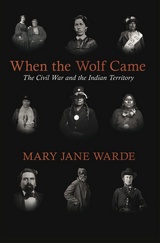
front cover of When the Wolf Came
When the Wolf Came
The Civil War and the Indian Territory
Mary Jane Warde
University of Arkansas Press, 2013
Winner of the 2014 Oklahoma Book Award for nonfiction

Winner of the 2014 Pate Award from the Fort Worth Civil War Round Table.


When the peoples of the Indian Territory found themselves in the midst of the American Civil War, squeezed between Union Kansas and Confederate Texas and Arkansas, they had no way to escape a conflict not of their choosing--and no alternative but to suffer its consequences. When the Wolf Came explores how the war in the Indian Territory involved almost every resident, killed many civilians as well as soldiers, left the country stripped and devastated, and cost Indian nations millions of acres of land. Using a solid foundation of both published and unpublished sources, including the records of Cherokee, Choctaw, and Creek nations, Mary Jane Warde details how the coming of the war set off a wave of migration into neighboring Kansas, the Red River Valley, and Texas. She describes how Indian Territory troops in Unionist regiments or as Confederate allies battled enemies--some from their own nations--in the territory and in neighboring Kansas, Missouri, and Arkansas. And she shows how post-war land cessions forced by the federal government on Indian nations formerly allied with the Confederacy allowed the removal of still more tribes to the Indian Territory, leaving millions of acres open for homesteads, railroads, and development in at least ten states. Enhanced by maps and photographs from the Oklahoma Historical Society's photographic archives, When the Wolf Came will be welcomed by both general readers and scholars interested in the signal public events that marked that tumultuous era and the consequences for the territory's tens of thousands of native peoples.

[more]

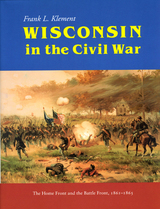
front cover of Wisconsin in the Civil War
Wisconsin in the Civil War
The Home Front and the Battle Front, 1861-1865
Frank Klement
Wisconsin Historical Society Press, 1997
The final book by Marquette University historian Frank L. Klement (1905-1994), this is a vivid chronological narrative of Wisconsin's role in the pivotal event in American history. In this volume, Klement greatly expanded his 1962 booklet on this topic, adding new material on each of Wisconsin's fifty-three infantry regiments, political and constitutional issues, soldiers voting, women and the war, and Wisconsin's black soldiers.
[more]

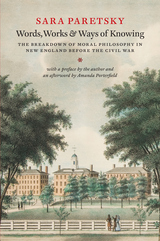
front cover of Words, Works, and Ways of Knowing
Words, Works, and Ways of Knowing
The Breakdown of Moral Philosophy in New England before the Civil War
Sara Paretsky
University of Chicago Press, 2016
Crime writer Sara Paretsky is known the world over for her acclaimed series of mysteries starring Chicago private investigator V. I. Warshawski, now in its seventeenth installment. Paretsky’s work has long been inflected with history—for her characters the past looms large in the present—and in her decades-long career, she has been recognized for transforming the role of women in contemporary crime fiction.
What’s less well-known is that before Paretsky began her writing career, she earned a PhD in history from the University of Chicago with a dissertation on moral philosophy and religion in New England in the early and mid-nineteenth century. Now, for the first time, fans of Paretsky can read that earliest work, Words, Works, and Ways of Knowing.

Paretsky here analyzes attempts by theologians at Andover Seminary, near Boston, to square and secure Calvinist religious beliefs with emerging knowledge from history and the sciences. She carefully shows how the open-minded scholasticism of these theologians paradoxically led to the weakening of their intellectual credibility as conventional religious belief structures became discredited, and how this failure then incited reactionary forces within Calvinism. That conflict between science and religion in the American past is of interest on its face, but it also sheds light on contemporary intellectual battles.

Rounding out the book, leading religious scholar Amanda Porterfield provides an afterword discussing where Paretsky’s work fits into the contemporary study of religion. And in a sobering—sometimes shocking—preface, Paretsky paints a picture of what it was like to be a female graduate student at the University of Chicago in the 1970s. A treat for Paretsky’s many fans, this book offers a glimpse of the development of the mind behind the mysteries.
[more]


Send via email Share on Facebook Share on Twitter