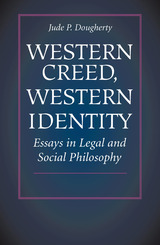
front cover of Western Creed, Western Identity
Western Creed, Western Identity
Essays in Legal and Social Philosophy
Jude P. Dougherty
Catholic University of America Press, 2000
In Western Creed, Western Identity, Jude P. Dougherty investigates the classical roots of Western culture and its religious sources in an effort to define its underlying intellectual and spiritual commitments.
[more]

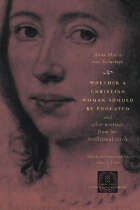
front cover of Whether a Christian Woman Should Be Educated and Other Writings from Her Intellectual Circle
Whether a Christian Woman Should Be Educated and Other Writings from Her Intellectual Circle
Anna Maria van Schurman
University of Chicago Press, 1998
Advocate and exemplar of women's education, female of aristocratic birth and modest demeanor, Anna Maria van Schurman (1607-1678) was one of Reformation Europe's most renowned writers defending women's intelligence. From her early teens, Schurman garnered recognition and admiration for her accomplishments in languages, philosophy, poetry, and painting. As an adult she actively engaged in written correspondence and debate with Europe's leading intellectuals. Nevertheless, Schurman refused to regard herself as an anomaly among women. A supporter of the female sex, she argues that the same rigorous education that shaped her should be made available to all Christian daughters of the aristocracy.

Gathered here in meticulous translation are Anna Maria van Schurman's defense of women's education, her letters to other learned women, and her own account of her early life, as well as responses to her work from male contemporaries, and rare writings by Schurman's mentor, Voetius. This volume will interest the general reader as well as students of women's, religious, and social history.
[more]

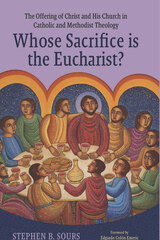
front cover of Whose Sacrifice is the Eucharist? The Offering of Christ and His Church in Catholic and Methodist Theology
Whose Sacrifice is the Eucharist? The Offering of Christ and His Church in Catholic and Methodist Theology
Stephen B. Sours
Catholic University of America Press, 2024
This book explores what Catholics and Methodists believe about eucharistic sacrifice. Eucharistic sacrifice refers to the offering that Christ and his church make in the celebration of the Lord’s Supper. It is, therefore, both a Christian doctrine and a church practice. The sacrificial dimension of the sacrament comes both from Christ’s sacrifice on the cross and from his self-offering at the Last Supper in which Christ gives himself to the Father on behalf of his people. “This is my body, which is given for you” (Luke 22:19). The eucharist is a sacrificial meal because in the bread and cup Christians are united to the body and blood of Christ that was sacrificed for them on the cross. Moreover, the resurrected Lord is really present with his people in the eucharist, and while his historic crucifixion is an event in the past, Jesus’ salvation continues and his grace is given to his people in the sacrament, “for this is my blood of the covenant, which is poured out for many for the forgiveness of sins” (Matthew 26:28). Catholics and Methodists believe that Jesus instructs his followers to repeat his words and actions from the Last Supper in their celebration of the eucharist, but a long running assumption is that Catholics and Methodists—following the historic Reformation schism—are deeply divided over eucharistic sacrifice. This book challenges that assumption by analyzing what these churches teach on eucharistic sacrifice from historical, sacramental, liturgical, and ecumenical perspectives. Key figures like Thomas Aquinas and John Wesley help define eucharistic sacrifice in each tradition. Subsequently, authoritative texts such as ecclesial statements, eucharistic prayers, and hymns further specify what Catholics and Methodists believe they are doing when they offer the eucharist to God. Sours argues that far from being divided, Catholics and Methodists have much in common regarding this controversial doctrine.
[more]

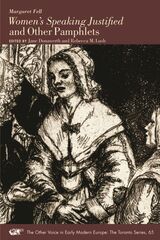
front cover of Women's Speaking Justified and Other Pamphlets
Women's Speaking Justified and Other Pamphlets
Margaret Fell
Iter Press, 2018
Margaret Fell (1614–1702), one of the co-founders of the Society of Friends and a religious activist, was a prolific writer and distributor of Quaker pamphlets. This volume offers eight texts that span her writing career and represent her range of writing: autobiography, epistle or public letter, examination or record of a trial, letter to the king, and argument for women’s preaching. These selections also document Fell’s contributions to Friends’ theology, exemplify seventeenth-century women’s English-language literacy, illustrate Fell’s theories of biblical reading, and exhibit the common qualities of Quaker rhetoric.

The Other Voice in Early Modern Europe - The Toronto Series, volume 65
[more]

front cover of Wrestling with Our Faith Tradition
Wrestling with Our Faith Tradition
Lloyd Lee Wilson
QuakerPress, 2005

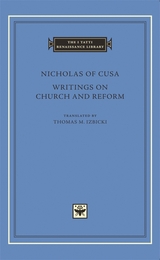
front cover of Writings on Church and Reform
Writings on Church and Reform
Nicholas of CusaTranslated by Thomas M. Izbicki
Harvard University Press, 2008

Nicholas of Cusa (1401–1464), widely considered the most important original philosopher of the Renaissance, was born in Kues on the Moselle River. A polymath who studied canon law and became a cardinal of the Roman Catholic Church, he wrote principally on speculative theology, philosophy, and church politics. As a political thinker he is best known for De concordantia catholica, which presented a blueprint for peace in an age of ecclesiastical discord.

This volume makes most of Nicholas’s other writings on Church and reform available in English for the first time, including legal tracts arguing the case of Pope Eugenius IV against the conciliarists, theological examinations of the nature of the Church, and writings on reform of the papacy and curia. Among the works translated are an early draft of De concordantia catholica and the Letter to Rodrigo Sanchez de Arevalo, which discusses the Church in light of the Cusan idea of “learned ignorance.”

[more]

front cover of Writings on Grace
Writings on Grace
The Complete Ecrits sur la grace
Blaise Pascal
Catholic University of America Press, 2025
A few years before he died in 1662, Blaise Pascal wrote fifteen interconnected essays on grace, which have collectively come to be known as the Écrits sur la grâce. These were not published before his death, and were not polished and revised by him with an eye to publication, which means that they show his mind at work experimentally, trying out lines of argument and engagements with magisterial and patristic texts without resolving them into anything like a final system. The Écrits are replete with experimental formulations and bursts of literary and intellectual energy; taken together, they provide an intense and extreme presentation of Pascal's version of Augustinianism with respect to grace, election, and predestination, the meaning of the Council of Trent, and much else. These essays provide one of the keys to the entirety of Pascal's thought, and they provide a view of grace's workings -- perhaps better, a grammar of grace -- which still warrants serious attention by Catholic theologians. Less than one-fifth of the Écrits has yet been published in English. This book provides a complete translation, made from the French text provided in Michel Le Guern's edition (1998, 2000) of Pascal's Oeuvres complètes, and annotated to provide full information about Pascal's sources and how he used them. The translation is followed by a substantial interpretive essay in which Pascal's positions and approaches are restated and argued with.
[more]


Send via email Share on Facebook Share on Twitter