
 A SCHOLARLY BOOK REPOSITORY
3 start with W start with W

“Every home is a different story,” says one narrator in White Wolf while looking for her own childhood home. Every unhappy home is unhappy in its own way—and so are the stories in Krisztina Tóth’s new volume, in which the writer’s voice is darker and more radical than ever.
These are stories of trauma, oppression, submission, exclusion, stigma, and violence. Many of them tell of childhood abuses, unpunished crimes, lost children—suffering that goes without punishment, apology, and forgiveness. Her mostly nameless heroes are everywhere around us, stepping into the same elevator, running behind us on the staircase. Many of them are so wounded or tormented that they behave in strange ways. In White Wolf, Tóth observes these characters with acute sensitivity and attentiveness to detail.
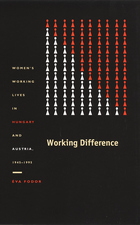
Fodor brings qualitative and quantitative analyses to bear, combining statistical analyses of survey data, interviews with women managers in both countries, and archival materials including those from the previously classified archives of the Hungarian communist party and transcripts from sessions of the Austrian Parliament. She shows how women's access to power varied in degree and operated through different principles and mechanisms in accordance with the stratification systems of the respective countries. In Hungary women's mobility was curtailed by political means (often involving limited access to communist party membership), while in Austria women's professional advancement was affected by limited access to educational institutions and the labor market. Fodor discusses the legacies of Austria's and Hungary's "gender regimes" following the demise of state socialism and during the process of integration into the European Union.

This book embraces the widest possible range of workers in the music industry. It deals with all music genres from high-flying to commercial and observes various workers in the production chain beyond musicians. Niche segments of the sector, such as YouTube-based commercial hip hop, are given special treatment. Using a variety of empirical research methods, the study examines the trends as workers are pushed towards digital entrepreneurship and platform work, on the one hand, and live performance, on the other. The focus on domestic work and informality offers a feminist analysis of work in music. This approach sheds light on gendered divisions of labor and forms of (self-)exploitation that usually remain invisible. The book proposes a new model of cultural autonomy that takes account of the semiperipheral relationship of music industry workers and institutions to both the market and the state.
READERS
Browse our collection.
PUBLISHERS
See BiblioVault's publisher services.
STUDENT SERVICES
Files for college accessibility offices.
RECENTLY PUBLISHED





UChicago Accessibility Resources
home | accessibility | search | about | contact us
BiblioVault ® 2001 - 2026
The University of Chicago Press