
 A SCHOLARLY BOOK REPOSITORY
9 start with W start with W
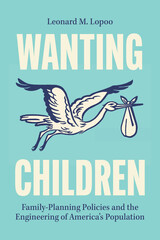
On the eugenic origins of US reproductive laws—and the surprising policy changes needed to remedy it.
The US government spends hundreds of millions of dollars every year to promote and facilitate contraception. Whereas other wealthy countries support broader fertility interventions under the banner of “family planning,” the United States remains committed only to helping Americans—and especially poorer Americans—plan not to have a family.
In an unflinching treatise on one of the century’s defining social issues, Leonard M. Lopoo shows how the US’s asymmetric reproductive approach is a vestige of the country’s earlier sins: America’s first reproductive policies were authored by some of the twentieth century’s most prominent eugenicists, a group whose primary goal was birth prevention among lower economic classes and racial minorities. These origins have consequently created a contradictory position for the country today, in which contraception for the lowest-income Americans is subsidized, while many upper-class Americans employ technologies to have children with preferable traits.
Lopoo recasts this personal and politicized topic in elegant, stark terms. If the United States is to legislate reproduction, the only defensible approach is equity: helping people who want children to have children. Wanting Children posits a new and elevating criterion for how we think about fertility in the twenty-first century.
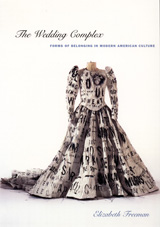
Freeman draws on queer theory and social history to focus on a range of texts where weddings do not necessarily lead to legal marriage but instead reflect yearnings for intimate arrangements other than long-term, state-sanctioned, domestic couplehood. Beginning with a look at the debates over gay marriage, she proceeds to consider literary works by Nathaniel Hawthorne, William Faulkner, Carson McCullers, Vladimir Nabokov, and Edgar Allan Poe, along with such Hollywood films as Father of the Bride, The Graduate, and The Godfather. She also discusses less well-known texts such as Su Friedrich’s experimental film First Comes Love and the off-Broadway, interactive dinner play Tony ‘n’ Tina’s Wedding.
Offering bold new ways to imagine attachment and belonging, and the public performance and recognition of social intimacy, The Wedding Complex is a major contribution to American studies, queer theory, and cultural studies.

Who cares for parental caregivers? The short answer is, parenting groups do. Who Cares for Parents examines how parenting groups collectively build and contribute significant resources to form a broader care infrastructure for adult family caregivers with children. This book looks at the content of care parenting groups provide for parents, through comparative research including mothers, fathers, and nonbinary parents. Cases include some of the most recognizable parenting groups in the United States, some with vast networks of parent members numbering in the thousands or even millions, like the Parent Teacher Association, La Leche League, and MOMS Club International. The book also examines newer and, perhaps, less well known groups like the City Dads Group, the Upper East Side (UES) Mommas, as well as smaller sets of local dads’ groups and a babysitting co-op.
Can parents in the contemporary United States secure some of the necessary resources to provide care, not only for their children but also for themselves, through parenting groups? The evidence from this research suggests they can. Parenting groups have a long history of organizing membership, meetings, education, material resources, and advocacy to provide for parents’ needs. Parenting groups’ ideologies and practices often seek broad goals, and sometimes include far reaching advocacy, innovative solutions, and possibilities for what Price-Glynn calls strategic parenting and social change. Alongside their successes, however, parenting groups also face challenges of producing narrow and temporary alliances, exclusion, and exacerbating inequalities. Despite their many challenges, Price-Glynn remains hopeful about the possibilities for non-familial and collective care infrastructure like that performed by parent groups.



READERS
Browse our collection.
PUBLISHERS
See BiblioVault's publisher services.
STUDENT SERVICES
Files for college accessibility offices.
RECENTLY PUBLISHED





UChicago Accessibility Resources
home | accessibility | search | about | contact us
BiblioVault ® 2001 - 2026
The University of Chicago Press