
 A SCHOLARLY BOOK REPOSITORY
8 start with W start with W


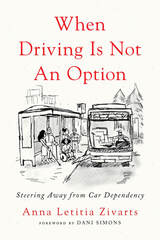
In When Driving is Not an Option disability advocate Anna Letitia Zivarts shines a light on the number of people in the US who cannot drive and explains how improving our transportation system with nondrivers in mind will create a better quality of life for everyone.
Drawing from interviews with involuntary nondrivers from around the US and from her own experience, Zivarts explains how nondrivers get around and the changes necessary to make our communities more accessible. These changes include improving sidewalk connectivity; providing reliable and affordable transit and paratransit; creating more options for biking, scooting, and wheeling; building more affordable and accessible housing; and the understanding the unrecognized burden of asking and paying for rides.
Zivarts shows that it is critical to include people who can’t drive in transportation planning decisions. She outlines steps that organizations can take to include and promote leadership of those who are most impacted—and too often excluded—by transportation systems designed by and run by people who can drive. The book ends with a checklist of actions that you, as an individual living in a car-dependent society, can take in your own life to help all of us move beyond automobility.
When the needs of involuntary nondrivers are viewed as essential to how we design our transportation systems and our communities, not only will we be able to more easily get where we need to go, but the changes will lead to healthier, climate-friendly communities for everyone.
Using national surveys, administrative data, and nearly 120 original interviews with workers, employers, advocates, and policymakers, Osterman finds that direct care workers are marginalized and often invisible in the health care system. While doctors and families alike agree that good home care aides and CNAs are crucial to the well-being of their patients, the workers report poverty-level wages, erratic schedules, exclusion from care teams, and frequent incidences of physical injury on the job. Direct care workers are also highly constrained by policies that specify what they are allowed to do on the job, and in some states are even prevented from simple tasks such as administering eye drops.
Osterman concludes that broadening the scope of care workers’ duties will simultaneously boost the quality of care for patients and lead to better jobs and higher wages. He proposes integrating home care aides and CNAs into larger medical teams and training them as “health coaches” who educate patients on concerns such as managing chronic conditions and transitioning out of hospitals. Osterman shows that restructuring direct care workers’ jobs, and providing the appropriate training, could lower health spending in the long term by reducing unnecessary emergency room and hospital visits, limiting the use of nursing homes, and lowering the rate of turnover among care workers.
As the Baby Boom generation ages, Who Will Care for Us? demonstrates the importance of restructuring the long-term care industry and establishing a new relationship between direct care workers, patients, and the medical system.
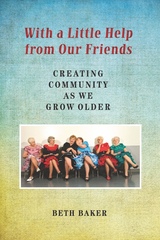
• a mobile home cooperative in small-town Oregon
• a senior artists colony in Los Angeles
• neighbors helping neighbors in "Villages" or "naturally occurring retirement communities"
• intentional cohousing communities
• best friends moving in together
• multigenerational families that balance togetherness and privacy
• niche communities including such diverse groups as retired postal workers, gays and lesbians, and Zen Buddhists
Drawing on new research showing the importance of social support to healthy aging and the risks associated with loneliness and isolation, the author encourages the reader to plan for a future with strong connections. Baker explores whether individuals in declining health can really stay rooted in their communities through the end of life and concludes by examining the challenge of expanding the home-care workforce and the potential of new technologies like webcams and assistive robots.
This book is the recipient of the annual Norman L. and Roselea J. Goldberg Prize for the best project in the area of medicine.
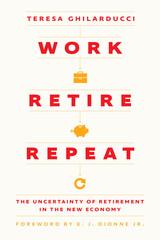
A damning portrait of the dire realities of retirement in the United States—and how we can fix it.
While the French went on strike in 2023 to protest the increase in the national retirement age, workers in the United States have all but given up on the notion of dignified retirement for all. Instead, Americans—whose elders face the highest risk of poverty compared to workers in peer nations—are fed feel-good stories about Walmart clerks who can finally retire because a customer raised the necessary funds through a GoFundMe campaign.
Many argue that the solution to the financial straits of American retirement is simple: people need to just work longer. Yet this call to work longer is misleading in a multitude of ways, including its endangering of the health of workers and its discrimination against people who work in lower-wage occupations. In Work, Retire, Repeat, Teresa Ghilarducci tells the stories of elders locked into jobs—not because they love to work but because they must.
But this doesn’t need to be the reality. Work, Retire, Repeat shows how relatively low-cost changes to how we finance and manage retirement will allow people to truly choose how they spend their golden years.

Yet this is only half the story. Populations in the poorer countries of the South are also ageing. Life-expectancy has increased due the availability of lifesaving medicine. Child mortality has decreased, so people are having smaller families. India will soon have one of the largest populations of over-sixties. The one-child policy in China will similarly lead to a severe imbalance in the age-profile of the people.
In A World Grown Old, Jeremy Seabrook examines the real implications of the ageing phenomenon and challenges our preconceptions about how it should be tackled. Arguing that the accumulated skills of the elderly should be employed to enrich society, rather than being perceived as a 'burden', he calls for a radical rethinking of our attitude to population issues, migration, social structures and employment policy.
READERS
Browse our collection.
PUBLISHERS
See BiblioVault's publisher services.
STUDENT SERVICES
Files for college accessibility offices.
RECENTLY PUBLISHED






UChicago Accessibility Resources
home | accessibility | search | about | contact us
BiblioVault ® 2001 - 2025
The University of Chicago Press