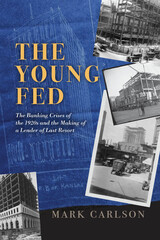
front cover of The Young Fed
The Young Fed
The Banking Crises of the 1920s and the Making of a Lender of Last Resort
Mark Carlson
University of Chicago Press, 2025

A new history of crisis responses in the central bank’s formative years.

The long-standing description of the Federal Reserve as a “lender of last resort” refers to the central bank’s emergency liquidity provision for financial entities in periods of crisis. As Mark Carlson shows, this function was foundational to how the Fed was designed but has, at times, proven challenging to implement. The Young Fed examines the origins of the Federal Reserve’s emergency liquidity provision which, along with the setting of monetary policy, has become a critical responsibility.

Focusing on the Fed’s response to the financial crises of the 1920s, Carlson documents the formative deliberations of central bank policymakers regarding how to assist banks experiencing distress; the lessons that were learned; and how those lessons shaped subsequent policies. Carlson depicts an early Fed that experimented with a variety of approaches to crises, ranging from bold spectacles featuring cash-filled armored cars to behind-the-scenes interventions to prevent inducing panics or bank runs. The Young Fed weaves previously unpublished material from the Fed archives into a watershed work in American economic history: a deeply sourced account of how the world’s most important central bank became a lender of last resort.


[more]

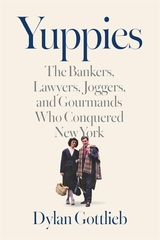
front cover of Yuppies
Yuppies
The Bankers, Lawyers, Joggers, and Gourmands Who Conquered New York
Dylan Gottlieb
Harvard University Press, 2026

How the rise of Wall Street in the 1980s lured a generation of young upstarts to New York, unleashing a political and cultural transformation whose national repercussions are still felt today.

Yuppies may have been a classic 1980s stereotype, but they were also a very real demographic: a wave of hundreds of thousands of highly educated young professionals that washed over New York during that decade. As Wall Street moved to the center of American life, it drew a generation of young people into its vortex. For the first time, banks recruited roughly one-third of graduating classes from top universities.

America’s economy had a new main character. Young bankers extracted profits from waning industries, shattering the foundations on which stable middle-class employment had long rested. Yuppie lawyers devised deals and tax strategies that eroded workers’ power and wages. As consumers, yuppies created new cultures of fitness and of excess, popularizing marathon running and fine dining as status markers. As city-dwellers, they were pioneers of gentrification. And as voters and political donors, yuppies engineered a takeover of local and national government, using their wealth to back candidates who would remake the country in their image.

Yuppies reminds us that we still live in the shadow of the greed-is-good 1980s: Our cities are playgrounds for the wealthy, and Wall Street and Washington remain locked in a tight embrace. Dylan Gottlieb’s exquisite recounting leaves no doubt that the yuppie takeover of New York began a more unequal chapter in American life—one we continue writing today.

[more]


Send via email Share on Facebook Share on Twitter