
 A SCHOLARLY BOOK REPOSITORY
3 start with Y start with Y
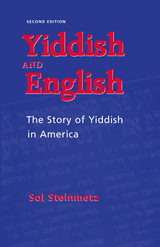
This is the only book to seriously treat the intriguing linguistic and cultural phenomenon of the intimate contact between Yiddish and English over the past 120 years.
Yiddish arrived in America as the mother tongue of millions of Jewish immigrants from eastern Europe. Not only did this language without a homeland survive in the great American melting pot, it infiltrated the majority language, English, with a wide variety of new words and expressions and helped to establish a new ethnic language called "Jewish English." New Yorkers, in particular, have adopted a long list of Yiddish words, including the well-known "kosher," "chutzpah," "klutz," "yenta," "nosh," "mavin," "schlep," and "shmo."
Yiddish had first developed from language sharing as Jews of northern France and northern Italy migrated into the German-speaking region of the Rhine Valley in the Middle Ages. Sol Steinmetz traces the development of such words as bonhomme from the Old French meaning "good man" to the Yiddish of bonim, or shul for synagogue derived from the German schuol, meaning "school," which had come originally from the Latin schola, for example. With a rich collection of quotations from literature and the press, Steinmetz documents the unusually high lexical, semantic, and intonational exchanges between Yiddish and English in America. He offers more than 1,200 Yiddish words, expressions, idioms, and phrases that have melted into the English vernacular.
Yiddish and English is important for Judaica collections with its two appendixes-one on the romanization of Yiddish and another of Yiddish-origin words, a Jewish-English glossary, a selected bibliography, and an index. But this slim volume is so entertaining and informative for the general reader that it is recommended for anyone who delights in word derivations and language.
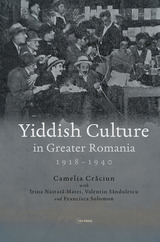
In the newly created Greater Romania, the Jewish community included more than half a million individuals still speaking Yiddish. Building on pre-war trends, the new nation-state faced an antisemitism problem since its inception. This continued in the period that followed, culminating in the horrors of the Holocaust, which destroyed most of the Yiddish-language community. Most survivors were discouraged from continuing to use a language that reminded them of a painful past.
This volume examines the socio-cultural mechanisms responsible for restructuring the Yiddish cultural life after the changes brought about by the end of World War I and the creation of Greater Romania. It describes how this process evolved until the political regimes banned the activity of Yiddish theaters, press and, ultimately, the usage of Yiddish, thus making cultural life impossible.
The four authors identify the main institutions, individuals and projects that promoted Yiddish cultural life in interwar Romania. They also trace the impact of Yiddish within Romanian society through joint projects, events, and initiatives. Special attention is given to Yiddish theater, which played a key role both within the community and in its interaction with the Romanian-speaking public.

A professor of Jewish literature buys a lake house in the countryside with the aim of enjoying it with her husband, dogs, and grown sons, only to discover that her new neighbor is a sexist, dog-hating, and deeply antisemitic bully. The editor of a magazine devoted to lost languages resents the popularity of a younger, less sophisticated novelist, who happens to have been her student. A young woman tries to find her way after her fiancé calls off their wedding. With the contradictions, yearnings, imperfections, and longing for grace that beset all of us, these characters reach their own epiphanies—with results that are by turns breathtaking and heartbreaking.
READERS
Browse our collection.
PUBLISHERS
See BiblioVault's publisher services.
STUDENT SERVICES
Files for college accessibility offices.
RECENTLY PUBLISHED



UChicago Accessibility Resources
home | accessibility | search | about | contact us
BiblioVault ® 2001 - 2025
The University of Chicago Press