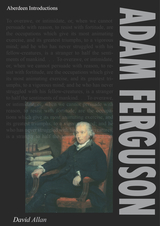
front cover of Adam Ferguson
Adam Ferguson
David Allan
Aberdeen University Press, 2007
Adam Ferguson (1723-1816) was among the Scottish Enlightenment’s most influential philosophers as well as one of its most colourful and engaging characters. His pioneering contributions to the development of political economy and social theory have long been acknowledged—though, unfortunately, they have also often been misrepresented. At the same time, it is clear that the significance both of his professional activities as a distinguished university teacher in Edinburgh and of his status as one of the eighteenth century’s foremost historians of the Roman republic has been insufficiently appreciated. This innovative study of Ferguson’s life and ideas sets out to introduce this much-misunderstood figure to a new and wider audience. Paying particular attention to the powerful intellectual currents which converged so fruitfully in his writings, it explores the deep Scottish and European roots of Ferguson’s thought and assesses the continuing pertinence of some of his arguments about the origins and nature of society for an understanding of the modern world.
[more]

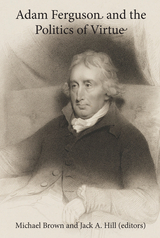
front cover of Adam Ferguson and the Politics of Virtue
Adam Ferguson and the Politics of Virtue
Jack A Hill
Aberdeen University Press, 2023
The essays in this collection offer a reassessment of the Scottish Enlightenment philosopher, Adam Ferguson. Moving beyond a concentration on his early Essay on the History of Civil Society (1767), the book explores his experience as a teacher of moral philosophy, his political views in an Age of Revolution, and his historical treatment of the Roman Republic. It also offers an assessment of his intellectual influence and legacy.
[more]

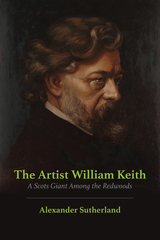
front cover of The Artist William Keith
The Artist William Keith
A Scots Giant Among the Redwoods
Alexander Sutherland
Aberdeen University Press, 2026

The Artist William Keith: A Scots Giant Among the Redwoods reveals the rise of William Keith (November 18, 1838? – April 13, 1911), a fatherless child from a humble presbyterian upbringing in rural Aberdeenshire, Scotland to an eminent position in the artistic and civic circles of Gold Rush-era San Francisco. Illustrated with 20 images, Alexander Sutherland’s detailed and engaging study traces Keith’s personal, family and artistic influences, his lively personality and his drive to make a name for himself.

Brought to America by his widowed mother in 1851, Keith’s initial career in wood engraving was superseded by an interest in painting. He later trained in Europe, influenced by German Realism, the Barbizon painters in Paris, and later, studying portraiture in Munich. However, his major artistic shift came in 1872, when he befriended fellow Scot, John Muir (April 21, 1838 – December 24, 1914), a conservationist and environmentalist.

Their numerous trips into the mountains of Yosemite and other wilderness regions in search of suitable subjects for painting was the catalyst for a thirty-eight-year friendship and cemented Keith’s success as a landscape painter. A later influence was landscape artist George Inness (1825-94), who helped Keith find a way out of a period of despondency. Keith’s later years in San Francisco were characterised by cosmopolitan and Suffragist connections and influence in the bohemian art world of California. The San Francisco Earthquake of 1906 destroyed much of his life’s work but Keith responded pragmatically producing further work -tangible evidence of his remarkable resilience.
[more]

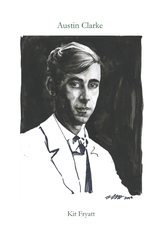
front cover of Austin Clarke
Austin Clarke
Kit Fryatt
Aberdeen University Press, 2020
This is the first book to examine the work of Austin Clarke (1896-1974) in the light of modern critical and theoretical perspectives. Clarke was one of Ireland's major writers whose career was devoted as much to fiction, drama and autobiography as to poetry.

Kit Fryatt assesses Clarke's work in its entirety but focuses on key works which reveal how resourcefully Clarke explored themes such as the coherence of the personality, the inner lives of women and the roots of repression.
[more]

front cover of Continuity, Change and Pragmatism in the Law
Continuity, Change and Pragmatism in the Law
Essays in Memory of Professor Angelo Forte
Andrew R.C. Simpson
Aberdeen University Press, 2016
Professor Angelo Forte (1949–2012) held the Chair of Commercial Law at the University of Aberdeen between 1993 and 2010. During that time, he made significant scholarly contributions to commercial law, Scots private law and legal history. As a commercial lawyer and a former solicitor, he was committed to the production of high quality research that could engage with the needs of business and commerce. He was also particularly interested in exploring the extent to which legal change had occurred as the result of purely practical considerations, such as alterations in commercial reality. In this regard he advanced our understanding of the influence of English law in eighteenth-century Scotland. Latterly he also advanced our understanding of laws that seem to have been applied among some of the Gaelic-speaking peoples of Scotland almost a thousand years ago. His eclectic writings were highly esteemed both at home and abroad. His rigour as a scholar proved inspirational to several generations of students, and it also led to a wide range of international collaborations.
[more]

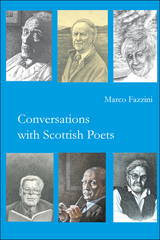
front cover of Conversations with Scottish Poets
Conversations with Scottish Poets
Marco Fazzini
Aberdeen University Press, 2015
Conversations with Scottish Poets presents fourteen interviews conducted by Italian literary critic and translator Marco Fazzini since the 1980s. By asking the same or similar questions of Scottish poets of different generations, the interviews provide insight both into the ideas and working methods of the individual poets and also into the ways in which the poets’ relationship with their country and its languages have changed between the twentieth and twenty first centuries.

Includes interviews with:
· Norman MacCaig
· Sorely Maclean / Somhairle MacGill-Eain
· Edwin Morgan
· Derick Thompson / Ruaridh MacThòmais
· Iain Chrichton Smith / Iain Mac a’ Ghobhainn
· Alasdair Gray
· Kenneth White
· Douglas Dunn
· Valerie Gillies
· Christopher Whyte / Crìsdean MacIlleBhàin
· John Burnside
· David Kinloch
· Robert Crawford
· Don Paterson
 
[more]

front cover of Diary of General Patrick Gordon of Auchleuchries 1635-1699
Diary of General Patrick Gordon of Auchleuchries 1635-1699
Volume 1: 1635-1659
Dmitry Fedosov
Aberdeen University Press, 2010
The great Russian historian, S.M. Soloviev, regarded Patrick Gordon as “one of the most remarkable men” ever employed by the tsars, and was grateful to him for “recording his adventures and existence day by day, leaving to us curious tidings of himself, of his brothers in arms, and of Russia before the age of transformation” – and much else besides. Passages from the Diary were published in 1859. Now, 150 years on, the appearance of the first of six volumes marks the beginning of the publication of the complete work.
[more]

front cover of Diary of General Patrick Gordon of Auchleuchries 1635-1699
Diary of General Patrick Gordon of Auchleuchries 1635-1699
Volume 2: 1659-1667
Dmitry Fedosov
Aberdeen University Press, 2011
Paul Dukes writes: In this second volume of Patrick Gordon’s Diary containing ‘curious tidings of himself, of his brothers in arms, and of Russia before the age of transformation’ (to quote again the great historian S.M. Soloviev), our hero continues his account of service in Warsaw and elsewhere in Poland before moving to Moscow in 1661 with Paul Menzies and others. He tells of the difficulties with officialdom in his early years and his more successful military activities, often in the company of fellow Scots. He also gives a full description of a mission to London, including meetings with Charles II. Dmitry Fedosov continues his magnificent edition of a vital historical source and a most entertaining narrative.
[more]

front cover of Diary of General Patrick Gordon of Auchleuchries 1635-1699
Diary of General Patrick Gordon of Auchleuchries 1635-1699
Volume 3: 1677-1678
Dmitry Fedosov
Aberdeen University Press, 2012
Paul Bushkovitch writes: The Diary of General Patrick Gordon, now in the original language, is the most important source for Russian and European history of the seventeenth century to be published in decades. The present superbly edited volume contains an absolutely unique eyewitness account of the main action in the first of Russia’s many wars with the Ottoman Empire. Gordon’s record of events and his observations are not limited to military matters, and provide material for the political, social, and cultural history of Russia as well as that of the Ukrainian Cossacks.
[more]

front cover of Diary of General Patrick Gordon of Auchleuchries 1635-1699
Diary of General Patrick Gordon of Auchleuchries 1635-1699
Volume 4: 1684-1689
Dmitry Fedosov
Aberdeen University Press, 2013
Geoffrey Parker writes: ‘I started to study the military history of seventeenth-century Europe forty-five years ago, and yet I have never come across a source like the Diary written by Patrick Gordon, a Scottish Catholic who in 1651, at the age of sixteen, fled his native land to become a "soldier of fortune."’ Parker continues: ‘Dmitry Fedosov of the Russian Academy of Sciences is producing a scholarly edition of Gordon’s entire surviving text in both the original and in Russian.... Fedosov includes an excellent apparatus criticus,identifying places, persons, and foreign terms; he provides a detailed index.’ The high standard set in the earlier volumes is continued in the fourth. Considering the years 1684-1689, the diary describes all manner of military activities, in particular two campaigns against the Ottoman Turks culminating in the capture of their fortress at Azov. In addition, Gordon gives an evocative account of a visit to Britain, meetings with King James VII and II in London followed by a reunion with friends and family back home in Aberdeenshire. He also tells us of many contacts with the future Peter the Great before and during the young tsar’s seizure of power from his half-sister the Regent Sophia.
[more]

front cover of Diary of General Patrick Gordon of Auchleuchries 1635-1699
Diary of General Patrick Gordon of Auchleuchries 1635-1699
Volume 5: 1690-1695
Dmitry Fedosov
Aberdeen University Press, 2014
Paul Dukes writes: The publication of the Diary of Patrick Gordon has by now fully established itself as an invaluable source for Russian, British and European history in the second half of the seventeenth century. Volume V, thoroughly edited like its predecessors by Dmitry Fedosov, comprises a wide range of activities on land and sea from 1690 to 1695, many of them involving the young tsar Peter. Having helped the future Peter the Great to consolidate his hold on the throne, Gordon grew closer to him in ‘large discourse’, being ‘entertained & detained all night’, and so on. On the practice battlefield, the Scottish general played a leading part realistic enough for himself to be shot in the thigh and his son-in-law to be mortally wounded. As Fedosov says, Gordon along with the tsar proceeded from the pastimes of Mars to those of Neptune in naval exercises on the White Sea. Moving south to actual combat, the Russian forces re-engaged the Crimean Khanate and Ottoman Empire in further episodes in the long struggle for the fortress of Azov. Volume V, the longest of the six, contains many letters to and from Gordon and a wide range of his observations on political developments throughout Europe.
[more]

front cover of Diary of General Patrick Gordon of Auchleuchries 1635-1699
Diary of General Patrick Gordon of Auchleuchries 1635-1699
Volume 6: 1696-1699
Dmitry Fedosov
Aberdeen University Press, 2016
Professor Robert Frost writes: the sixth and final volume of The Diary of General Patrick Gordon of Auchleuchries is in some ways the most significant of all. It covers the vital period in which Peter the Great launched his challenge to the traditional Russian system and set Russia on the path to great power status. Gordon played a central role in two of the great dramas of these years: the successful siege and defence of Azov, which firmly established Russian power on the Caspian Sea, and the crushing of the Revolt of the Streltsy, the most dangerous early challenge to Peter’s reforms. Gordon’s diary gives unparalleled insight into these dramatic events and adds much to our knowledge of one of the most significant and charismatic rulers in Russian history. Gordon tells the story with characteristic detachment and a wealthof detail. As a diarist he ranks with Samuel Pepys, and the publication of Volume VI marks the completion of a project for which Dmitry Fedosov and Paul Dukes deserve to be congratulated. After three centuries, the original text of a hugely important historical work, and what can also be seen to be a significant literary achievement, is fully available for the first time.
[more]

front cover of Footloose in Farm Service
Footloose in Farm Service
Autobiographical Recollections of John Dickie
Marjory Harper
Aberdeen University Press, 2012
John Dickie was born in Aberdeen in 1824. Five years later the family moved to a croft at Balquhain, in the shadow of Bennachie, and up to the age of 23 his world was contained within a 15-mile radius of Inverurie. An itinerant farm servant, John worked at Harlaw, Thainstone, Daviot, Tarves, Udny and Oldmeldrum until in December 1847 he exchanged the country for the city, when he returned to Aberdeen to marry and take up employment as a warehouseman. He died in 1903.

Throughout his life John Dickie enjoyed dipping his pen in the ink. Some of his efforts were for the benefit of others: on two occasions in the 1860s he petitioned his employers, on behalf of his fellow workers, to request a Saturday half-day and an increase in wages. But his most illuminating piece of work is this unpublished memoir of his early years, which reflects not only his personal rhythms of life and work, but also the impact of regional and national issues on the farming communities of Aberdeenshire.
[more]

front cover of The Gaelic Crisis in the Vernacular Community
The Gaelic Crisis in the Vernacular Community
A Comprehensive Sociolinguistic Survey of Scottish Gaelic
Conchúr Ó Giollagáin, Gòrdan Camshron, Pàdruig Moireach, Brian Ó Curnáin, Iain Caimbeul, Brian MacDonald and Tamás Péterváry
Aberdeen University Press, 2020
This book emerges from the work of Soillse's Islands Gaelic Research Project (IGRP) conducted between 2015 and 2017. Soillse was a research collaboration, established between founding members – the University of the Highlands and Islands, the University of Aberdeen, the University of Edinburgh and the University of Glasgow – to provide a much enhanced research capacity to inform public policy towards the maintenance and revitalisation of Gaelic language and culture. This publication provides contemporary data and analysis of the societal and spatial extent of Gaelic speakers and Gaelic speaking in the remaining vernacular communities in Scotland. The survey modules examined: census demolinguistics; preschoolers' language practice; teenager data; three indicative communities and speaker typologies, providing qualitative and quantitative information on community, family, school and individual language acquisition and practice.
[more]

front cover of J. J. R. Macleod
J. J. R. Macleod
Co-discoverer of insulin
By Michael J Williams, edited by Kenneth C McHardy
Aberdeen University Press, 2026

This biography reveals the little-known story of medically qualified research physiologist and biochemist, John Macleod (1876-1935). From child of a Free Kirk minister in rural Perthshire, it records his education at the Grammar School and University in Aberdeen. Rapid career progress in Leipzig, Aberdeen and London, culminated in his appointment as Professor of Physiology in Cleveland, Ohio aged only 27. He moved on to similar positions in Toronto then back in Aberdeen. In Cleveland, he became an expert on carbohydrate physiology; in Toronto in 1922, he led the four-man team that discovered the world’s first clinically useful insulin. The following year, he was jointly awarded the Nobel Prize in Medicine or Physiology for this life-saving scientific breakthrough, together with colleague, Frederick Banting. The latter unfairly claimed that Macleod had stolen credit for the work. With important political backing, Banting’s view prevailed sullying Macleod’s reputation and legacy. In a 1982 book, The Discovery of Insulin, Canadian historian Michael Bliss gave a new, detailed interpretation of what had happened in Macleod’s department, concluding that history had underestimated Macleod’s magnificent contributions. Michael Williams (1931-2022), a diabetes specialist, educated at the same school and medical school as Macleod, went on to produce this detailed account of Macleod, originally published in 1993. This refreshed edition, JJR Macleod: Co-discoverer of Insulin, adds descriptions of several interventions over recent years to restore Macleod’s reputation as a scientist whose work has contributed to saving hundreds of millions of lives.
 

[more]

front cover of James Boswell
James Boswell
Murray Pittock
Aberdeen University Press, 2007
James Boswell (1740-95) has gone down in history as the biographer of Samuel Johnson, a sexual adventurer, a toadying Scot, and as a writer who typified the divided consciousness of the Scottish eighteenth century. Before the discovery and (since 1950) publication of his private papers, critics often saw him as a bit of a fool, whose achievement was primarily that of being lucky enough to be the friend and amanuensis of the most famous Englishman of his day. More recently, the stature of Boswell’s achievement and his complexity as a writer have been better appreciated, but without adequate understanding of his role as a specifically Scottish author and thinker of the age of Enlightenment: in particular, his anxious critique of Humean scepticism is discussed here. This study examines, through a close reading of both published and unpublished materials, how Boswell deliberately sets out to write ambiguously about himself and the major events of his time; how, far from echoing Johnson, Boswell improves on his sayings and teasingly criticizes him; and how Boswell’s political and religious sympathies with Jacobitism, Scotland and Catholicism coloured the way in which he understood his own, and his country’s, uncertain place in the new world of British imperial opportunity.
[more]

front cover of The Lost World of John Witherspoon
The Lost World of John Witherspoon
Unravelling the Snodgrass affair, 1762 to 1776
Ronald Lyndsey Crawford
Aberdeen University Press, 2015
John Witherspoon (1723 – 1794) is remembered today as one of only two Scots among the 56 ‘signers’ of the Declaration of American Independence and the only clergyman to have added his name to the list of founding fathers of the nation that was set to become the United States. On that basis alone, Witherspoon earns his place as an important figure in the early history of the ‘Empire of Liberty’ – even though he has been described by some American scholars as the ‘forgotten Founder.’

But Witherspoon had two careers. His American career (as College President at Princeton and an influential politician in the revolutionary and immediate post-revolutionary war period) has understandably tended to overshadow his earlier career in Scotland as a leading light within the Popular (or Evangelical) party in the Church of Scotland at a time when the Kirk was dominated by the Moderates led by such men as William Robertson, Hugh Blair and Alexander ‘Jupiter’ Carlyle. This study shows that he had few friends among the preponderance of Moderate ministerial colleagues in the Presbytery of Paisley.

The ground-breaking research underpinning this book reveals for the first time the full astonishing story of Witherspoon’s involvement in an action against him in the Court of Session in Edinburgh, a process that was begun by a lawyer, John Snodgrass, and five others in 1762 and was not determined until 1776, by which time the Paisley minister had long left Scotland for a new life as sixth President of the College of New Jersey. The process would engage the professional skills of some of the most celebrated figures in Scottish advocacy of the period, including George Wallace, Henry Dundas, David Dalrymple, Charles Hay and Andrew Crosbie.

In an important ‘Concluding Essay’ the author makes a convincing case for the Snodgrass affair having influenced Witherspoon’s decision to make a new life for himself and his family in America, demolishing the traditional view that it was somehow irrelevant to that decision.
[more]

front cover of Medbh McGuckian
Medbh McGuckian
The Poetics of Exemplarity
Shane Alcobia-Murphy
Aberdeen University Press, 2012
This is the first monograph wholly devoted to the poetry of Medbh McGuckian and it presents pathways into her work that have thus far remained largely unexplored. The chapters examine the ways in which McGuckian uses literary exemplars to explore the psychodramas of female literary authorship and ways of approaching issues of memory, trauma and elegiac remembrance.

This monograph provides an excellent introduction to McGuckian’s poetry and argues that her work self-reflexively presents a deeply felt belief in the primacy (and efficacy) of poetry in the modern world.
[more]

front cover of Northern Lights
Northern Lights
Essays in Private Law in Memory of Professor David Carey Miller
Roderick R.M. Paisley
Aberdeen University Press, 2018
Professor David Carey Miller (1941–2016) held the Chair of Property Law at the University of Aberdeen, and in that capacity inspired generations of students to explore a range of questions and problems that interested him. Among his eclectic writings, his contributions to comparative law, Scots Property law and to land reform in South Africa were recognised as being of particular importance in his lifetime.

In Northern Lights: Essays in Private Law in Memory of Professor David Carey Miller, colleagues, friends and students of Professor Carey Miller seek to honour his memory by advancing those core lines of enquiry that featured so prominently in his research. Some, writing on comparative law, display the remarkably different consequences that follow from the divergent ways in which the civilian and the common law traditions classify legal questions, problems and claims. Others, writing on land law in South Africa and Scotland, reflect on changing concepts of “ownership”. For example, it is suggested at one point that landowners in Scotland are increasingly expected to do something productive or useful with their land in order to continue as owners. Still other contributors focus on Scots law, a system that has traditionally been seen as “mixed”, that is to say influenced by both the civilian and the common law traditions. Research into Scots Private law draws attention to the merits of rigorous research into core principles of the legal system, so as to facilitate the deduction of answers to new legal questions when they arise. In addition, some writers explore the use of established legal principles to evaluate proposed changes to the law in response to factors such as changing and social commercial reality. All of the essays in the volume seek to pay tribute to a great friend and scholar.
[more]

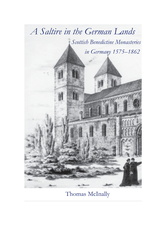
front cover of A Saltire in the German Lands
A Saltire in the German Lands
Scottish Benedictine Monasteries in Germany 1575-1862
Thomas McInally
Aberdeen University Press, 2016
For almost three hundred years, when Catholicism was illegal in Scotland, southern Germany was host to communities of Scottish Benedictine monks. From the Reformation onwards Scots went to monasteries run by their own countrymen in Bavaria, Franconia and Thuringia in order to take up life in a religious order.

Throughout their stay in the lands of the Holy Roman Emperor the concern of these Scots Benedictines was to support and engage in the missionary activities of the Catholic Church in Scotland. Almost inevitably, however, they became involved in German political life in part through being active participants in their hosts’ counter-Reformation.

They became witnesses to and minor participants in a number of major cataclysmic events including the Thirty Years’ War, the War of Austrian Succession, the French Revolutionary and Napoleonic Wars all of which threatened their continued existence. However, their survival and prosperity came to depend on the strong networks of support developed by Scots at home and in continental Europe.

From the late seventeenth through to the nineteenth century the monasteries were able to engage energetically in the provision of education not only for their fellow Scots but for their German hosts. Efforts in this regard led to their making significant contributions to the wider European Enlightenment movement – a fact that has long been known in Germany although almost unrecognised elsewhere.

A Saltire in the German Lands is an attempt to bring their achievements to the wider audience they deserve.
[more]

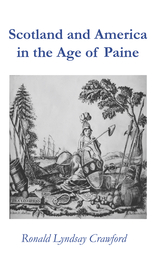
front cover of Scotland and America in the Age of Paine
Scotland and America in the Age of Paine
Ronald Lyndsey Crawford
Aberdeen University Press, 2022
Thomas Paine is rightly regarded as among the most influential of English political iconoclasts. His two best-known works – Common Sense (1776) and Rights of Man (1791) – ensured his remarkable success in positioning himself, both literally and literarily, at the forefront of both the American and French revolutions. It is no exaggeration that Paine’s works lie at the heart of popular revolutionary sentiment as it came to express itself in the later eighteenth century. For that reason they were regarded at one level as manifestos of the crying need for social and political change, but at the same time by government and the law as dangerous instruments of sedition and republicanism. Ronald Crawford explores how, in both Scotland and America, Paine’s brand of radicalism took particular hold, though only for a limited period – the ‘Age of Paine’.

Part One of the book explores American themes discoverable in the works of Francis Hutcheson, David Hume, Adam Smith and Adam Ferguson; the explosive political impact within Scotland of Rights of Man (1776); and how Scottish precedents, through the writings of Benjamin Franklin and Thomas Jefferson, helped shape the educational system of the early United States.

Part Two examines the careers of four Scots emigrants who made distinguished contributions to the American ideal of liberty: the ‘bookman’ Robert Aitken who employed Paine as contributing editor of his Pennsylvania Magazine; John Witherspoon, President of the College of New Jersey, one of the signatories to the Declaration of Independence in 1776; the radical poet, Alexander Wilson, whose (very different) Scottish and American careers are re-examined with the help of newly found original sources; and the lawyer from Fife, James Wilson, another signer, whose remarkable contributions to the evolution of the US Constitution are considered from the point of view of his indebtedness to numerous Scottish sources.
[more]

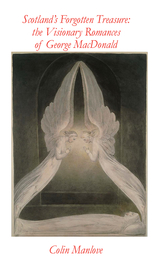
front cover of Scotland's Forgotten Treasure
Scotland's Forgotten Treasure
The Visionary Romances of George MacDonald
Colin Manlove
Aberdeen University Press, 2016
Scotland’s Forgotten Treasure is a detailed study of the aesthetics and the religious vision of the fantasy works written by nineteenth-century Scottish novelist, George MacDonald. MacDonald’s Phantastes (1858) and Lilith (1895) are the origin of much modern fantasy writing, and Colin Manlove brings to bear on MacDonald’s major achievements decades of study in fantasy literature to unlock the structures that govern MacDonald’s imagination and the relevance of his works to contemporary religious and scientific thought.

Manlove reveals in MacDonald’s works a depth and complexity that establishes them as among the the most original works of nineteenth-century literature, and a treasure that should be the centrepiece of any account of nineteenth-century Scottish fiction.
[more]

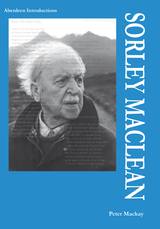
front cover of Sorley MacLean
Sorley MacLean
Peter Mackay
Aberdeen University Press, 2010
Sorley MacLean (1911-1996) was the greatest Gaelic poet of the 20th Century and one of the leading figures in the Scottish literary Renaissance. He is best known for his love poetry, for poems written while he was serving in Africa during the Second World War, forpoems exploring place and history, and for the long political poem ‘An Cuilithionn’. His 1943 Dàin do Eimhir agus Dàin Eile is generally regarded the single-most important book published in Gaelic in the last century.

This book offers the first single authored English language introduction to MacLean’s work. It places MacLean’s poetry in poetic, political and historical contexts, exploring its engagement with Gaelic traditions and other language literatures and also with contemporary philosophical and political movements. Discussing the entirety of MacLean’s oeuvre – and offering in-depth case studies of individual poems and groups of poems – this introduction raises questions about translation and cultural ownership in modern Scotland, and shows how and why MacLean’s work continues to resonate.
[more]

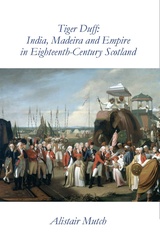
front cover of Tiger Duff
Tiger Duff
India, Madeira and Empire in Eighteenth-Century Scotland
Alistair Mutch
Aberdeen University Press, 2017
Wounded in battle, ringleader of an officers’ mutiny, survivor of a mauling by a tiger, candidate in a Parliamentary by-election – Patrick ‘Tiger’ Duff (1742–1803) had an eventful life. The son of a Speyside tenant farmer, he rose to the rank of General in the East India Company army and retired to a country estate near Turriff. He made a fortune in India, in part because of his family connections with the Gordons of Letterfourie. James and Alexander Gordon were successful wine merchants in Madeira. They not only provided for Patrick’s education, but also employed his brothers James and Robert in the wine trade. In turn, Patrick was able to win business for the partnership amongst the hard-drinking British in India.

Scottish merchants, such as the Gordons, were an important part of the British merchant community in Madeira. Wealth from both sources, the empire of conquest in India and the empire of commerce exemplified by Madeira, flowed back into Scotland and fuelled the process of agricultural improvement.
[more]

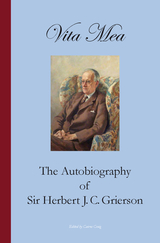
front cover of Vita Mea
Vita Mea
The Autobiography of Sir Herbert J.C. Grierson
Cairns Craig
Aberdeen University Press, 2015
Herbert Grierson was only 28 when he was appointed Professor of English Literature at the University of Aberdeen in 1895; in the following quarter of a century he established himself as the most distinguished literary critic of his time: first, by the publication in 1912 of his edition of the poetry of the then little acknowledged seventeenth-century English poet John Donne, and subsequently by his influential anthology of The Metaphysical Poets, published in 1919. Because of Grierson, Donne became the most admired poet of some of the twentieth-century’s most influential poets, and the ‘Metaphysicals’ became the model for many of the most radical developments in twentieth-century poetry.
[more]

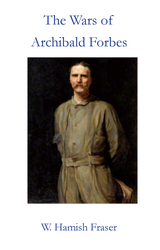
front cover of The Wars of Archibald Forbes
The Wars of Archibald Forbes
W. Hamish Fraser
Aberdeen University Press, 2015
With heroic journeys on horseback and on foot to get to the nearest telegraph station, Archibald Forbes transformed the profession of war correspondent into something recognisably modern. He was widely regarded as the greatest war correspondent of the nineteenth century and the model with whom all others had to compete. It was he, more than any other, who appreciated the public demand for immediacy and therefore the need to get reports from the front into the press as fast as possible. He transformed the fortunes of the Daily News by making extensive use of the telegraph: his brilliant descriptive writing shaped images of wars for a public greedy for information and excitement.

Despite persistent health difficulties he covered in the 1870s the Franco-Prussian War, the Paris Commune, the Carlist Wars in Spain, the Serbian-Turkish War, the Russo-Turkish War, the occupation of Cyprus, the Afghan War, the Zulu War, the Indian Famine and the Prince of Wales’s visit to India.

At the same time, he kept up a prolific output of articles in many of which he did not hesitate to challenge the assumptions of the military authorities, to criticise the generals and to press for modernisation of the army. He defended the freedom of war correspondents to report wars as they saw them against the growing pressures to have their work censored and controlled. When ill-health forced him to abandon war work he became a tireless lecturer in Britain, the United States, Australia and New Zealand and his predictions on the shape of future wars came all too true in 1914.
[more]


Send via email Share on Facebook Share on Twitter