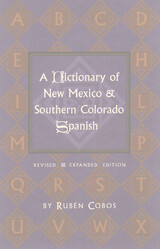
front cover of A Dictionary of New Mexico and Southern Colorado Spanish
A Dictionary of New Mexico and Southern Colorado Spanish
Revised and Expanded Edition
Rubén Cobos
Museum of New Mexico Press, 2011
Continuously in print since 1983, Dictionary of New Mexico and Southern Colorado Spanish, has become a classic Spanish reference book, widely used in classrooms across the United States. As a teenager in Albuquerque, esteemed linguist and folkorist Rubén Cobos (1911-2010) was intrigued by and began documenting the regional variations of spoken Spanish. This was to become his work of a lifetime spanning seventy-five years. Dr. Cobos began recording Indo-Hispanic folklore material in the early 1940s. With the co-operation of the villagers, farmers, sheepherders, and other hard-working people in the small towns throughout New Mexico and Southern Colorado he recorded the nuances, slang and the regionally distinctive words of Spanish spoken in the communities of the upper Rio Grande and Southern Colorado.

Ruben Cobos spent a decade working on the revised and expanded edition of the dictionary, published in 2003. The Dictionary of New Mexico and Southern Colorado Spanish has assumed its place as the most authoritative reference on the archaic dialect of Spanish spoken in this region.
[more]

logo for Museum of New Mexico Press
Heritage and Change
Southern Paiute and Chemehuevi Nuwuvi Basketry, 1870 to 2026
Catherine S. Fowler
Museum of New Mexico Press, 2026
 The Southern Paiute and Chemehuevi people have lived for countless generations in the southern Great Basin of western North America in a homeland that extends to parts of Utah, Nevada, California, and northern Arizona. Referred to by a variety of names and spellings in the Euro­American literature, they are the people whose name for themselves is “Nuwu”—or collectively, “Nuwuvi.” Nuwuvi basket weaving is a traditional and evolving art form that connects weavers to their ancestors and to the natural world.
            This publication, years in the making, includes chapters by Catherine S. Fowler, Judith W. Finger, John J. Kania, and Larry Dalrymple that explore the cultural history of the Nuwuvi people, the work of known weavers, and the characteristics and development of Nuwuvi basketry from the 1870s to 2022. It focuses particularly on the fine-coiled work produced during the American Arts and Crafts Movement period of the 1890s to 1930s. Working separately and together, the authors analyzed over 1,200 baskets in museum collections across the United States, from the Smithsonian Institution in Washington, D.C., to the Lost City Museum in Henderson, Nevada. They researched the baskets’ collectors—from John Wesley Powell to Helen J. Stewart and Isabel T. Kelly—and conducted interviews with contemporary weavers. In order to give the reader as broad a visual understanding of Nuwuvi coiled baskets as possible, images of baskets from the collection of Judith and Andrew Finger are included. The book is lavishly illustrated with archival and contemporary photographs.
[more]

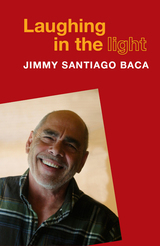
front cover of Laughing in the Light
Laughing in the Light
Jimmy Santiago Baca
Museum of New Mexico Press, 2020
Jimmy Santiago Baca’s newest collection of essays picks up where his earlier acclaimed book, Working in the Dark, left off. Laughing in the Light is the writer’s first attempt to revisit his past, launching into the past twenty years with a renewed heart and wizened spirit as he shares his experiences, what he has learned along the way, and how his views have changed. Baca delves deeper into contemporary issues as he explores themes ranging from arts, culture, education, and justice reform.
[more]

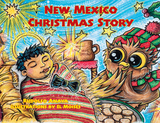
front cover of New Mexico Christmas Story
New Mexico Christmas Story
Owl in a Straw Hat 3
Rudolfo Anaya
Museum of New Mexico Press, 2020
Acclaimed New Mexico author Rudolfo Anaya presents a northern New Mexico Christmas tale in this third volume from his Owl in a Straw Hat series featuring the loveable Ollie Tecolote and his Wisdom School classmates Uno the Unicorn, Jackie Jackalope, Bessie Beaver, Sally Skunk, Robbie Rabbit, and Ninja Raccoon. The story begins on Christmas Eve morning in Chimayó and the students play in the snow and decorate a Christmas tree for the classroom. They are looking forward to the evening’s activities. Nana, their teacher, is making posole and chile colorado and has invited some special guests to join them for dinner. After that Nana says they’ll walk to El Santuario to visit the Santo Niño and promises hot chocolate and biscochitos afterward! Along the way, they will act the parts of the shepherds in Los pastores, the Shepherds’ Play, which is about shepherds visiting the newborn baby Jesus and bringing him gifts. At the end of their journey, they too will visit the Nativity and bring their own gifts on this magical night.

[more]

front cover of New Mexico Poetry Anthology 2023
New Mexico Poetry Anthology 2023
Levi Romero
Museum of New Mexico Press, 2023
Finalist, Poetry, Reading the West (Mountains and Plains Independent Booksellers Association)
Best Poetry Books of 2023, Book Riot

 
"This anthology explores plenty of themes, including community, culture, family, history, and identity…. [it] even features poems in Spanish, encompassing themes such as their city and the experiences of asylum seekers. 'Querido Nuevo México, // Te pregunto, pa’ ‘onde vas? (Dear New Mexico // I ask you, where are you going?)' writes Carmella Scorcia Pacheco, who wonders about the past, present, and the future of New Mexico."—Book Riot

Poetry of Place: A selection of poems from the New Mexico Poetry Anthology 2023 defines the essence of the Land of Enchantment.” —New Mexico Magazine

“Many of the selections are published bilingually in Spanish-English translation and other languages including indigenous tongues and Yiddish are to be found in these pages. It’s all here: Farolitos. Sephardic Jewish rituals. Family traditions. Grief. Recovery. Resilience. Adobes. Santa Fe. Albuquerque. Taos. Los Lunas. Espanola. Mesilla. Cities, villages, ranches, farms. The homeless. Asylum-seekers. Outlaws. Dancers. Matanzas. Basketball. Mountains. Llanos. Guns. Syringes. Rattlesnakes. Scorpions. Roadrunners. Sandhill cranes. Coyotes. Cattle. Horses. Babies. Abuelitos. Ghosts. Elders. Gringas. Sunsets …. This grand book could come from nowhere else BUT New Mexico, and, arguably only from the present time, the third decade of this 21st century Southwestern/Norteño soul. It’s that special.”— Bill Nevins, Enchanted Circle

“The poems…can be enjoyed in brief, bite-sized readings or in longer sittings. Read them silently or aloud.”— David Steinberg, Albuquerque Journal
 
These voices rise as a canto, singing the joys, sorrows, and praises of individual experiences to form a poetry collective that encompasses the poetic-cultural landscape that is New Mexico.”—Levi Romero (New Mexico Inaugural Poet Laureate) and Michelle Otero (Emerita Albuquerque Poet Laureate) New Mexico Poetry Anthology 2023 is an ode and homage to nuestra querencia, our beloved homeland. Two hundred original, previously unpublished poems resonate themes including community, culture, history, identity, landscape, and water. From a diverse group of poets, the poems are introspective and personal; reflective and astute; steady and celebratory. Including poignant, unique, even humorous perspectives on life in New Mexico influenced by the COVID-19 pandemic, this collective of voices serves as a welcome remedio to all aspects of post-pandemic life, for ears aching for words of beauty, strength, and solace as we emerge from the cocoon of survivability.
[more]

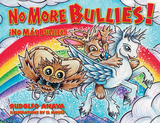
front cover of No More Bullies!/¡No Más Bullies
No More Bullies!/¡No Más Bullies
Owl in a Straw Hat 2
Rudolfo Anaya
Museum of New Mexico Press, 2019
The adventures and lessons continue in this second book featuring “Owl in a Straw Hat” (Ollie Tecolote). This book tackles the subject of bullying of classmates for being different. Jackie Jackalope is missing from school and the teacher (Ollie’s grandmother) gets to the bottom of it. The kids have been teasing Jackie about her horns and she has run away to her parents in Pot of Gold Land. A contrite Ollie along with Uno the Unicorn (both guilty of teasing) volunteer to find and bring Jackie back to school. Their journey to Jackie’s home leads to encounters with three guardians of the Dark Forest (NM monsters/legends): La Llorona, El Kookoóee, and Skeleton Woman; and the Golden Carp who allows them to cross Rainbow Bridge. They reach Jackie and apologize and take her back to Wisdom School. Rudolfo Anaya’s magical characters are brought to life by illustrator El Moisés.
[more]

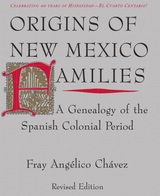
front cover of Origins of New Mexico Families
Origins of New Mexico Families
A Genealogy of the Spanish Colonial Period
Fray Angélico Chávez
Museum of New Mexico Press, 1992
This classic genealogy reference book is considered to be the starting place for anyone having family history ties to New Mexico, and for those interested in the history of New Mexico. Well before Jamestown and the Pilgrims, New Mexico was settled continuously beginning in 1598 by Spaniards whose descendants still make up a major portion of the population of New Mexico.
[more]

front cover of Sabino's Map
Sabino's Map
Life in Chimayó’s Old Plaza, Thirtieth Anniversary Edition
Don J. Usner
Museum of New Mexico Press, 2024
“Now, as I contemplate stepping into a role as [Chimayó] elder, I hope the sentiment of community endures and that this book inspires new generations of Chimayosos to continue building toward a bright future—while remaining rooted firmly in a remarkable history.”—Don J. Usner, from the Preface (2024)
 
“Brimming with voices, las voces de la gente…. the first-person narrator who returns again and again to the text like a knowing and trusted pariente inviting the reader to sit for a while in the Plaza del Cerro. —Jim Sagel
 
“Quite simply…the best history yet made of a northern New Mexico community. It is thorough, balanced, gracefully written, and blessed with an insider’s access and affection.”—William De Buys

Chimayó is renowned for its Hispano master weaving families, lowriders, and its storied church, El Santurio de Chimayó. The old Plaza del Cerro had once been the village’s center place, where locals gathered to pick up mail, socialize and celebrate religious and family events. Over the years after WWII, the plaza was neglected, but the memory of the once-vibrant place remained vivid in the stories of village elders.
The first edition of Sabino’s Map, published in 1995, documented oral histories of these elders. It would prove to be a critical turning point for many Chimayosos. At the Chimayó book launch, Usner recalls locals embraced the book, one cousin of his even declaring, “For the first time in my life I feel like I can be proud to be from Chimayó.” In the past thirty years since its publication, the community and its people have been revitalized with the help of the Chimayó Cultural Preservation Association and the establishment of a museum on the old plaza—in the home of Usner’s ancestors.

This landmark publication, read and passed on through generations, is considered a classic of New Mexico literature, alongside other treasured books including John Nichols’s Milagro Beanfield War, Rudolfo Anaya’s Bless Me Ultima, and Ruben Cobos’s Dictionary of New Mexico and Northern New Mexico Spanish.  
 
[more]

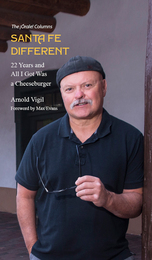
front cover of Santa Fe Different
Santa Fe Different
22 Years and All I Got Was a Cheeseburger
Arnold Vigil
Museum of New Mexico Press, 2019
From 2004 to 2009, the Albuquerque Journal North ran the ¡ÓRALE! SANTA FE column by Santa Fe native and veteran journalist Arnold Vigil. The editor gave carte blanche to Vigil in his selection of topics ranging from encounters with locals and tourists to social commentary about changes that have taken place over the years. Vigil’s local perspective and humorous insights about Santa Fe, its inhabitants, and visitors struck a chord with readers—native Nuevomexicanos and long-time residents alike. Despite its popularity, the column was discontinued as a result of the economic downturn.
[more]

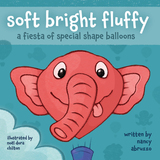
front cover of soft bright fluffy
soft bright fluffy
a fiesta of special shape balloons
Nancy Abruzzo
Museum of New Mexico Press, 2021
Every year in October, visitors gather from all over the world to celebrate hot air balloons at the Albuquerque International Balloon Fiesta. The stars of the show are the whimsical Special Shape balloons—these fanciful, brightly colored balloons in the form of bees, trees, pigs, clowns, and more delight children and families as they take flight. Nancy Abruzzo, balloon enthusiast and a pilot herself, presents the magic of Special Shape balloons in this children’s picture book for young readers beautifully illustrated by Nöel Dora Chilton.
[more]

logo for Museum of New Mexico Press
The White Orchard
Selected Interviews, Essays, and Poems
Arthur Sze
Museum of New Mexico Press, 2025
A poet’s creative process comes to light in this latest book by National Book Award recipient Arthur Sze. Sze has assembled an illuminating selection of seven interviews, three essays, and poems to examine the evolution of his compositions, his decades teaching poetry, and his deep connection to the cultures and landscape of New Mexico.
          A son of Chinese immigrants who was born and raised in New York City and on Long Island, Sze first studied science at MIT. His call to write poetry pulled him away from that academic pursuit, but the sciences would continue to influence his writing. In 2024, Sze received the National Book Foundation Science + Literature Award for The Glass Constellation: New and Collected Poems (Copper Canyon Press). Sze spent over two decades as an educator, teaching creative writing and poetry to Indigenous students from across America at Santa Fe’s Institute of American Indian Arts (IAIA). In this compilation, Sze is interviewed by his former IAIA student, award-winning Diné poet, editor, and visual artist Esther Belin.
Sze’s fluency in his parents’ native tongue, along with study at the University of California at Berkeley, allowed him to delve into Chinese poetry, both as a student and translator of classical and contemporary works. The White Orchard shows his wider connection to Asian American poetry across the United States and how he has drawn inspiration from translating Chinese poetry into English. Arthur Sze is one of our finest poets, and this collection demonstrates how literature can enrich us all.
 
[more]


Send via email Share on Facebook Share on Twitter