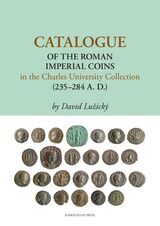
front cover of Catalogue of the Roman Imperial Coins in the Charles University Collection (235–284 A.D.)
Catalogue of the Roman Imperial Coins in the Charles University Collection (235–284 A.D.)
David Lužický
Karolinum Press, 2026

Spotlights over five hundred Roman Imperial coins from Charles University's vast collection of ancient coins.

Charles University’s collection of ancient coins in its present state has existed since l945. Greek, Roman, and other ancient coins were entrusted to the care of the Seminar for Ancient History and compiled into a single collection along with antique coins from the original collection of the Czech University. The collection contains about 4,000 pieces altogether, mostly in silver and bronze.

This publication presents a catalogue of 564 Roman Imperial coins dating from 235 to 284 A. D. and is part of efforts to gradually catalogue the entirety of Charles University’s collection of ancient coins, stored in the depository of the CU Institute of Greek and Latin Studies. The book builds upon Václav Marek’s 1985 monograph, The Roman Republican Coins in the Collection of Charles University, and Federico Gambacorta’s 2013 continuation titled Catalogue of the Late Roman, Byzantine and Barbaric Coins in the Charles University Collection (364–1092 A. D.).


[more]

logo for Harvard University Press
Early Tamil Epigraphy from the Earliest Times to the Sixth Century A.D.
Iravatham Mahadevan
Harvard University Press
This book presents the earliest South Indian inscriptions (ca. second century B.C.E. to sixth century A.D.), written in Tamil in local derivations of the Ashokan Brahmi script. They are the earliest known Dravidian documents available and show some overlap with the early Cera and Pandya dynasties. Their language is Archaic Tamil, with a few borrowings from Prakrit and influences of old Kannada, both resulting from the early presence of northern Jainism. The widespread occurrence of pottery inscriptions indicates that the Tamil-Brahmi script had taken deep roots all over the countryside, leading to the cultured society visible in the classical Tamil poetry of the Cankam (Sangam) texts of the early centuries C.E. The work includes texts, transliteration, translation, detailed commentary, inscriptional glossary, and indexes.
[more]


Send via email Share on Facebook Share on Twitter