
 A SCHOLARLY BOOK REPOSITORY
Results by Title
4 books about 1661?-1731
4 books about 1661?-1731
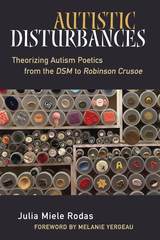
Autistic Disturbances
Theorizing Autism Poetics from the DSM to Robinson Crusoe
Julia Miele Rodas
University of Michigan Press, 2018
While research on autism has sometimes focused on special talents or abilities, autism is typically characterized as impoverished or defective when it comes to language. Autistic Disturbances reveals the ways interpreters have failed to register the real creative valence of autistic language and offers a theoretical framework for understanding the distinctive aesthetics of autistic rhetoric and semiotics. Reinterpreting characteristic autistic verbal practices such as repetition in the context of a more widely respected literary canon, Julia Miele Rodas argues that autistic language is actually an essential part of mainstream literary aesthetics, visible in poetry by Walt Whitman and Gertrude Stein, in novels by Charlotte Brontë and Daniel Defoe, in life writing by Andy Warhol, and even in writing by figures from popular culture. Autistic Disturbances pursues these resonances and explores the tensions of language and culture that lead to the classification of some verbal expression as disordered while other, similar expression enjoys prized status as literature. It identifies the most characteristic patterns of autistic expression-repetition, monologue, ejaculation, verbal ordering or list-making, and neologism-and adopts new language to describe and reimagine these categories in aesthetically productive terms. In so doing, the book seeks to redress the place of verbal autistic language, to argue for the value and complexity of autistic ways of speaking, and to invite recognition of an obscured tradition of literary autism at the very center of Anglo-American text culture.
[more]

Charles Johnson's "General History of the Pyrates" and Global Commerce
Noel Chevalier
Bucknell University Press, 2025
A bestseller upon its publication in 1724, Charles Johnson’s General History of the Pyrates shaped public perceptions of piracy with its portraits of such legendary figures as Blackbeard, Mary Read, Anne Bonny, and Bartholomew Roberts. Yet despite influencing everything from Treasure Island to Peter Pan, Johnson’s book has yet to be taken seriously as a literary work in its own right.
This study explores how General History of the Pyrates was at the heart of early eighteenth-century British debates about commerce, colonialism, and law. Examining how pirates are depicted as both monsters and Great Men, Noel Chevalier untangles the contradictions within a Britain emerging as a colonial superpower, where ruthlessness and ambition were both feared and praised. Traveling the high seas to plunder treasure from foreign lands, pirates were not so different from the British capitalists who built fortunes from resource extraction, the plantation economy, and the transatlantic slave trade. Connecting the work to later books like Gulliver’s Travels and The Beggar’s Opera that satirized the era and its power-hungry prime minister Robert Walpole, Chevalier shows how the pirate became an iconic figure in 1720s Britain, a time of cold-hearted capitalism and rapacious colonial expansion.
This study explores how General History of the Pyrates was at the heart of early eighteenth-century British debates about commerce, colonialism, and law. Examining how pirates are depicted as both monsters and Great Men, Noel Chevalier untangles the contradictions within a Britain emerging as a colonial superpower, where ruthlessness and ambition were both feared and praised. Traveling the high seas to plunder treasure from foreign lands, pirates were not so different from the British capitalists who built fortunes from resource extraction, the plantation economy, and the transatlantic slave trade. Connecting the work to later books like Gulliver’s Travels and The Beggar’s Opera that satirized the era and its power-hungry prime minister Robert Walpole, Chevalier shows how the pirate became an iconic figure in 1720s Britain, a time of cold-hearted capitalism and rapacious colonial expansion.
[more]
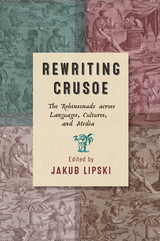
Rewriting Crusoe
The Robinsonade across Languages, Cultures, and Media
Jakub Lipski
Bucknell University Press, 2020
Published in 1719, Defoe’s Robinson Crusoe is one of those extraordinary literary works whose importance lies not only in the text itself but in its persistently lively afterlife. German author Johann Gottfried Schnabel—who in 1731 penned his own island narrative—coined the term “Robinsonade” to characterize the genre bred by this classic, and today hundreds of examples can be identified worldwide. This celebratory collection of tercentenary essays testifies to the Robinsonade’s endurance, analyzing its various literary, aesthetic, philosophical, and cultural implications in historical context. Contributors trace the Robinsonade’s roots from the eighteenth century to generic affinities in later traditions, including juvenile fiction, science fiction, and apocalyptic fiction, and finally to contemporary adaptations in film, television, theater, and popular culture. Taken together, these essays convince us that the genre’s adapt- ability to changing social and cultural circumstances explains its relevance to this day.
Published by Bucknell University Press. Distributed worldwide by Rutgers University Press.
Published by Bucknell University Press. Distributed worldwide by Rutgers University Press.
[more]
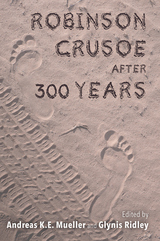
Robinson Crusoe after 300 Years
Andreas K. E. Mueller
Bucknell University Press, 2021
There is no shortage of explanations for the longevity of Defoe’s Robinson Crusoe, which has been interpreted as both religious allegory and frontier myth, with Crusoe seen as an example of the self-sufficient adventurer and the archetypal colonizer and capitalist. Defoe’s original has been reimagined multiple times in legions of Robinsonade or castaway stories, but the Crusoe myth is far from spent. This wideranging collection brings together eleven scholars who suggest new and unfamiliar ways of thinking about this most familiar of works, and who ask us to consider the enduring appeal of “Crusoe,” more recognizable today than ever before.
[more]
READERS
Browse our collection.
PUBLISHERS
See BiblioVault's publisher services.
STUDENT SERVICES
Files for college accessibility offices.
RECENTLY PUBLISHED





UChicago Accessibility Resources
home | accessibility | search | about | contact us
BiblioVault ® 2001 - 2026
The University of Chicago Press