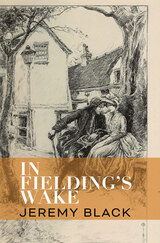
front cover of In Fielding’s Wake
In Fielding’s Wake
Jeremy Black
St. Augustine's Press, 2022
In the second volume of The Weight of Words Series, Jeremy Black continues his efforts to present and preserve Britain's literary genius. Its intelligence and enduring influence is in large part reliant on the underlining conservatism that has motivated authors such as Agatha Christie (Black's earlier subject) and Henry Fielding alike. 

Fielding's epic comic novel, Tom Jones, is unforgettable for many reasons, but the author must be credited with an aptitude for documenting contemporary cultural history and his contribution to a new species of writing. Black's treatment of Fielding draws to the fore a man who was of his time but not confined to it. "Philosophy in practice encompassed his stance as a man of action as well as a reflective writer of genius." Fielding is shown to provide across the breadth of his work extensive and invaluable commentary on issues as diverse as law and order, marriage, women, and the interplay of urban and rural life. Black, an historian, is here a student of storytelling and recovers Fielding's rich descriptions of the human heart and call to defy the vices with which circumstances might taunt it.

Black has done a service along many fronts at once: the science of the novel and genre, the history of a people and the figure of a memorable writer. 
[more]

front cover of Towards the Ethics of Form in Fiction
Towards the Ethics of Form in Fiction
Narratives of Cultural Remission
Leona Toker
The Ohio State University Press, 2010
Scholars and critics have long recognized the need for ethical criticism to address not only the idea-content but also the morphological aspects of narrative, yet the search continues for ways to study the ethics of narrative form. In Towards the Ethics of Form in Fiction: Narratives of Cultural Remission, Leona Toker suggests a method of linking formal features of narratives with the types of moral vision that they represent.
 
Toker is especially interested in cultural remissions such as the carnivalesque—that is, the inverting of standard cultural hierarchies or the blurring of boundaries between normally separated social groups, actors and audiences, self and other. She argues that cultural remissions have the potential not simply to provide a break from the determinacies of our quotidian existence but also to return us to that existence with some alteration of our perceptions, beliefs, and values. Toker contends that the ethical consequences of reading fiction result from features of its aesthetics, particularly what she calls, following the semiotician Louis Hjemslev, “the form of the content”—the patterns arising from the artistic deployment of narrative details. In addition to addressing the carnivalesque discourse of Bakhtin as well as the theory of oppositionality developed by de Certeau and Chambers, she puts theory into practice through detailed analyses of canonical texts by Fielding, Sterne, Austen, Hawthorne, Dickens, Conrad, Joyce, and other writers.

 
 
[more]


Send via email Share on Facebook Share on Twitter