
 A SCHOLARLY BOOK REPOSITORY
Results by Title
5 books about 1753-1784
5 books about 1753-1784
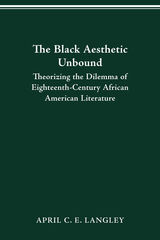
The Black Aesthetic Unbound
Theorizing the Dilemma of Eighteenth-Century African American Literature
April C. E. Langley
The Ohio State University Press, 2007
During the era of the slave trade, more than 12 million Africans were brought as slaves to the Americas. Their memories, ideas, beliefs, and practices would forever reshape its history and cultures. April C. E. Langley’s The Black Aesthetic Unbound exposes the dilemma of the literal, metaphorical, and rhetorical question, "What is African in African American literature?" Confronting the undeniable imprints of West African culture and consciousness in early black writing such as Olaudah Equiano’s The Interesting Narrative or Phillis Wheatley’s poetry, the author conceives eighteenth-century Black Experience to be literally and figuratively encompassing and inextricably linked to Africa, Europe, and America.
Consequently, this book has three aims: to locate the eighteenth century as the genesis of the cultural and historical movements which mark twentieth-century black aestheticism—known as the Black Aesthetic; to analyze problematic associations of African identity as manifested in an essentialized Afro-America; and to study the relationship between specific West African modes of thought and expression and the emergence of a black aesthetic in eighteenth-century North America. By exploring how Senegalese, Igbo, and other West African traditions provide striking new lenses for reading poetry and prose by six significant writers, Langley offers a fresh perspective on this important era in our literary history. Ultimately, the author confronts the difficult dilemma of how to use diasporic, syncretic, and vernacular theories of Black culture to think through the massive cultural transformations wrought by the Middle Passage.
Consequently, this book has three aims: to locate the eighteenth century as the genesis of the cultural and historical movements which mark twentieth-century black aestheticism—known as the Black Aesthetic; to analyze problematic associations of African identity as manifested in an essentialized Afro-America; and to study the relationship between specific West African modes of thought and expression and the emergence of a black aesthetic in eighteenth-century North America. By exploring how Senegalese, Igbo, and other West African traditions provide striking new lenses for reading poetry and prose by six significant writers, Langley offers a fresh perspective on this important era in our literary history. Ultimately, the author confronts the difficult dilemma of how to use diasporic, syncretic, and vernacular theories of Black culture to think through the massive cultural transformations wrought by the Middle Passage.
[more]

Foremother Love
Phillis Wheatley and Black Feminist Criticism
Dana Murphy
Duke University Press, 2025
In Foremother Love, Dana Murphy examines the importance of eighteenth-century poet Phillis Wheatley as a foundational figure for Black feminist criticism. Murphy establishes Phillis (as she refers to her) as a writer who wrote in response to and in conversation with other creators as well as a critic who was invested in sharing, explaining, and evaluating her own and others’ work and contexts. Indeed, Phillis played a key role in the development of what Murphy calls “foremother love”—the Black feminist depiction of the love of an unrelated feminist ancestor as a legitimate relation for the practice of inheritance, mourning, liberation, and friendship. Drawing on the work of Barbara Christian, June Jordan, Audre Lorde, Barbara Smith, and others, Murphy shows that Black feminist criticism becomes a transhistorical theorization when read in conjunction with Phillis’s labor and vision. Revealing how Phillis lives on in Black feminist criticism, Murphy contends that foremother love is an ethic of critical care that implores readers to recognize the affective labor of all those working in the field.
[more]
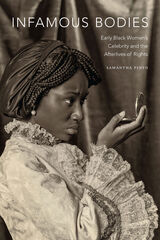
Infamous Bodies
Early Black Women’s Celebrity and the Afterlives of Rights
Samantha Pinto
Duke University Press, 2020
The countless retellings and reimaginings of the private and public lives of Phillis Wheatley, Sally Hemings, Sarah Baartman, Mary Seacole, and Sarah Forbes Bonetta have transformed them into difficult cultural and black feminist icons. In Infamous Bodies, Samantha Pinto explores how histories of these black women and their ongoing fame generate new ways of imagining black feminist futures. Drawing on a variety of media, cultural, legal, and critical sources, Pinto shows how the narratives surrounding these eighteenth- and nineteenth-century celebrities shape key political concepts such as freedom, consent, contract, citizenship, and sovereignty. Whether analyzing Wheatley's fame in relation to conceptions of race and freedom, notions of consent in Hemings's relationship with Thomas Jefferson, or Baartman's ability to enter into legal contracts, Pinto reveals the centrality of race, gender, and sexuality in the formation of political rights. In so doing, she contends that feminist theories of black women's vulnerable embodiment can be the starting point for future progressive political projects.
[more]

Loose Ends
Closure and Crisis in the American Social Text
Russell Reising
Duke University Press, 1996
In this study of American cultural production from the colonial era to the present, Russell Reising takes up the loose ends of popular American narratives to craft a new theory of narrative closure. In the range of works examined here—from Phillis Wheatley’s poetry to Herman Melville’s Israel Potter , from Henry James’s "The Jolly Corner" to the Disney Studio’s Dumbo—Reising finds endings that violate all existing theories of closure and narratives that expose the the often unarticulated issues that inspired these texts.
Reising suggests that these "non-endings" entirely refocus the narrative structures they appear to conclude, accentuate the narrative stresses and ideological fissures that the texts seem to suppress, and reveal "shadow narratives" that trail alongside the dominant story line. He argues that unless the reader notices the ruptures in the closing moments of these works, the social and historical moments in which the narrative and the reader are embedded will be missed. This reading not only offers new interpretive possibilities, but also uncovers startling affinities between the poetry of Phillis Wheatley and the fiction of Henry James, between Charles Brockden Brown’s Wieland and Melville’s least-studied novel, and between Emily Dickinson’s poem "I Started Early—Took My Dog" and Disney’s animated classic.
Pursuing the implications of these failed moments of closure, Reising elaborates on topics ranging from the roots of domestic violence and mass murder in early American religious texts to the pornographic imperative of mid-century nature writing, and from James’s "descent" into naturalist and feminist fiction to Dumbo’s explosive projection of commercial, racial, and political agendas for postwar U. S. culture.
Reising suggests that these "non-endings" entirely refocus the narrative structures they appear to conclude, accentuate the narrative stresses and ideological fissures that the texts seem to suppress, and reveal "shadow narratives" that trail alongside the dominant story line. He argues that unless the reader notices the ruptures in the closing moments of these works, the social and historical moments in which the narrative and the reader are embedded will be missed. This reading not only offers new interpretive possibilities, but also uncovers startling affinities between the poetry of Phillis Wheatley and the fiction of Henry James, between Charles Brockden Brown’s Wieland and Melville’s least-studied novel, and between Emily Dickinson’s poem "I Started Early—Took My Dog" and Disney’s animated classic.
Pursuing the implications of these failed moments of closure, Reising elaborates on topics ranging from the roots of domestic violence and mass murder in early American religious texts to the pornographic imperative of mid-century nature writing, and from James’s "descent" into naturalist and feminist fiction to Dumbo’s explosive projection of commercial, racial, and political agendas for postwar U. S. culture.
[more]
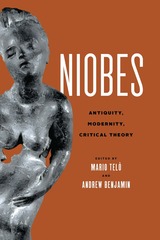
Niobes
Antiquity, Modernity, Critical Theory
Edited by Mario Telò and Andrew Benjamin
The Ohio State University Press, 2024
A marginalized but persistent figure of Greek tragedy, Niobe, whose many children were killed by Apollo and Artemis, embodies yet problematizes the philosophically charged dialectics between life and death, mourning and melancholy, animation and inanimation, silence and logos. The essays in Niobes present her as a set of complex figurations, an elusive mythical character but also an overdetermined figure who has long exerted a profound influence on various modes of modern thought, especially in the domains of aesthetics, ethics, psychoanalysis, and politics. As a symbol of both exclusion and resistance, Niobe calls for critical attention at a time of global crisis. Reconstructing the dialogues of Phillis Wheatley, G. W. F. Hegel, Walter Benjamin, Aby Warburg, and others with Niobe as she appears in Aeschylus, Sophocles, Ovid, and the visual arts, a collective of major thinkers—classicists, art historians, and critical theorists—reflect on the space that she can occupy in the humanities today. Inspiring new ways of connecting the classical tradition and ancient tragic discourse with crises and political questions relating to gender, race, and social justice, Niobe insists on living on. Contributors: Barbara Baert, Andrew Benjamin, drea brown, Adriana Cavarero, Rebecca Comay, Mildred Galland-Szymkowiak, John T. Hamilton, Paul A. Kottman, Jacques Lezra, Andres Matlock, Ben Radcliffe, Victoria Rimell, Mario Telò, Mathura Umachandran, Daniel Villegas Vélez
[more]
READERS
Browse our collection.
PUBLISHERS
See BiblioVault's publisher services.
STUDENT SERVICES
Files for college accessibility offices.
RECENTLY PUBLISHED



UChicago Accessibility Resources
home | accessibility | search | about | contact us
BiblioVault ® 2001 - 2026
The University of Chicago Press