
 A SCHOLARLY BOOK REPOSITORY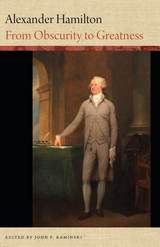
Editor John P. Kaminski has gathered a remarkable collection of quotations by and about Alexander Hamilton that paint for us a nuanced portrait of a complex man. Through his own words and the words of his contemporaries -- including the man who killed him in a duel, Aaron Burr -- we can gain a better understanding of this fascinating man who rose from anonymity on a small Caribbean island to the corridors of power.
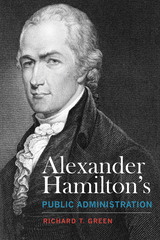
American public administration inherited from Alexander Hamilton a distinct republican framework through which we derive many of our modern governing standards and practices. His administrative theory flowed from his republican vision, prescribing not only the how of administration but also what should be done and why. Administration and policy merged seamlessly in his mind, each conditioning the other. His Anti-Federalist detractors clearly saw this and fought his vision tooth and nail.
That conflict endures to this day because Americans still have not settled on just one vision of the American republic. That is why, Richard Green argues, Hamilton is a pivotal figure in our current reckoning. If we want to more fully understand ourselves and our ways of governing today, we must start by understanding Hamilton, and we cannot do that without exploring his administrative theory and practice in depth.
Alexander Hamilton’s Public Administration considers Hamilton both as a founder of the American republic, steeped in the currents of political philosophy and science of his day, and as its chief administrative theorist and craftsman, deeply involved in establishing the early institutions and policies that would bring his interpretation of the written Constitution to life. Accordingly, this book addresses the complex mix of classical and modern ideas that informed his vision of a modern commercial and administrative republic; the administrative ideas, institutions, and practices that flowed from that vision; and the substantive policies he deemed essential to its realization. Green’s analysis grows out of an immersion in Hamilton’s extant papers, including reports, letters, pamphlets, and essays. Readers will find a comprehensive explanation of his theoretical contributions and a richly detailed account of his ideas and practices in historical context.
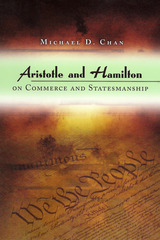
Although America’s founders may have been inspired by the political thought of ancient Greece and Rome, the United States is more often characterized by its devotion to the pursuit of commerce. Some have even said that a modern commercial republic such as the United States unavoidably lowers its moral horizon to little more than a concern with securing peace and prosperity so that commerce can flourish.
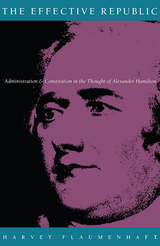
Although Hamilton exterted an extraordinary influence on American institutions, his contribution and the thinking behind it often have been obscured and misconstrued by piecemeal approaches to his voluminous writings. Here, Flaumenhaft draws upon more than two dozen volumes of Hamilton’s papers to produce a comprehensive account of his thought on the principles of politics—the account which Hamilton himself hoped to give in a multivolume treatise, but died before producing.
Beginning with a discussion of the place of general principles in Hamilton’s thought, The Effective Republic proceeds to his views on popular representation as a safeguard of individual liberty. Flaumenhaft then elaborates on Hamilton’s thinking about efficacious administration, especially how the President and Senate meet the requirements of unity and duration in a republic, and on the importance of an independent judiciary for constitutional integrity. What emerges clearly as Hamilton’s chief concern is the need to make government not only safe but effective—hindered from doing harm by its popular base, but also, through the differentiation of administrative powers and tasks, capable of doing good.
Interpreting, linking, and, and arranging Hamilton’s words, Flaumenhaft allows Hamilton to speak for himself, to explain his benificiaries his vision of what the republican experiment needed in order to succeed.

Historians on Hamilton brings together a collection of top scholars to explain the Hamilton phenomenon and explore what it might mean for our understanding of America’s history. The contributors examine what the musical got right, what it got wrong, and why it matters. Does Hamilton’s hip-hop take on the Founding Fathers misrepresent our nation’s past, or does it offer a bold positive vision for our nation’s future? Can a musical so unabashedly contemporary and deliberately anachronistic still communicate historical truths about American culture and politics? And is Hamilton as revolutionary as its creators and many commentators claim?
Perfect for students, teachers, theatre fans, hip-hop heads, and history buffs alike, these short and lively essays examine why Hamilton became an Obama-era sensation and consider its continued relevance in the age of Trump. Whether you are a fan or a skeptic, you will come away from this collection with a new appreciation for the meaning and importance of the Hamilton phenomenon.
READERS
Browse our collection.
PUBLISHERS
See BiblioVault's publisher services.
STUDENT SERVICES
Files for college accessibility offices.
RECENTLY PUBLISHED




UChicago Accessibility Resources
home | accessibility | search | about | contact us
BiblioVault ® 2001 - 2026
The University of Chicago Press