front cover of 1650-1850
1650-1850
Ideas, Aesthetics, and Inquiries in the Early Modern Era (Volume 28)
Kevin L. Cope
Bucknell University Press, 2023
Rigorously inventive and revelatory in its adventurousness, 1650–1850 opens a forum for the discussion, investigation, and analysis of the full range of long-eighteenth-century writing, thinking, and artistry. Combining fresh considerations of prominent authors and artists with searches for overlooked or offbeat elements of the Enlightenment legacy, 1650–1850 delivers a comprehensive but richly detailed rendering of the first days, the first principles, and the first efforts of modern culture. Its pages open to the works of all nations and language traditions, providing a truly global picture of a period that routinely shattered boundaries. Volume 28 of this long-running journal is no exception to this tradition of focused inclusivity. Readers will experience two blockbuster multi-author special features that explore both the deep traditions and the new frontiers of early modern studies: one that views adaptation and digitization through the lens of “Sterneana,” the vast literary and cultural legacy following on the writings of Laurence Sterne, a legacy that sweeps from Hungarian renditions of the puckish novelist through the Bloomsbury circle and on into cybernetics, and one that pays tribute to legendary scholar Irwin Primer by probing the always popular but also always challenging writings of that enigmatic poet-philosopher, Bernard Mandeville. All that, plus the usual cavalcade of full-length book reviews.

ISSN: 1065-3112

Published by Bucknell University Press, distributed worldwide by Rutgers University Press.
[more]

front cover of 1650-1850
1650-1850
Ideas, Aesthetics, and Inquiries in the Early Modern Era (Volume 29)
Kevin L. Cope
Bucknell University Press, 2024

Exploratory, investigative, and energetically analytical, 1650–1850 covers the full expanse of long-eighteenth-century thought, writing, and art while delivering abundant revelatory detail. Essays on well-known cultural figures combine with studies of emerging topics to unveil a vivid rendering of a dynamic period, simultaneously committed to singular genius and universal improvement. Welcoming research on all nations and language traditions, 1650–1850 invites readers into a truly global Enlightenment. Topics in volume 29 include Samuel Johnson’s notions about the education of women and a refreshing account of Sir Joseph Banks’s globetrotting. A guest-edited, illustration-rich, interdisciplinary special feature explores the cultural implications of water. As always, 1650–1850 culminates in a bevy of full-length book reviews critiquing the latest scholarship on long-established specialties, unusual subjects, and broad reevaluations of the period.

ISSN 1065-3112

Published by Bucknell University Press, distributed worldwide by Rutgers University Press.

[more]

front cover of Advertising the Self in Renaissance France
Advertising the Self in Renaissance France
Lemaire, Marot, and Rabelais
Scott Francis
University of Delaware Press, 2019
Advertising the Self in Renaissance France is a study of how authors and readers are represented in printed editions of three major literary figures of the French Renaissance: Jean Lemaire de Belges, Clément Marot, and François Rabelais. Print culture is marked by an anxiety of reception that became much more pronounced with increasingly anonymous and unpredictable readerships in the sixteenth century. To allay this anxiety, authors, as well as editors and printers, turned to self-fashioning in order to sell not only their books, but also particular ways of reading. They advertised correct modes of reading as transformative experiences that helped the actual reader attain the image of the ideal reader held up by the text and paratext, experiences provided by selfless authors. Thus, authorial personae were constructed around the self-fashioning offered to readers, creating an interdependent relationship that anticipated modern advertising.

Published by University of Delaware Press. Distributed worldwide by Rutgers University Press.
 
[more]

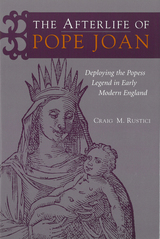
front cover of The Afterlife of Pope Joan
The Afterlife of Pope Joan
Deploying the Popess Legend in Early Modern England
Craig M. Rustici
University of Michigan Press, 2010
Amid the religious tumult of the sixteenth and seventeenth centuries, English scholars, preachers, and dramatists examined, debated, and refashioned tales concerning Pope Joan, a ninth-century woman who, as legend has it, cross-dressed her way to the papacy only to have her imposture exposed when she gave birth during a solemn procession.
 
The legend concerning a popess had first taken written form in the thirteenth century and for several hundred years was more or less accepted. The Reformation, however, polarized discussions of the legend, pitting Catholics, who denied the story’s veracity, against Protestants, who suspected a cover-up and instantly cited Joan as evidence of papal depravity. In this heated environment, writers reimagined Joan variously as a sorceress, a hermaphrodite, and even a noteworthy author.
 
The Afterlife of Pope Joan examines sixteenth- and seventeenth-century debates concerning the popess’s existence, uncovering the disputants’ historiographic methods, rules of evidence, rhetorical devices, and assumptions concerning what is probable and possible for women and transvestites. Author Craig Rustici then investigates the cultural significance of a series of notions advanced in those debates: the claim that Queen Elizabeth I was a popess in her own right, the charge that Joan penned a book of sorcery, and the curious hypothesis that the popess was not a disguised woman at all but rather a man who experienced a sort of spontaneous sex change.
  
The Afterlife of Pope Joan draws upon the discourses of religion, politics, natural philosophy, and imaginative literature, demonstrating how the popess functioned as a powerful rhetorical instrument and revealing anxieties and ambivalences about gender roles that persist even today. 
 
Craig M. Rustici is Associate Professor of English at Hofstra University.
[more]

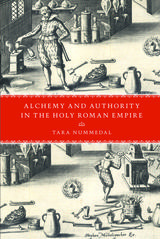
front cover of Alchemy and Authority in the Holy Roman Empire
Alchemy and Authority in the Holy Roman Empire
Tara Nummedal
University of Chicago Press, 2007
What distinguished the true alchemist from the fraud? This question animated the lives and labors of the common men—and occasionally women—who made a living as alchemists in the sixteenth- and seventeenth-century Holy Roman Empire. As purveyors of practical techniques, inventions, and cures, these entrepreneurs were prized by princely patrons, who relied upon alchemists to bolster their political fortunes. At the same time, satirists, artists, and other commentators used the figure of the alchemist as a symbol for Europe’s social and economic ills.

Drawing on criminal trial records, contracts, laboratory inventories, satires, and vernacular alchemical treatises, Alchemy and Authority in the Holy Roman Empire situates the everyday alchemists, largely invisible to modern scholars until now, at the center of the development of early modern science and commerce. Reconstructing the workaday world of entrepreneurial alchemists, Tara Nummedal shows how allegations of fraud shaped their practices and prospects. These debates not only reveal enormously diverse understandings of what the “real” alchemy was and who could practice it; they also connect a set of little-known practitioners to the largest questions about commerce, trust, and intellectual authority in early modern Europe.
[more]

front cover of Alva Ixtlilxochitl's Native Archive and the Circulation of Knowledge in Colonial Mexico
Alva Ixtlilxochitl's Native Archive and the Circulation of Knowledge in Colonial Mexico
Amber Brian
Vanderbilt University Press, 2016
Modern Language Association's Katherine Singer Kovacs Prize, Honorable Mention, 2016

Born between 1568 and 1580, Alva Ixtlilxochitl was a direct descendant of Ixtlilxochitl I and Ixtlilxochitl II, who had been rulers of Texcoco, one of the major city-states in pre-Conquest Mesoamerica. After a distinguished education and introduction into the life of the empire of New Spain in Mexico, Ixtlilxochitl was employed by the viceroy to write histories of the indigenous peoples in Mexico. Engaging with this history and delving deep into the resultant archives of this life's work, Amber Brian addresses the question of how knowledge and history came to be crafted in this era.

Brian takes the reader through not only the history of the archives itself, but explores how its inheritors played as crucial a role in shaping this indigenous history as the author. The archive helped inspire an emerging nationalism at a crucial juncture in Latin American history, as Creoles and indigenous peoples appropriated the history to give rise to a belief in Mexican exceptionalism. This belief, ultimately, shaped the modern state and impacted the course of history in the Americas. Without the work of Ixtlilxochitl, that history would look very different today.
[more]

front cover of Baroque Times in Old Mexico
Baroque Times in Old Mexico
Seventeenth-Century Persons, Places, and Practices
Irving A. Leonard
University of Michigan Press, 1959

This book opens a window on a forgotten and glorious time—the life of colonial Mexico. Here is the color of that era in a mosaic of life—a worldly ambitious archbishop, a beautiful nun-poetess, a Creole scholar torn between faith and scientific learning, poetasters, inquisitors—and in the background, the first glimmers of Mexican nationalism. Baroque in its intricate pattern of caste and custom, rich with silver pouring from its mines, the feudal society of Old Mexico lives in this account of a vanished time.

[more]

front cover of The Chinese in Maritime Southeast Asia
The Chinese in Maritime Southeast Asia
Trade and Merchant Communities in 17th-century Insulindia
Marie-Sybille de Vienne
National University of Singapore Press, 2025
An in-depth exploration of the Dutch East-India Company and what its history reveals about the Chinese community in the Dutch East Indies.

Connections between Asian and European markets increased dramatically in the seventeenth century, indicating a turning point in the global history of trade.  The Dutch East-India Company (or VOC) was central to this process; however, counter to the VOC’s aims, the winners of the game in maritime Southeast Asia were often Chinese merchants. As this book shows, at the time, these merchants were the only economic agents capable of trading both in major Southeast Asian commercial hubs and developing exchanges with China and Japan. The Chinese operated with a flexibility of means and a fluidity of management that allowed them to react rapidly and quickly gain returns on investment. In Batavia, as in other Southeast Asian emporiums, the increasingly numerous and diverse Chinese elites assumed direct responsibility for the management of their community; this made them the most important non-European free community in the city during the second half of the seventeenth century.

The Chinese in Maritime Southeast Asia tells this remarkable story through an examination of the VOC’s abundant sources, which record relations between the Chinese minority and the Dutch rulers who relied upon them.
[more]

front cover of The Complete Fables of Jean de la Fontaine
The Complete Fables of Jean de la Fontaine
Jean de la Fontaine, edited and with a rhymed verse translation by Norman B. Spector
Northwestern University Press, 1988
This edition of The Complete Fables of Jean de la Fontaine includes an English translation published alongside the French text. Norman Spector adapted the French text from the 1883–85 edition by Henri Régnier, adding four tales from the 1962 edition by Georges Couton. Spector’s translation is in rhymed verse, and remains faithful to the original not only in metrical patterns and rhyme schemes but also in tone: wit and le mot juste are skillfully and wonderfully combined. This translation gives the reader of English a chance to enjoy the grace, wit, and versatility of La Fontaine.
[more]

front cover of Cultivating Peace
Cultivating Peace
The Virgilian Georgic in English, 1650-1750
Schoenberger, Melissa
Bucknell University Press, 2019
During the decades following the English civil wars, British poets seeking to make sense of lingering political instabilities turned to Virgil’s Georgics. This ancient poem betrays deep ambivalences about war, political power, and empire, and such poets as Andrew Marvell, John Dryden, and Anne Finch found in these attitudes valuable ways of responding to the uncertainties of their own time. Composed during a period of brutal conflict in Rome, Virgil’s agricultural poem distrusts easy stability, urging its readers to understand that lasting peace must be sowed, tended, reaped, and replanted, year after year. Like the ancient poet, who famously depicted a farmer’s scythe suddenly recast as a sword, the poets discussed in Cultivating Peace imagine states of peace and war to be fundamentally and materially linked. In distinct ways, they dismantle the dream of the golden age renewed, proposing instead that peace must be sustained by constant labor.

Published by Bucknell University Press. Distributed worldwide by Rutgers University Press.
[more]

front cover of Culture and Language at Crossed Purposes
Culture and Language at Crossed Purposes
The Unsettled Records of American Settlement
Jerome McGann
University of Chicago Press, 2022
Culture and Language at Crossed Purposes unpacks the interpretive problems of colonial treaty-making and uses them to illuminate canonical works from the period.

Classic American literature, Jerome McGann argues, is haunted by the betrayal of seventeenth- and eighteenth-century Indian treaties—“a stunned memory preserved in the negative spaces of the treaty records.” A noted scholar of the “textual conditions” of literature, McGann investigates canonical works from the colonial period, including the Arbella sermon and key writings of William Bradford, John Winthrop, Anne Bradstreet, Cotton Mather’s Magnalia, Benjamin Franklin’s celebrated treaty folios and Autobiography, and Thomas Jefferson’s Notes on the State of Virginia. These are highly practical, purpose-driven works—the record of Enlightenment dreams put to the severe test of dangerous conditions. McGann suggests that the treaty-makers never doubted the unsettled character of what they were prosecuting, and a similar conflicted ethos pervades these works. Like the treaty records, they deliberately test themselves against stringent measures of truth and accomplishment and show a distinctive consciousness of their limits and failures. McGann’s book is ultimately a reminder of the public importance of truth and memory—the vocational commitments of humanist scholars and educators.  
[more]

front cover of Curtain Calls
Curtain Calls
British and American Women and the Theater, 1660–1820
Mary A. Schofield
Ohio University Press, 1991

“I here and there o’heard a Coxcomb cry,
Ah, rot—’tis a Woman’s Comedy.”

Thus Aphra Behn ushers in a new era for women in the British Theatre (Sir Patient Fancy, 1678). In the hundred years that were to follow—and exactly those years that Curtain Calls examines—women truly took the theater world by storm.

For each woman who chose a career in the theater world of the eighteenth century, there is a unique tale of struggle, insult, success, good or bad fortune, disaster, seduction, or fame. Whether acting, writing, reviewing, or stage managing, women played a major, if frequently unacknowledged, role in the history of the theater from the late seventeenth through the early nineteenth centuries. From Alpha Behn’s earliest plays through the glorious celebrity of Sara Siddons, women molded the taste of the age and carved out in the theater one of the few available opportunities for independence and renown.

Not all the women who tried succeeded, of course, and even the best faced opposition as they challenged the male stronghold of playwriting and theater managing. Curtain Calls maps the new territory as these pioneering women staked it for their own; it chronicles their lives, their triumphs, and their losses.

We begin with Aphra Behn, whose first play was staged in 1670, and conclude in the early decades of the nineteenth century with Inchbald and Siddons. The one hundred and fifty years encompassed by their lives contain the careers of dozens of lesser–known women, a network, as Dr. Johnson would have it, encompassing both talent and tribulation.

Contributors include: Edward Langhans, Linda R. Payne, Pat Rogers, Maureen e. Mulvihill, Deborah Payne, Betty Rizzo, Ellen Donkin, Frances M. Kavenik, Jessica Munns, nancy Cotton, Edna L. Steevs, Doreen Saar, Jean B. Kern, Katherine M. Rogers, Constance Clark, William J. Burling, Judith Phillips Stanton, Douglas Butler, Rose Zimbardo, and the editors.

[more]

front cover of Digital Pedagogy in Early Modern Studies
Digital Pedagogy in Early Modern Studies
Method and Praxis
Edited by Andie Silva and Scott Schofield
Iter Press, 2023
A collection of essays on early modern digital humanities by leading scholars in the field.
 
This collection of essays focuses on teaching at the intersection of early modern literature, book history, and digital media. It considers how teaching different fields and methods of study can be enhanced and facilitated by digital technologies. The volume provides a snapshot of current thinking on digital pedagogy as practiced by leading scholars in the field and offers a series of models that may be adapted, personalized, and repurposed by future teachers seeking to bring digital methodologies to their classrooms. Supplementary materials for this title are available on the Iter Press website (iterpress.org): see under Books/Supplementary Materials.
 
[more]

front cover of Dramatic Extracts in Seventeenth-Century English Manuscripts
Dramatic Extracts in Seventeenth-Century English Manuscripts
Watching, Reading, Changing Plays
Laura Estill
University of Delaware Press, 2015

Throughout the seventeenth century, early modern play readers and playgoers copied dramatic extracts (selections from plays and masques) into their commonplace books, verse miscellanies, diaries, and songbooks. Dramatic Extracts in Seventeenth-Century English Manuscripts: Watching, Reading, Changing Plays is the first to examine these often overlooked texts, which reveal what early modern audiences and readers took, literally and figuratively, from plays. As this under-examined archival evidence shows, play readers and playgoers viewed plays as malleable and modular texts to be altered, appropriated, and, most importantly, used. These records provide information that is not available in other forms about the popularity and importance of early modern plays, the reasons plays appealed to their audiences, and the ideas in plays that most interested audiences.

Tracing the course of dramatic extracting from the earliest stages in the 1590s, through the prolific manuscript circulation at the universities, to the closure and reopening of the theatres, Estill gathers these microhistories to create a comprehensive overview of seventeenth-century dramatic extracts and the culture of extracting from plays. Dramatic Extracts in Seventeenth-Century English Manuscripts: Watching, Reading, Changing Plays explores new archival evidence (from John Milton’s signature to unpublished university plays) while also analyzing the popularity of perennial favorites such as Shakespeare’s The Tempest. The study of dramatic extracts is the study of particulars: particular readers, particular manuscripts, particular plays or masques, particular historic moments. As D. F. McKenzie puts it, “different readers [bring] the text to life in different ways.” By providing careful analyses of these rich source texts, this book shows how active play-viewing and play-reading (that is, extracting) ultimately led to changing the plays themselves, both through selecting and manipulating the extracts and positioning the plays in new contexts.


Published by University of Delaware Press. Distributed worldwide by Rutgers University Press.
 
[more]

front cover of Dystopias of Infamy
Dystopias of Infamy
Insult and Collective Identity in Early Modern Spain
Javier Irigoyen-García
Bucknell University Press, 2022
Insults, scorn, and verbal abuse—frequently deployed to affirm the social identity of the insulter—are destined to fail when that language is appropriated and embraced by the maligned group. In such circumstances, slander may instead empower and reinforce the collective identity of those perceived to be a threat to an idealized society. In this innovative study, Irigoyen-Garcia examines how the discourse and practices of insult and infamy shaped the cultural imagination, anxieties, and fantasies of early modern Spain. Drawing on sixteenth- and seventeenth-century literary works, archival research, religious and political literature, and iconographic documents, Dystopias of Infamy traces how the production of insults haunts the imaginary of power, provoking latent anxieties about individual and collective resistance to subjectification. Of particular note is Cervantes’s tendency to parody regulatory fantasies about infamy throughout his work, lampooning repressive law for its paradoxical potential to instigate the very defiance it fears.
[more]

front cover of Early Modern Studies after the Digital Turn
Early Modern Studies after the Digital Turn
Edited by Laura Estill, Diane K. Jakacki, Michael Ullyot
Iter Press, 2016
The essays collected in this volume address the digital humanities’ core tensions: fast and slow; surficial and nuanced; quantitative and qualitative. Scholars design algorithms and projects to process, aggregate, encode, and regularize historical texts and artifacts in order to position them for new and further interpretations. Every essay in this book is concerned with the human-machine dynamic, as it bears on early modern research objects and methods. The interpretive work in these pages and in the online projects discussed orients us toward the extensible future of early modern scholarship after the digital turn.
[more]

front cover of Economies of Praise
Economies of Praise
Value, Labor, and Form in Seventeenth-Century English Poetry
Ryan Netzley
Northwestern University Press, 2024

Reevaluates early modern poems of praise as, paradoxically, challenging an artistic economy that values exchange and productivity
 
Early modern poems of praise typically insist that they do not have a purpose or enact real labor beyond their effortless listing of laudable qualities. And yet the poets discussed in this study, including Ben Jonson, Andrew Marvell, Anne Bradstreet, Lucy Hutchinson, and John Milton, hint at an alternative aesthetic economy at work in their verse. Poetic praise, it turns out, might show us a social world outside the organizing principle of exchange.
 
In Economies of Praise: Value, Labor, and Form in Seventeenth‑Century English Poetry, Ryan Netzley explores how poems of praise imagine alternatives to market and gift economies and point instead to a self-contained aesthetic economy that works against a more expansive and productivist understanding of literary art. By depicting exchange as inconsequential, unproductive, and redundant rather than a necessary constituent of social order, these poems model for modern readers a world without the imperative to create, appraise, and repeatedly demonstrate one’s own value.

[more]

front cover of English Society
English Society
1580-1680
Wrightson, Keith
Rutgers University Press, 2003
English Society brings together the results of recent historiography, together with much original research by the author, to provide a fascinating picture of society and social change in the period. The first section of the book discusses some of the enduring characteristics of society: social stratification and social mobility, kinship, neighborliness, patronage and deference, courtship and family formation, relationships between husbands and wives, parents and children. The second half of the book charts the course of social change: problems of public order, crime and social control, educational and religious developments, and profound changes in popular culture brought about by the growth of popular literacy and the consolidation of the Protestant Reformation. At every point, Keith Wrightson brings his material to life with his arresting use of contemporary diaries and texts.
[more]

logo for University of Minnesota Press
Essaying Shakespeare
Karen Newman
University of Minnesota Press, 2009

A pioneering scholar of Shakespeare and early modern letters provides an overview of work in the field

For more than twenty-five years, Karen Newman has brought her critical acumen to bear on early modern studies. In this collection of her essays on Shakespeare—some acknowledged classics and others never before published—Newman shows how changing theoretical trends have shaped Shakespeare studies, from new historicism and gender studies to critical race studies and globalization.

Central to Newman’s work is social exchange, or the circulation of people and objects. At least two of these essays have had a powerful and lasting impact on Shakespeare studies: “Renaissance Family Politics and Shakespeare’s The Taming of the Shrew” and “‘And wash the Ethiop White’: Femininity and the Monstrous in Othello.” Three essays appear in print for the first time: an examination of clothing of the poor and the portrayal of the king as a beggar in Richard II; a stinging review of Harold Bloom’s book Shakespeare: The Invention of the Human; and a rethinking of claims about the globalization of culture and cultural translation.Essaying Shakespeare chronicles Newman’s own critical development to provide a significant map of critical work on Shakespeare.
[more]

front cover of The Fake Husband, A Comedy
The Fake Husband, A Comedy
Flaminio Scala
Iter Press, 2020
Scala’s The Fake Husband offers readers and performers an accessible English script which captures the comic brilliance of the commedia dell’arte. Expanded from an earlier scenario, Il marito (The Husband), the play presents characters originally created by members of the Gelosi troupe, in particular the stars Isabella Andreini and Sylvia Roncagli. Scala’s ability to capture the individual artistry of these women makes this script especially exciting and shows his appreciation of the towering contribution made by the female performers who joined the troupes in the 1560s. Also included is a comprehensive study of Scala’s place in the theatrical world and beyond.

The Other Voice in Early Modern Europe - The Toronto Series, volume 75
[more]

logo for University of London Press
Fasti Ecclesiae Anglicanae 1541–1857
The Welsh Dioceses XIV
Compiled by William H. Campbell
University of London Press, 2026

A detailed history of the Church of England’s Welsh dioceses, including the building of cathedrals and churches.

The volumes in this series trace the process of reorganization and reform that took place in the Church of England after the Norman conquest, with the building of new cathedrals, the establishment of new constitutions for their chapters, and the appointment of foreign clergy. In this period, when many documents are undated, the chronological framework is provided by the careers of bishops, dignitaries, canons, and cathedral priors.  

​This volume covers the years 1541 to 1857, with a focus on the Welsh dioceses. During this period, six new dioceses were created out of larger dioceses, with former abbey churches named as their cathedrals. These fourteen cathedrals were known as the New Foundation, as compared with the thirteen medieval secular cathedrals of the Old Foundation. Further substantial reorganization took place in the 1830s, and additional dioceses were created to meet the needs of the period. This volume offers a detailed and comprehensive account of the period, making it an essential research tool for historians.

[more]

front cover of Florence in the Forgotten Centuries, 1527-1800
Florence in the Forgotten Centuries, 1527-1800
A History of Florence and the Florentines in the Age of the Grand Dukes
Eric Cochrane
University of Chicago Press, 1976
The city of Florence has long been admired as the home of the brilliant artistic and literary achievement of the early Renaissance. But most histories of Florence go no further than the first decades of the sixteenth century. They thus give the impression that Florentine culture suddenly died with the generation of Leonardo, Machiavelli, and Andrea del Sarto.

Eric Cochrane shows that the Florentines maintained their creativity long after they had lost their position as the cultural leaders of Europe. When their political philosophy and historiography ran dry, they turned to the practical problems of civil administration. When their artists finally yielded to outside influence, they turned to music and the natural sciences. Even during the darkest days of the great economic depression of the late seventeenth and early eighteenth centuries, they succeeded in preserving—almost alone in Europe—the blessings of external peace and domestic tranquility.
[more]

front cover of For All Waters
For All Waters
Finding Ourselves in Early Modern Wetscapes
Lowell Duckert
University of Minnesota Press, 2017

Recent years have witnessed a surge in early modern ecostudies, many devoted to Shakespearean drama. Yet in this burgeoning discipline, travel writing appears moored in historicization, inorganic subjects are far less prevalent than organic ones, and freshwater sites are hardly visited. For All Waters explores these uncharted wetscapes. 

Lowell Duckert shows that when playwrights and travel writers such as Sir Walter Raleigh physically interacted with rivers, glaciers, monsoons, and swamps, they composed “hydrographies,” or bodily and textual assemblages of human and nonhuman things that dissolved notions of human autonomy and its singular narrativity. With a playful, punning touch woven deftly into its theoretical rigor, For All Waters disputes fantasies of ecological solitude that would keep our selves high and dry and that would try to sustain a political ecology excluding water and the poor. The lives of both humans and waterscapes can be improved simultaneously through direct engagement with wetness. 

For All Waters concludes by investigating waterscapes in peril today—West Virginia’s chemical rivers and Iceland’s vanishing glaciers—and outlining what we can learn from early moderns’ eco-ontological lessons. By taking their soggy and storied matters to heart, and arriving at a greater realization of our shared wetness, we can conceive new directions to take within the hydropolitical crises afflicting us today.

[more]

front cover of From the Blue Windows
From the Blue Windows
Recollections of Life in Queenstown, Singapore, in the 1960s and 1970s
Tan Kok Yang
National University of Singapore Press, 2013
Imagine a Singapore in which flat rental was S$50 a month, a plate of noodles cost as little as 20 cents, and television broadcasts ended at 10pm every night.
 From the Blue Windows is a collection of Tan Kok Yang's memories of growing up in Queenstown back when the tallest residential building there was fourteen storeys, the Alexandra Canal flooded regularly, and wayang shows were a regular feature on Mei Ling Street. He stayed in Princess Estate, an area that was colloquially known as "the Blue Windows" because of its unique blue glass louvred windows.


With nostalgia and a sense of loss, this memoir is a personal tribute to and celebration of Queenstown and a simple but fulfilling way of life that has all but vanished from modern Singapore.
[more]

front cover of The Gendering of Men, 1600–1750
The Gendering of Men, 1600–1750
The English Phallus
Thomas A. King
University of Wisconsin Press, 2004

    Taking on nothing less than the formation of modern genders and sexualities, Thomas A. King develops a history of the political and performative struggles that produced both normative and queer masculinities in the seventeenth and eighteenth centuries. The result is a major contribution to gender studies, gay studies, and theater and performance history.
    The Gendering of Men, 1600–1750 traces the transition from a society based on alliance, which had subordinated all men, women, and boys to higher ranked males, to one founded in sexuality, through which men have embodied their claims to personal and political privacy. King proposes that the male body is a performative production marking men’s resistance to their subjection within patriarchy and sovereignty. Emphasizing that categories of gender must come under historical analysis, The Gendering of Men explores men’s particpation in an ongoing struggle for access to a universal manliness transcending other biological and social differentials.

This is volume one of two projected volumes.

[more]

front cover of Giambattista Marino
Giambattista Marino
Adonis
Thomas E. Mussio
Arizona Center for Medieval and Renaissance Studies, 2019
This is the first complete translation in English of Giambattista Marino’s Adone, a poem of 20 cantos written in Italian and first published in 1623 in Paris. Although Marino’s work has been characterized as a mythological poem with the tragic tale of Venus and Adonis at its core and woven through with retellings of many Greek and Roman myths, it is clear that Marino strove to write more than an Italian version of Ovid’s Metamorphoses. The highly wrought descriptive passages that permeate the poem, the allusions to contemporary political figures and events, and the rich scientific, philosophical, and theological language of many passages reflect Marino’s particular poetic style, his broad interests, and his engagement with the political and intellectual scene of early seventeenth-century Europe. One of the goals of this translation is to provide a highly accessible version of the whole poem and to expand its readership to include not only students and scholars of the romance epic and the early modern period but also curious general readers. It is hoped that this modern, annotated translation will spur new research on Marino’s poem and bear new assessments of the poem’s relation to its sources, of its influence on later literature, and of its vital connection with key issues of Marino’s time, such as scientific advancement, discovery and exploration, and the power and influence of the Catholic Church.

Translated, with introduction and notes by Thomas E. Mussio.
[more]

logo for University College London
Global Goods and the Country House
Comparative Perspectives, 1650–1800
Edited by Jon Stobart
University College London, 2023
Fresh insights into the multi-directional flow of goods and cultures that enmeshed the eighteenth century.

Global goods were central to the material culture of eighteenth-century country houses. Across Europe, mahogany furniture, Chinese wallpapers, and Indian textiles formed the backdrop to genteel practices of drinking sweetened coffee, tea, and chocolate from Chinese porcelain. They tied these houses and their wealthy owners into global systems of supply and the processes of colonialism and empire.

Global Goods and the Country House builds on these narratives and then challenges them by decentering our perspective. It offers a comparative framework that explores the definition, ownership, and meaning of global goods outside the usual context of European imperial powers. What were global goods and what did they do for and mean to wealthy landowners in places at the “periphery” of Europe (Sweden and Wallachia), in the British colonies of North America and the Caribbean, or in the extra-colonial context (Japan or Rajasthan)? By placing these goods in their specific material context—from the English country house to the princely palaces of Rajasthan—we gain a better understanding of their use and meaning and of their role in linking the global and the local.
 
[more]

front cover of Globalizing Chocolate and Tobacco
Globalizing Chocolate and Tobacco
Medical Exchange in the Early Modern World
Susan G. Polansky
Bucknell University Press, 2026

This groundbreaking volume explores two early and opposing Spanish medical perspectives on chocolate and other New World substances. In the early 1600s, doctors Bartolomé Marradón and Antonio Colmenero de Ledesma returned from travels to the Americas with starkly different views: Marradón cautioned against tobacco and offered only limited approval of chocolate, while Colmenero vigorously defended chocolate’s health benefits. Their writings, translated and circulated across Europe, helped transform chocolate from a medicinal drink into a global commodity. Featuring the first bilingual edition of Marradón’s Dialogue (1618)—in full Spanish and English—and a new bilingual presentation of Colmenero’s influential Curious Treatise (1631), this book provides rare insight into early modern medical thought, cultural exchange, and the globalization of taste. Essential for readers of food history, early modern medicine, and transatlantic interchange, it uniquely reveals how debates over health, culture, and commerce brewed in a cup of chocolate.

Published by Bucknell University Press. Distributed worldwide by Rutgers University Press.

[more]

front cover of He Words Me
He Words Me
Men Writing as Women in Early Modern England
Catherine Loomis
Arizona Center for Medieval and Renaissance Studies, 2026
A collection of works by early modern men writing in women’s voices.

This anthology gives students and scholars access to a body of texts that provide a clearer understanding of what life was like for early modern women by presenting hundreds of little-known primary texts that contain details about early modern women’s work, relationships, emotional and intellectual development, friendships, and daily struggles. He Words Me brings together work from a variety of genres in which male authors adopt the voice of a female narrator and use that voice to provide intimate details about the lives of women. 

These works introduce modern readers to less familiar genres, complement or contradict portrayals of women in canonical texts, and raise compelling questions about who speaks for women and when women can speak for themselves. Through these women’s voices, readers can encounter characters and experiences that will broaden their understanding of early modern English literature and culture, and of the history of women in the late sixteenth and early seventeenth centuries.
[more]

front cover of The Heretic of Cacheu
The Heretic of Cacheu
Crispina Peres and the Struggle over Life in Seventeenth-Century West Africa
Toby Green
University of Chicago Press, 2025
Tells the extraordinary story of seventeenth-century West African slave trader Crispina Peres to explore the shifting, sophisticated world in which she lived.
 
In 1665, Crispina Peres, the most powerful trader in the West African slave-trafficking port of Cacheu, was arrested by the Portuguese Inquisition. Her enemies had conspired to denounce her for taking treatments prescribed by Senegambian healers, the djabakós. But who was Peres? And why was the Inquisition so concerned with policing the faith of a West African woman in today’s Guinea-Bissau?
 
In The Heretic of Cacheu, award-winning historian Toby Green takes us to the heart of this conundrum, immersing us in the atmosphere of an otherwise distant setting. We learn how people in seventeenth-century Cacheu built their houses; styled their clothes; healed themselves from illness; and worshipped, worked, and played. Green renders the haunting realities of the growing slave trade and the rise of European empires in shocking detail. By the 1650s, the relationships between Europe, West Africa, and the Americas were already old and tangled, with slaving ports, colonies, and military bases having intermingled over many generations. But Cacheu also profoundly troubled this dynamic. It was globally connected to places ranging from China and India to Brazil and Colombia, and women such as Crispina Peres ran the town and challenged the patriarchy of empire.
 
For the first time, through surviving documents recording Peres’s case, The Heretic of Cacheu lets readers experience the reality of this unique place and time through a remarkable act of historical recovery.
[more]

front cover of The Involuntary American
The Involuntary American
A Scottish Prisoner's Journey to the New World
Carol R. Gardner
Westholme Publishing, 2024
A Common Man’s Survival After Being Captured at the Battle of Dunbar and Sold into Servitude in America 
In the winter of 1650–51, one hundred fifty ragged and hungry Scottish prisoners of war arrived at Massachusetts Bay Colony, where they were sold as indentured laborers for 20 to 30 pounds each. Among them was Thomas Doughty, a common foot soldier who had survived the Battle of Dunbar, a forced marched of 100 miles without food or water, imprisonment in Durham Cathedral, and a difficult Atlantic crossing. An ordinary individual who experienced extraordinary events, Doughty was among some 420 Scottish soldiers who were captured during the War of the Three Kingdoms, transported to America, and sold between 1650 and 1651. Their experiences offer a fresh perspective on seventeenth-­century life. 
The Involuntary American: A Scottish Prisoner’s Journey to the New World by Carol Gardner describes Doughty’s life as a soldier, prisoner of war, exile, servant, lumberman, miller, and ultimately free landowner. It follows him and his peers through critical events: the apex of the Little Ice Age, the War of the Three Kingdoms, the colonization of New England, the burgeoning transatlantic trade in servants and slaves, King Philip’s and King William’s wars, and the Salem witch crisis. First­person accounts of individuals who lived through those events—Scottish, English, Puritan, Native American, wealthy, poor, working class, educated or not— provide rich period detail and a variety of perspectives. 
The Involuntary American demonstrates how even indi­viduals of humble circumstances were swept into the mael­strom of the First Global Age. It expands our understanding of immigration to the colonies, colonial servitude, the link­ages and tensions between Europe, Massachusetts Bay, and America’s northeastern frontier, and of New England socie­ty in the early colonial period.
[more]

front cover of Involuntary Confessions of the Flesh in Early Modern France
Involuntary Confessions of the Flesh in Early Modern France
Nora Martin Peterson
University of Delaware Press, 2017

Involuntary Confessions of the Flesh in Early Modern France was inspired by the observation that small slips of the flesh (involuntary confessions of the flesh) are omnipresent in early modern texts of many kinds. These slips (which bear similarities to what we would today call the Freudian slip) disrupt and destabilize readings of body, self, and text—three categories whose mutual boundaries this book seeks to soften—but also, in their very messiness, participate in defining them. Involuntary Confessions capitalizes on the uncertainty of such volatile moments, arguing that it is instability itself that provides the tools to navigate and understand the complexity of the early modern world. Rather than locate the body within any one discourse (Foucauldian, psychoanalytic), this book argues that slips of the flesh create a liminal space not exactly outside of discourse, but not necessarily subject to it, either. Involuntary confessions of the flesh reveal the perpetual and urgent challenge of early modern thinkers to textually confront and define the often tenuous relationship between the body and the self. By eluding and frustrating attempts to contain it, the early modern body reveals that truth is as much about surfaces as it is about interior depth, and that the self is fruitfully perpetuated by the conflict that proceeds from seemingly irreconcilable narratives.

Interdisciplinary in its scope, Involuntary Confessions of the Flesh in Early Modern France pairs major French literary works of the sixteenth and seventeenth centuries (by Marguerite de Navarre, Montaigne, Madame de Lafayette) with cultural documents (confession manuals, legal documents about the application of torture, and courtly handbooks). It is the first study of its kind to bring these discourses into thematic (rather than linear or chronological) dialog. In so doing, it emphasizes the shared struggle of many different early modern conversations to come to terms with the body’s volatility.

Published by University of Delaware Press. Distributed worldwide by Rutgers University Press.
 

[more]

front cover of Jansenism
Jansenism
An International Anthology
Shaun Blanchard
Catholic University of America Press, 2024
Jansenism: An International Anthology is the first comprehensive anthology of Jansenist texts in English translation. Covering the full sweep of the Jansenist movement from the 1630s until the early nineteenth century, this anthology is a major asset to historians of early modernity, theologians, advanced and beginner students, and interested non-specialists. Readers of English can now directly hear the voices of the women and men, nuns and priests, and politicians and pamphleteers embroiled in some of the most dynamic controversies of early modern Christianity. While giving due attention to France, the anthology showcases the geographic breadth of Jansenism, from Portugal to Lebanon. Consequently, a team of translators have provided texts translated not just from French and Latin; selections from German, Spanish, Portuguese, Italian, and Arabic also appear here. Blanchard and Yoder present a diverse range of texts, including letters, tracts, periodical excerpts, books, treatises, and synodal documents. These readings cover the controversies over divine grace and penance for which Jansenism is infamous, but they also show the widening scope of Jansenists’ reformist concerns as the movement developed and changed. They address issues such as liturgical reform, devotion to Mary and the saints, politics, religious toleration, prayer, gender and the role of women in the Church, polemics, and ecclesiastical reform. The whole volume is introduced by an essay introducing Jansenism, exposing the important themes, summarizing the relevant scholarship, and contextualizing the content that will follow. Jansenism: An International Anthology provides the first port-of-call for the study of Jansenism in English. The anthology presents a diverse and rich selection of primary source texts and draws on the best recent research into the fascinating and controversial transnational phenomena called “Jansenism.”
[more]

front cover of Johnson in Japan
Johnson in Japan
Kimiyo Ogawa
Bucknell University Press, 2021
The study and reception of Samuel Johnson’s work has long been embedded in Japanese literary culture. The essays in this collection reflect that history and influence, underscoring the richness of Johnson scholarship in Japan, while exploring broader conditions in Japanese academia today. In examining Johnson’s works such as the Rambler (1750-52), Rasselas (1759), Lives of the Most Eminent English Poets (1779-81), and Journey to the Western Islands of Scotland (1775), the contributors—all members of the half-century-old Johnson Society of Japan—also engage with the work of other important English writers, namely Shakespeare, Mary Shelley, Jane Austen, and Matthew Arnold, and later Japanese writers, including Natsume Soseki (1867-1916). If the state of Johnson studies in Japan is unfamiliar to Western academics, this volume offers a unique opportunity to appreciate Johnson’s centrality to Japanese education and intellectual life, and to reassess how he may be perceived in a different cultural context.

Published by Bucknell University Press. Distributed worldwide by Rutgers University Press.
[more]

front cover of Lear’s Other Shadow
Lear’s Other Shadow
A Cultural History of Queen Lear
Thomas G. Olsen
University of Delaware Press, 2025
Lear’s Other Shadow: A Cultural History of Queen Lear offers a deep cultural analysis of the figure of Queen Lear, who shadows and eventually sometimes overshadows her royal husband across the nearly one-thousand-year life of this archetypal tale. What appears to be a deliberate strategy of suppression, even erasure in Shakespeare’s King Lear later inspired dozens of stage, page, and cinematic remakes and adaptations in which this figure is revived or remembered, often pointedly so. From Jacob Gordin’s Yiddish-language Miriele Efros (1898), through edgy stage remakes such as Gordon Bottomley’s King Lear’s Wife (1915) and the Women’s Theatre Group’s Lear’s Daughters (1987), to novelized retellings from Jane Smiley’s A Thousand Acres (1991) to Preti Taneja’s We That Are Young (2018) and J. R. Thorp’s Learwife (2021), and even the television series Empire (2015–2020) and Succession (2018–2023), Queen Lear regularly emerges from her shadowy origins to challenge how we understand the ancient King Leir/King Lear story. These and many other examples reveal fascinating patterns of adaptation and reinterpretation that Lear's Other Shadow identifies and analyzes for the first time, showing how and why Queen Lear is at the center of this ancient story, whether she is heard from or not.
[more]

front cover of The Limits of Matter
The Limits of Matter
Chemistry, Mining, and Enlightenment
Hjalmar Fors
University of Chicago Press, 2014
During the seventeenth and eighteenth centuries, Europeans raised a number of questions about the nature of reality and found their answers to be different from those that had satisfied their forebears. They discounted tales of witches, trolls, magic, and miraculous transformations and instead began looking elsewhere to explain the world around them. In The Limits of Matter, Hjalmar Fors investigates how conceptions of matter changed during the Enlightenment and pins this important change in European culture to the formation of the modern discipline of chemistry.
           
Fors reveals how, early in the eighteenth century, chemists began to view metals no longer as the ingredients for “chrysopoeia”—or gold making—but as elemental substances, or the basic building blocks of matter. At the center of this emerging idea, argues Fors, was the Bureau of Mines of the Swedish State, which saw the practical and profitable potential of these materials in the economies of mining and smelting.

By studying the chemists at the Swedish Bureau of Mines and their networks, and integrating their practices into the wider European context, Fors illustrates how they and their successors played a significant role in the development of our modern notion of matter and made a significant contribution to the modern European view of reality.
[more]

front cover of Mapping Wider Worlds
Mapping Wider Worlds
Early Modern Women's Travel Writing
Yoojung Choi
University of Delaware Press, 2027

Mapping Wider Worlds uncovers how early professional women writers in Britain invented a genre of women’s travel fiction in an era of increased mobility and exploration. As marketplace authorship began to take shape, writers such as Delarivier Manley, Mary Davys, Penelope Aubin, and Eliza Haywood turned to this genre to challenge the link between women’s travel and promiscuity, positioning travel instead as a site of knowledge production and self-discovery. In this book, Yoojung Choi reveals how these women authors not only reshaped cultural attitudes toward women’s mobility, but also redefined professional authorship in the late seventeenth and early eighteenth centuries, preceding and paving the way for travel literature by Lady Mary Wortley Montagu, Hester Piozzi, and Mary Wollstonecraft. 

[more]

front cover of Masculinity and Danger on the Eighteenth-Century Grand Tour
Masculinity and Danger on the Eighteenth-Century Grand Tour
Sarah Goldsmith
University of London Press, 2020
The Grand Tour, a customary trip through Europe undertaken by British nobility and wealthy landed gentry during the seventeenth and eighteenth centuries, played an important role in the formation of contemporary notions of elite masculinity. Through an examination of testimonies written by Grand Tourists, tutors, and their families, Sarah Goldsmith argues that the Grand Tour educated young men in a wide variety of skills, virtues, and vices that extended well beyond polite society.

Goldsmith demonstrates that the Grand Tour was a means of constructing Britain’s next generation of leaders. Influenced by aristocratic concepts of honor and inspired by military-style leadership, elite society viewed experiences of danger and hardship as powerfully transformative and therefore as central to constructing masculinity. Scaling mountains, volcanoes, and glaciers, and even encountering war and disease, Grand Tourists willingly tackled a variety of perils. Through her study of these dangers, Goldsmith offers a bold revision of eighteenth-century elite masculine culture and the critical role the Grand Tour played within it.
[more]

front cover of The Meaning of Shakespeare, Volume 2
The Meaning of Shakespeare, Volume 2
Troilus and Cressida, All's Well That Ends Well, Measure for Measure, Othello, Macbeth, King Lear, Timon of Athens, Antony and Cleopatra, Coriolanus, Pericles, Cymbeline, The Winter's Tale, The Tempest
Harold C. Goddard
University of Chicago Press, 1960
A classic, accessible guide to the plays of Shakespeare by a legendary teacher and scholar

Centuries after they were originally performed, the plays of Shakespeare continue to inspire, entertain, and awe audiences and readers today. At the same time, however, there's no question that even the most sophisticated reader can sometimes benefit from the insight and guidance of an expert when entering Shakespeare's long-gone world and complicated figurative language. 
 

William Goddard is here to help. He taught Shakespeare for decades as much-loved professor at Swarthmore College, and here he distills that experience into an accessible, engaging companion to the plays. Across two volumes, Goddard covers all of Shakespeare's plays and brings fresh insight to familiar characters, scenes, and verses. Goddard writes, "The greatest poetry has always depicted the world as a little citadel of nobility threatened by an immense barbarism, a flickering candle surrounded by infinite night" Shakespeare's candle still burns, and with Goddard's help we can all see it brighter than ever.

“I believe we are nearer the beginning than the end of our understanding of Shakespeare's genius . . . ”
 
[more]

front cover of Milton’s Moving Bodies
Milton’s Moving Bodies
Marissa Greenberg and Rachel Trubowitz
Northwestern University Press, 2024

A collection of innovative examinations of embodiment in Milton’s oeuvre that challenge assumptions about disciplinary boundaries

This volume brings unprecedented focus to the forms, spaces, and implications of embodied motion in Milton’s writing and its afterlives to explore how and why he privileges the body—human and textual—as a site of dynamic movement. The contributors bring a variety of lenses to Milton’s moving bodies: political history, kinematics, mathematics, cosmology, translation, illustration, anatomies of racialized and disabled bodies, and twenty-first-century pedagogies. From these wide-ranging vantage points, they consider anew Milton’s contributions to the histories of scientific development, global exploration and imperial expansion, migration and diaspora, and translation and adaptation in England, Europe, and the Americas, from the early modern period to today. Milton’s Moving Bodies draws together established and emerging scholars, offering fresh analyses of the poet’s legacy for multiple traditions within and beyond Milton studies.

[more]

front cover of Mobility and Migration
Mobility and Migration
East Anglian Founders of New England, 1629-1640
Roger Thompson
University of Massachusetts Press, 1994

During the 1630s, more than 14,000 people sailed from Britain bound for New England, constituting what has come to be known as the Great Migration. This book offers the most extensive study of these emigrants ever undertaken. Focusing on 2,000 individuals who moved from the five counties of eastern England, it provides historians with important new findings on mobility, family life, kinship networks, and community cohesion. 

Roger Thompson reveals the personal experiences and ancestral histories of the emigrants. He follows them across the Atlantic and investigates their lives and achievements in the New World. Distinguising between such groups as gentry, entrepreneurs, artisans, farmers, and servants, he explores whether the migration tended to be a solitary uprooting from a stable and predictable world of familiar neighborhoods or simply a longer move among many relocations.

Thompson also sheds light on the issue of motivation: Were these settlers pulled by the hope of eventual enrichment or of founding a purified society, or were they pushed by intolerance and persecution at home? Did they see New England as a haven of escape or an opportunity to exploit? Did New Englanders seek to replicate “English ways,” preserving traditional culture and society, or did they embrace change and innovation? Mobility and Migration provides a wealth of new evidence for historians of both early modern England and colonial America.

[more]

front cover of Neither Hee Nor Any of His Companie Did Return Againe
Neither Hee Nor Any of His Companie Did Return Againe
Failed Colonies in the Caribbean and Latin America, 1492–1865
David MacDonald
Westholme Publishing, 2023
During the sixteenth and seventeenth centuries European powers vied for control of the land and resources in the Caribbean and Latin America. Colonies made Spain rich through gold, silver, and gems looted from the Native cultures, along with rare and exotic goods such as tobacco, sugar, and dyewood, and even humble products such as hides. In rapid turn, other European monarchies and merchants sent out colonizing expeditions to the region to exploit the resources of the New World, but creating permanent footholds was perilous. All European settlements founded in the New World faced a variety of challenges, including food supply, inconsistent support from Europe, leadership, ignorance of the area colonized, irrational expectations, religious discord, relations with Native peoples, and violent national rivalries. Colonies that succeeded and those that failed faced the same challenges, although in differing degrees and circumstances. The margin between survival and disaster was always small—there were few chances to succeed and the risk of failure was never far away. 
   In Neither Hee Nor Any of His Companie Did Return Againe: Failed Colonies in the Caribbean and Latin America, 1492–1865, historians David MacDonald and Raine Waters examine the European, and later American, failures to establish permanent settlements in the region. Beginning with Columbus’s ill-conceived ventures, the authors discuss the efforts, from German claims in Venezuela and Scottish attempts in Panama to defeated Confederates fleeing to Mexico, Brazil, and elsewhere. For each colony, the primary source information is contextualized and evaluated. Along the way, the authors determine commonalities across these ill-fated colonies as well as underscore the fact that while Indigenous peoples of the region often vigorously resisted predatory European colonization, their numbers were decimated by relentless warfare, slave raids, and European diseases. As Indian populations declined, colonists imported African slaves in large numbers. The brutal treatment of slaves resulted in those who escaped creating their own settlements that existed in a state of endemic warfare with European colonists. An important contribution to Atlantic World studies, this volume reveals the fine line between colonies that thrived and those that failed.
[more]

front cover of New Technologies and Renaissance Studies
New Technologies and Renaissance Studies
Edited by William R. Bowen and Raymond G. Siemens
Iter Press, 2008
Near the forefront of any examination of disciplinary pursuits in the academy today, among the many important issues being addressed is the role of computing and its integration into, and perhaps revolutionizing of, central methodological approaches. The series New Technologies in Medieval and Renaissance Studies addresses this context from both broad and narrow perspectives, with anticipated discussions rooted in areas including literature, art history, musicology, and culture in the medieval and Renaissance periods.

The first volume of the series, New Technologies and Renaissance Studies, presents a collection of contributions to one ongoing forum for the dialogue which lies at the heart of the book series, the annual "conference within a conference" of the same name which takes place during the Renaissance Society of America gathering, dedicated specifically to the intersection of computational methods and Renaissance studies. Papers in this volume exemplify those fruitful and productive exchanges, from their inception at the 2001 meeting in Chicago to the 2005 meeting in Cambridge.
[more]

front cover of New Technologies and Renaissance Studies II
New Technologies and Renaissance Studies II
Edited by Tassie Gniady, Kris McAbee, Jessica Murphy
Iter Press, 2014
Near the forefront of any examination of disciplinary pursuits in the academy today, among the many important issues being addressed is the role of computing and its integration into, and perhaps revolutionizing of, central methodological approaches. The series New Technologies in Medieval and Renaissance Studies addresses this context from both broad and narrow perspectives, with anticipated discussions rooted in areas including literature, art history, musicology, and culture in the medieval and Renaissance periods.

In the fourth volume of the New Technologies in Medieval and Renaissance Studies series, volume editors Tassie Gniady, Kris McAbee, and Jessica Murphy bring together some of the best work from the New Technologies in Medieval and Renaissance Studies panels at the Renaissance Society of America (RSA) annual meetings for the years 2004–2010. These essays demonstrate a dedication to grounding the use of “newest” practices in the theories of the early modern period. At the same time, the essays are interested in the moment—the needs of scholars then, the theories of media that informed current understanding, and the tools used to conduct studies.
[more]

front cover of New Technologies and Renaissance Studies III
New Technologies and Renaissance Studies III
Edited by Matthew Evan Davis and Colin Wilder
Iter Press, 2022
These essays explore problems with digital approaches to analog objects and offer digital methods to study networks of production, dissemination, and collection. Further, they reflect on the limitations of those methods and speak to a central truth of digital projects: unlike traditional scholarship, digital scholarship is often the result of collective networks of not only disciplinary scholars but also of library professionals and other technical and professional staff as well as students.
 
[more]

front cover of New Ways of Looking at Old Texts, VI
New Ways of Looking at Old Texts, VI
Papers of the Renaissance English Text Society 2011-2016
Edited by Arthur F. Marotti
Arizona Center for Medieval and Renaissance Studies, 2019

front cover of Ottoman Explorations of the Nile
Ottoman Explorations of the Nile
Evliya Çelebi’s Map of the Nile and The Nile Journeys in the Book of Travels (Seyahatname)
Robert Dankoff, Nuran Tezcan, and Michael D. Sheridan
Gingko, 2018
Before the time of Napoleon, the most ambitious effort to explore and map the Nile was undertaken by the Ottomans, as attested by two monumental documents: an elaborate map, with 475 rubrics, and a lengthy travel account. Both were achieved at about the same time—c. 1685—and both by the same man.

Evliya Çelebi’s account of his Nile journeys, in the tenth volume of his Book of Travels (Seyahatname), has been known to the scholarly world since 1938, when that volume was first published. The map, held in the Vatican Library, has been studied since at least 1949. Numerous new critical editions of both the map and the text have been published over the years, each expounding upon the last in an attempt to reach a definitive version. The Ottoman Explorations of the Nile provides a more accurate translation of the original travel account. Furthermore, the maps themselves are reproduced in greater detail and vivid color, and there are more cross-references to the text than in any previous edition. This volume gives equal weight and attention to the two parts that make up this extraordinary historical document, allowing readers to study the map or the text independently, while also using each to elucidate and accentuate the details of the other. 
 
[more]

front cover of The Part and the Whole in Early American Literature, Print Culture, and Art
The Part and the Whole in Early American Literature, Print Culture, and Art
Matthew Pethers
Bucknell University Press, 2024

The essays in this pathbreaking collection consider the significance of varied early American fragmentary genres and practices—from diaries and poetry, to almanacs and commonplace books, to sermons and lists, to Indigenous ruins and other material shards and fragments—often overlooked by critics in a scholarly privileging of the “whole.” Contributors from literary studies, book history, and visual culture discuss a host of canonical and non-canonical figures, from Edward Taylor and Washington Irving to Mary Rowlandson and Sarah Kemble Knight, offering insight into the many intellectual, ideological, and material variations of “form” that populated the early American cultural landscape. As these essays reveal, the casting of the fragmentary as aesthetically eccentric or incomplete was a way of reckoning with concerns about the related fragmentation of nation, society, and self. For a contemporary audience, they offer new ways to think about the inevitable gaps and absences in our cultural and historical archive.

[more]

front cover of The Politics of Rape
The Politics of Rape
Sexual Atrocity, Propaganda Wars, and the Restoration Stage
Jennifer L. Airey
University of Delaware Press, 2013
The Politics of Rape: Sexual Atrocity, Propaganda Wars, and the Restoration Stage is the first full-length study to examine representations of sexual violence on the Restoration stage. By reading theatrical depictions of sexual violence alongside political tracts, propaganda pamphlets, and circulating broadsides, this study argues that authors used dramatic representations of rape to respond to and engage with late-century upheavals in British political culture. Beginning with an examination of rape scenes in English Civil War propaganda, The Politics of Rape argues that Roundhead authors described acts of rape and atrocity to demonize their enemies, the Irish, the Catholics, and the Cavaliers. After the Restoration, propagandists and playwrights on each side of every political conflict would follow suit, altering the rhetoric of sexual violence in response to each new moment of political upheaval: The Restoration of Charles II, the Second and Third Anglo-Dutch Wars, the Popish Plot, the Exclusion Crisis, the Glorious Revolution, and the accession of William and Mary. The study offers an intensive look at British propaganda culture, gathering together a wealth of understudied pamphlet texts, and identifying a series of stock figures that recur throughout the century: The demonic Irishman, sexually violent villain of the 1641 Irish Rebellion tracts; the debauched Cavalier, the secretly Catholic royalist rapist; the poisonous Catholic bride, the malignant consort who encourages the rapes of Protestant women; the cannibal father, the evil patriarch who rapes his daughters-in-laws before ingesting his own sons as a symbol of monarchical overreach; and the ravished monarch, the male rape victim whose sexual violation protests his political disenfranchisement. The study also traces the appearance of these figures on the British stage, examining well-known works by Dryden, Rochester, Behn, Lee, and Shadwell, alongside lesser-known plays by Orrery, Howard, Settle, Crowne, Ravenscroft, Pix, Cibber, and Brady. The Politics of Rape thus offers a new method for understanding of the geo-political implications of theatrical sexual violence.

Published by University of Delaware Press. Distributed worldwide by Rutgers University Press.
 
[more]

front cover of Prologues and Epilogues of Restoration Theater
Prologues and Epilogues of Restoration Theater
Gender and Comedy, Performance and Print
Diana Solomon
University of Delaware Press, 2013
Often perceived as merely formulaic or historical documents, dramatic prologues and epilogues – players’ comic, poetic bids for the audience’s good opinion – became essential parts of Restoration theater, appearing in over 90 percent of performed and printed plays between 1660 and 1714. Their popularity coincided with the rise of the English actress, and Prologues and Epilogues of Restoration Theater unites these elements in the first book-length study on the subject. It finds that these paratexts provided the first sanctioned space for actresses in Britain to voice ideas in public, communicate directly with other women, and perform comedy – arguably the most powerful type of speech, and one that enabled interrogation of misogynist social practices. This book provides a taxonomy of prologues and epilogues with a corresponding appendix, and demonstrates through case studies of Anne Bracegirdle and Anne Oldfield how the study of prologues and epilogues enriches Restoration theater scholarship.

Published by University of Delaware Press. Distributed worldwide by Rutgers University Press.
 
[more]

logo for Seagull Books
Puzzles
A Seminar on the ‘Benefit of Christ’
Carlo Ginzburg and Adriano Prosperi
Seagull Books, 2025
A seminar, a sixteenth-century heretical text, and the art of slow reading—this is historical research as you’ve never seen it before.

Patience Games: A Seminar on the 'Benefit of Christ' invites readers into the unpredictable world of scholarly discovery, where interpretation is not a straight path but a labyrinth of dialogue revision. At the heart of this book is a seminar held forty years ago at the University of Bologna, where students wrestled with The Beneficio di Cristo, the incendiary sixteenth-century text that questioned Church authority and championed salvation through grace alone. This is not a neatly packaged historical study, however—it is an unfiltered look at the errors and insights that emerge in the collective process of reading and debating a text.

Through shifting hypotheses and the sheer unpredictability of research, Patience Games dismantles the illusion of scholarship as a sterile pursuit, revealing instead a messy, deeply human endeavor. Blending sharp analysis with wit and self-irony, the book makes a compelling case for the continued importance of slow reading—even in an age where knowledge is just a click away.
[more]

logo for University of Minnesota Press
Racine
From Ancient Myth to Tragic Modernity
Mitchell Greenberg
University of Minnesota Press, 2009

A study of all of the major tragedies of Jean Racine, France's preeminent dramatist-and, according to many, its greatest and most representative author-Mitchell Greenberg's work offers an exploration of Racinian tragedy to explain the enigma of the plays' continued fascination.

Greenberg shows how Racine uses myth, in particular the legend of Oedipus, to achieve his emotional power. In the seventeenth-century tragedies of Racine, almost all references to physical activity were banned from the stage. Yet contemporary accounts of the performances describe vivid emotional reactions of the audiences, who were often reduced to tears. Greenberg demonstrates how Racinian tragedy is ideologically linked to Absolutist France's attempt to impose the "order of the One" on its subjects. Racine's tragedies are spaces where the family and the state are one and the same, with the result that sexual desire becomes trapped in a closed, incestuous, and highly formalized universe.

Greenberg ultimately suggests that the politics and sexuality associated with the legend of Oedipus account for our attraction to charismatic leaders and that this confusion of the state with desire explains our continued fascination with these timeless tragedies.

[more]

front cover of Representing the Troubles in Irish Short Fiction
Representing the Troubles in Irish Short Fiction
Michael L. Storey
Catholic University of America Press, 2004
Representing the Troubles in Irish Short Fiction offers a comprehensive examination of Irish short stories written over the last eighty years that have treated the Troubles, Ireland's intractable conflict that arose out of its relationship to England.
[more]

front cover of Rivall Friendship, by Bridget Manningham
Rivall Friendship, by Bridget Manningham
Edited by Jean R. Brink
Arizona Center for Medieval and Renaissance Studies, 2021

The manuscript for Rivall Friendship was first acquired by the Newberry Library in 1937. At the time of the acquisition, the author of this seventeenth-century romance was anonymous. Scholar Jean R. Brink now suggests, based on dating of the manuscript and her analysis of its feminist themes, that the author was a woman. Specifically, Brink attributes the text to Bridget Manningham, who was the older sister of Thomas Manningham, a Jacobean and Caroline bishop, and the granddaughter of John Manningham, a diarist who recorded performances of Shakespeare’s plays. 

Rivall Friendship is a post–English Civil War romance that examines proto-feminist issues, such as patriarchal dominance in the family and marriage. Manningham is scrupulous about maintaining verisimilitude, and unlike more fantastical romances of the period that feature monsters, giants, and magic, this text aspires to a level of probability in its historical and geographical details. The text of Rivall Friendship is accessible to most modern readers, particularly to students and scholars accustomed to working with seventeenth-century texts.

[more]

front cover of Salonnières, Furies, and Fairies, revised edition
Salonnières, Furies, and Fairies, revised edition
The Politics of Gender and Cultural Change in Absolutist France
Anne E. Duggan
University of Delaware Press, 2021
The original edition of Salonnières, Furies, and Fairies, published in 2005, was a pathbreaking work of early modern literary history, exploring women’s role in the rise of the fairy tale and their use of this new genre to carve out roles as major contributors to the literature of their time. This new edition, with a new introduction and a forward by acclaimed scholar Allison Stedman, emphasizes the scholarly legacy of Anne Duggan’s original work, and its continuing field-changing implications. The book studies the works of two of the most prolific seventeenth-century women writers, Madeleine de Scudéry and Marie-Catherine d'Aulnoy. Analyzing their use of the novel, the chronicle, and the fairy tale, Duggan examines how Scudéry and d'Aulnoy responded to and participated in the changes of their society, but from different generational and ideological positions. This study also takes into account the history of the salon, an unofficial institution that served as a locus for elite women's participation in the cultural and literary production of their society. In order to highlight the debates that emerged with the increased participation of aristocratic women within the public sphere, the book also explores the responses of two academicians, Nicolas Boileau and Charles Perrault.
[more]

front cover of Scanderbeide
Scanderbeide
The Heroic Deeds of George Scanderbeg, King of Epirus
Margherita Sarrocchi
University of Chicago Press, 2006
The first historical heroic epic authored by a woman, Scanderbeide recounts the exploits of fifteenth-century Albanian warrior-prince George Scanderbeg and his war of resistance against the Ottoman sultanate. Filled with scenes of intense and suspenseful battles contrasted with romantic episodes, Scanderbeide combines the action and fantasy characteristic of the genre with analysis of its characters’ motivations. In selecting a military campaign as her material and epic poetry as her medium, Margherita Sarrocchi (1560?–1617) not only engages in the masculine subjects of political conflict and warfare but also tackles a genre that was, until that point, the sole purview of men. 

First published posthumously in 1623, Scanderbeide reemerges here in an adroit English prose translation that maintains the suspense of the original text and gives ample context to its rich cultural implications.

[more]

front cover of The Scientific Revolution
The Scientific Revolution
Steven Shapin
University of Chicago Press, 1996
"There was no such thing as the Scientific Revolution, and this is a book about it." With this provocative and apparently paradoxical claim, Steven Shapin begins his bold vibrant exploration of the origins of the modern scientific worldview.

"Shapin's account is informed, nuanced, and articulated with clarity. . . . This is not to attack or devalue science but to reveal its richness as the human endeavor that it most surely is. . . .Shapin's book is an impressive achievement."—David C. Lindberg, Science

"Shapin has used the crucial 17th century as a platform for presenting the power of science-studies approaches. At the same time, he has presented the period in fresh perspective."—Chronicle of Higher Education

"Timely and highly readable . . . A book which every scientist curious about our predecessors should read."—Trevor Pinch, New Scientist

"It's hard to believe that there could be a more accessible, informed or concise account of how it [the scientific revolution], and we have come to this. The Scientific Revolution should be a set text in all the disciplines. And in all the indisciplines, too."—Adam Phillips, London Review of Books

"Shapin's treatise on the currents that engendered modern science is a combination of history and philosophy of science for the interested and educated layperson."—Publishers Weekly

"Superlative, accessible, and engaging. . . . Absolute must-reading."—Robert S. Frey, Bridges

"This vibrant historical exploration of the origins of modern science argues that in the 1600s science emerged from a variety of beliefs, practices, and influences. . . . This history reminds us that diversity is part of any intellectual endeavor."—Choice

"Most readers will conclude that there was indeed something dramatic enough to be called the Scientific Revolution going on, and that this is an excellent book about it."—Anthony Gottlieb, The New York Times Book Review
[more]

front cover of Sex Changes with Kleist
Sex Changes with Kleist
Katrin Pahl
Northwestern University Press, 2019
Sex Changes with Kleist analyzes how the dramatist and poet Heinrich von Kleist (1777–1811) responded to the change in the conception of sex and gender that occurred in the eighteenth century. Specifically, Katrin Pahl shows that Kleist resisted the shift from a one-sex to the two-sex and complementary gender system that is still prevalent today. With creative close readings engaging all eight of his plays, Pahl probes Kleist’s appreciation for incoherence, his experimentation with alternative symbolic orders, his provocative understanding of emotion, and his camp humor. Pahl demonstrates that rather than preparing modern homosexuality, Kleist puts an end to modern gender norms even before they take hold and refuses the oppositional organization of sexual desire into homosexual and heterosexual that sprouts from these norms.

Focusing on the theatricality of Kleist’s interventions in the performance of gender, sexuality, and emotion and examining how his dramatic texts unhinge major tenets of classical European theater, Sex Changes with Kleist is vital reading for anyone interested in queer studies, feminist studies, performance studies, literary studies, or emotion studies. This book changes our understanding of Kleist and breathes new life into queer thought.
[more]

front cover of The Shadow of a Year
The Shadow of a Year
The 1641 Rebellion in Irish History and Memory
John Gibney
University of Wisconsin Press, 2013
In October 1641 a rebellion broke out in Ireland. Dispossessed Irish Catholics rose up against British Protestant settlers whom they held responsible for their plight. This uprising, the first significant sectarian rebellion in Irish history, gave rise to a decade of war that would culminate in the brutal re-conquest of Ireland by Oliver Cromwell. It also set in motion one of the most enduring and acrimonious debates in Irish history.
    Was the 1641 rebellion a justified response to dispossession and repression? Or was it an unprovoked attempt at sectarian genocide? John Gibney comprehensively examines three centuries of this debate. The struggle to establish and interpret the facts of the past was also a struggle over the present: if Protestants had been slaughtered by vicious Catholics, this provided an ideal justification for maintaining Protestant privilege. If, on the other hand, Protestant propaganda had inflated a few deaths into a vast and brutal “massacre,” this justification was groundless.
    Gibney shows how politicians, historians, and polemicists have represented (and misrepresented) 1641 over the centuries, making a sectarian understanding of Irish history the dominant paradigm in the consciousness of the Irish Protestant and Catholic communities alike.
[more]

front cover of Shakespeare and Contemporary Fiction
Shakespeare and Contemporary Fiction
Theorizing Foundling and Lyric Plots
Barbara L. Estrin
University of Delaware Press, 2012

In the first book to use fiction as theory, Barbara L. Estrin reverses chronological direction, beginning with contemporary novels to arrive at a re-visioned Shakespeare, uncovering a telling difference in the stories that script us and that influence our political unconscious in ways that have never been explored in literary-critical interpretations. Describing the animus against foreign blood, central to the dynamic of the foundling and lyric plots that form the nexus of her study, Estrin describes how late modern writers change those plots. Reading backward through the theoretical lens of their revisions allows us to rethink the Shakespeare we thought we knew. That innovative methodology, in turn, encourages us to read forward again with different tellings, ones that challenge the mythological homogeneity of the traditional classifications and that suggest new formulaic paradigms.

With close readings of four contemporary novels and three Shakespeare plays, Estrin identifies the cultural walls that contribute to political gate-keeping as she chronicles the connection between plot variations and gender revisionism in the work of Caryl Phillips, Liz Jensen, Anne Michaels, and W.G. Sebald, as well as two film-makers (Mona Hatoum and Mieke Bal) who demonstrate an understanding that mythical repercussions prove dangerous in the twentieth and twenty-first centuries even as they suggest how the heritage shaping their work, and to which they are themselves drawn, in turn proposes an alternative Shakespeare, one who frees us to ask other questions: At the time that the nation state was beginning to coalesce, what does Shakespeare’s frequent use of the foundling plot and his significant variations portend? How does his infusion of a revised lyric dynamic in The Merchant of VeniceOthello and The Winter’s Tale change our reading of plays where the two plots coalesce as they do in the contemporary novels that shape Estrin’s late modern interpretations? All the works in this study share the underlying premise that the connection between cultural origins and political destinies is reciprocal and that it is necessary and possible to transform the constructs—in memory and imagination—that continue to shape our lives.

Published by University of Delaware Press. Distributed worldwide by Rutgers University Press.
 

[more]

front cover of Shattering the Self in Early Modern English Verse
Shattering the Self in Early Modern English Verse
Gender, Sex, and Queerness Beyond the Human
Gina Filo
Northwestern University Press, 2026
Reconfiguring our understanding of early modern English erotic and literary landscapes
 
Rejecting the ideals of stability and sexual mastery demanded of masculine subjects, early modern English poets threw the limits of bodies and selves into question to embrace erotic experiences of genderqueer and transspecies embodiment and affiliation. Through close readings of still-canonical and lesser-read writers including William Shakespeare, John Donne, and Thomas Traherne, Gina Filo shows how these experimental encounters at the limits of the human were inextricable parts of the early modern literary and sexual imaginaries.
 
In its exploration of nonnormative forms of erotic attachment and embodiment, Shattering the Self in Early Modern English Verse: Gender, Sex, and Queerness Beyond the Human contributes to the burgeoning fields of early modern trans and ecocritical studies while also drawing on contemporary queer theory. Filo neither seeks to naively recuperate a fantasized past nor cedes relationality, sociality, or generativity to the normative. Instead, she shows how the embrace of erotic possibility, flexible, unstable subjectivities, and querying of the limits of “the human” were core features of early modern poetics, reconfiguring our understanding of English literary history and queer relationality today. 
[more]

front cover of Slavery, Emancipation and Colonial Rule in South Africa
Slavery, Emancipation and Colonial Rule in South Africa
Wayne Dooling
Ohio University Press, 2008
Slavery, Emancipation and Colonial Rule in South Africa examines the rural Cape Colony from the earliest days of Dutch colonial rule in the mid-seventeenth century to the outbreak of the South African War in 1899. For slaves and slave owners alike, incorporation into the British Empire at the beginning of the nineteenth century brought fruits that were bittersweet. The gentry had initially done well by accepting British rule, but were ultimately faced with the legislated ending of servile labor. To slaves and Khoisan servants, British rule brought freedom, but a freedom that remained limited. The gentry accomplished this feat only with great difficulty. Increasingly, their dominance of the countryside was threatened by English-speaking merchants and money-lenders, a challenge that stimulated early Afrikaner nationalism. The alliances that ensured nineteenth-century colonial stability all but fell apart as the descendants of slaves and Khoisan turned on their erstwhile masters during the South African War of 1899–1902.
[more]

front cover of Space, Drama, and Empire
Space, Drama, and Empire
Mapping the Past in Lope de Vega's Comedia
Javier Lorenzo
Bucknell University Press, 2023
Spanish poet, playwright, and novelist Félix Lope de Vega (1562–1635) was a key figure of Golden Age Spanish literature, second only in stature to Cervantes, and is considered the founder of Spain’s classical theater. In this rich and informative study, Javier Lorenzo investigates the symbolic use of space in Lope’s drama and its function as an ideological tool to promote an imagined Spanish national past. In specific plays, this book argues, historical landscapes and settings were used to foretell and legitimize the imperial present in Hapsburg Spain, allowing audiences to visualize and plot, as on a map, the country’s expansionist trajectory throughout the centuries. By focusing on connections among space, drama, and empire, this book makes an important contribution to the study of literature and imperialism in early modern Spain and equally to our understanding of the role and political significance of spatiality in Siglo de Oro comedia.
[more]

front cover of A Spectrum of Unfreedom
A Spectrum of Unfreedom
Captives and Slaves in the Ottoman Empire
Leslie Peirce
Central European University Press, 2021

Without the labor of the captives and slaves, the Ottoman empire could not have attained and maintained its strength in early modern times. With Anatolia as the geographic focus, Leslie Peirce searches for the voices of the unfree, drawing on archives, histories written at the time, and legal texts.

Unfree persons comprised two general populations: slaves and captives. Mostly household workers, slaves lived in a variety of circumstances, from squalor to luxury. Their duties varied with the status of their owner. Slave status might not last a lifetime, as Islamic law and Ottoman practice endorsed freeing one’s slave.

Captives were typically seized in raids, generally to disappear, their fates unknown. Victims rarely returned home, despite efforts of their families and neighbors to recover them. The reader learns what it was about the Ottoman environment of the sixteenth and seventeenth centuries that offered some captives the opportunity to improve the conditions of their bondage. The book describes imperial efforts to fight against the menace of captive-taking despite the widespread corruption among the state’s own officials, who had their own interest in captive labor.

From the fortunes of captives and slaves the book moves to their representation in legend, historical literature, and law, where, fortunately, both captors and their prey are present.

[more]

front cover of Spiritual Writings of Sister Margaret of the Mother of God (1635-1643)
Spiritual Writings of Sister Margaret of the Mother of God (1635-1643)
Margaret Van Noort
Iter Press, 2015

In 1635, as directed by her confessor so that he might understand “the state of her soul,” Margaret Van Noort, a lay sister of the royal convent of Discalced Carmelite nuns in Brussels, composed her spiritual autobiography. This text was followed by two diaries in 1636 and 1637 recording the workings of her inner life and relation to God, and reflecting the cosmopolitan Catholic tradition of her homeland. Now gathered in this volume, these works illustrate Margaret’s development from a troubled young lay sister into a woman of spiritual experience and authority.

[more]

front cover of A Taste for the Foreign
A Taste for the Foreign
Worldly Knowledge and Literary Pleasure in Early Modern French Fiction
Ellen R. Welch
University of Delaware Press, 2011

A Taste for the Foreign examines foreignness as a crucial aesthetic category for the development of prose fiction from Jacques Amyot’s 1547 translation of The Ethiopian Story to Antoine Galland’s early eighteenth-century version of The Thousand and One Nights. While fantastic storylines and elements of magic were increasingly shunned by a neo-classicist literary culture that valued verisimilitude above all else, writers and critics surmised that the depiction of exotic lands could offer a superior source for the novelty, variety, and marvelousness that constituted fiction’s appeal. In this sense, early modern fiction presents itself as privileged site for thinking through the literary and cultural stakes of exoticism, or the taste for the foreign. Long before the term exoticism came into common parlance in France, fiction writers thus demonstrated their understanding of the special kinds of aesthetic pleasure produced by evocations of foreignness, developing techniques to simulate those delights through imitations of the exotic. As early modern readers eagerly consumed travel narratives, maps, and international newsletters, novelists discovered ways to blur the distinction between true and imaginary representations of the foreign, tantalizing readers with an illusion of learning about the faraway lands that captured their imaginations.

This book analyzes the creative appropriations of those scientific or documentary forms of writing that claimed to inform the French public about exotic places. Concentrating on the most successful examples of some of the most important sub-genres of prose fiction in the long seventeenth century—heroic romances, shorter urban novels, fictional memoirs, and extraordinary voyages—the book examines how these types of fiction creatively appropriate the scientific or documentary forms of writing that claimed to inform the French public about exotic places.

Published by University of Delaware Press. Distributed worldwide by Rutgers University Press.
[more]

front cover of To Feast on Us as Their Prey
To Feast on Us as Their Prey
Cannibalism and the Early Modern Atlantic
Rachel B. Herrmann
University of Arkansas Press, 2019

Winner, 2020 Association for the Study of Food and Society Book Award, Edited Volume

Long before the founding of the Jamestown, Virginia, colony and its Starving Time of 1609–1610—one of the most famous cannibalism narratives in North American colonial history—cannibalism played an important role in shaping the human relationship to food, hunger, and moral outrage. Why did colonial invaders go out of their way to accuse women of cannibalism? What challenges did Spaniards face in trying to explain Eucharist rites to Native peoples? What roles did preconceived notions about non-Europeans play in inflating accounts of cannibalism in Christopher Columbus’s reports as they moved through Italian merchant circles?

Asking questions such as these and exploring what it meant to accuse someone of eating people as well as how cannibalism rumors facilitated slavery and the rise of empires, To Feast on Us as Their Prey posits that it is impossible to separate histories of cannibalism from the role food and hunger have played in the colonization efforts that shaped our modern world.

[more]

front cover of Toward a Premodern Posthumanism
Toward a Premodern Posthumanism
Anarchic Ontologies of Earthly Life in Early Modern France
Chad Córdova
Northwestern University Press, 2025

Drawing on early modern French thought to free nature and aesthetics from metaphysical humanism 

What good is aesthetics in a time of ecological crisis? Toward a Premodern Posthumanism: Anarchic Ontologies of Earthly Life in Early Modern France shows that philosophical aesthetics contains unheeded potentialities for challenging the ontological subjection of nature to the human subject. Drawing on deconstructive, ecological, and biopolitical thought, Chad Córdova uncovers in aesthetics something irreducible to humanist metaphysics: an account of how beings emerge and are interrelated, responsive, and even response-able without reason or why.
 
This anarchic and atelic ontology, recovered from Kant, becomes the guiding thread for a new, premodern trajectory of posthumanism. Charting a path from Aristotle to Heidegger to today’s plant-thinking, with new readings of Montaigne, Pascal, Diderot, Rousseau, and others along the way, this capacious study reveals the untimely relevance of pre-1800 practices of writing, science, and art. Enacting a multitemporal mode of reading, Córdova offers a defense and illustration of the importance of returning to early modern texts as a way to rethink nature, art, ethics, and politics in a time when these concepts are in flux and more contentious than ever.

[more]

front cover of Towns between Empires
Towns between Empires
Good Governance and “Police” in Case Studies from Transylvania, Wallachia, and Moldavia, 1500s–1800s
Mária Pakucs
Central European University Press, 2025
Towns between Empires contains contributions regarding urban administration and governance in the historical regions that are now in Romania, and that fall under the early modern concept of good governance. Chapters give insight into the concepts and solutions applied by urban governments to political, social and economic issues that were under their care and control. The authors approach various aspects of this topic: town councils as political and economic elites of early modern towns, urban political systems as models of early modern ideas of administration, relations between towns and central authorities (the Prince), healthcare as good governance.

The chapters in the volume capture the widest possible variety of political and administrative systems in the region. Transylvanian towns were structured and governed similarly to other small Central European urban centers, however significant diversity can be discerned following the Reformation. Moldavian and Wallachian towns in the 18th and 19th century are little known to international scholarship, and the chapters in this volume will fill this gap.
[more]

front cover of Tracing Paradise
Tracing Paradise
Two Years in Harmony with John Milton
Dawn Potter
University of Massachusetts Press, 2009

One winter morning, poet Dawn Potter sat down at her desk in Harmony, Maine, and began copying out the opening lines of John Milton's Paradise Lost. Her intent was to spend half an hour with a poem she had never liked, her goal to transcribe a page or two. Maybe she would begin to appreciate the poet's art, though she had no real expectations that the exercise would change her mind about the poem. Yet what began as a whim turned rapidly into an obsession, and soon Potter was immersed in a strange and unexpected project: she found herself copying out every single word of Milton's immense, convoluted epic.

Tracing Paradise: Two Years in Harmony with John Milton is her memoir of that long task. Over the course of twelve chapters, Potter explores her very personal response to Milton and Paradise Lost, tracing the surprising intersections between a seventeenth-century biblical epic and the routine joys and tragedies of domestic life in contemporary rural Maine. Curious, opinionated, and eager, she engages with the canon on mutable, individual terms. Though she writes perceptively about the details and techniques of Milton's art, always her reactions are linked to her present-tense experiences as a poet, small-time farmer, family member, and citizen of a poor and beleaguered north-country town.

A skilled and entertaining writer, Potter is also a wide-ranging and sophisticated reader. Yet her memoir is not a scholarly treatise: her enthusiasms and misgivings about both Milton and Paradise Lost ebb and flow with the days. Tracing Paradise reminds us that close engagement with another artist's task may itself be a form of creation. Above all, Potter's memoir celebrates one reader's difficult yet transformative love affair with Milton's glorious, irritating, inscrutable masterpiece.

[more]

front cover of Ukrainian Witchcraft Trials
Ukrainian Witchcraft Trials
Volhynia, Podolia, and Ruthenia, 17th–18th Centuries
Kateryna Dysa
Central European University Press, 2020

Drawing on quantitative data drawn from a range of trials Kateryna Dysa first describes the ideological background of the tribunals based on works written by priests and theologians that reflect attitudes toward the devil and witches. The main focus of her work, however, is the process leading to witchcraft accusations. From the stories of participants of the trials she shows what led people to enunciate first suspicions then accusations of witchcraft. Finally, she presents a microhistory from one Volhynian village, comparing attitudes toward two “female crimes” in the Ukrainian courts. 

The study is based on archival research including witch trials transcripts. Dysa approaches the trials as indications of belief and practice, attempting to understand the actors involved rather than dismiss or condemn them. She takes care to situate early modern Ukrainian witchcraft and its accompanying trials in a broader European context, with comparisons to some African cases as well.

[more]

front cover of Unsettled
Unsettled
The Culture of Mobility and the Working Poor in Early Modern England
Patricia Fumerton
University of Chicago Press, 2006

Migrants made up a growing class of workers in late sixteenth- and seventeenth- century England. In fact, by 1650, half of England’s rural population consisted of homeless and itinerant laborers. Unsettled is an ambitious attempt to reconstruct the everyday lives of these dispossessed people. Patricia Fumerton offers an expansive portrait of unsettledness in early modern England that includes the homeless and housed alike.

            Fumerton begins by building on recent studies of vagrancy, poverty, and servants, placing all in the light of a new domestic economy of mobility. She then looks at representations of the vagrant in a variety of pamphlets and literature of the period. Since seamen were a particularly large and prominent class of mobile wage-laborers in the seventeenth century, Fumerton turns to seamen generally and to an individual poor seaman as a case study of the unsettled subject: Edward Barlow (b. 1642) provides a rare opportunity to see how the laboring poor fashioned themselves, for he authored a journal of over 225,000 words and 147 pages of drawings. Barlow’s journal, studied extensively here for the first time, vividly charts what he himself termed his “unsettled mind” and the perpetual anxieties of England’s working and wayfaring poor. Ultimately, Fumerton explores representations of seamen as unsettled in the broadside ballads of Barlow’s time.

[more]

front cover of Victorian Science in Context
Victorian Science in Context
Edited by Bernard Lightman
University of Chicago Press, 1997
Victorians were fascinated by the flood of strange new worlds that science was opening to them. Exotic plants and animals poured into London from all corners of the Empire, while revolutionary theories such as the radical idea that humans might be descended from apes drew crowds to heated debates. Men and women of all social classes avidly collected scientific specimens for display in their homes and devoured literature about science and its practitioners.

Victorian Science in Context captures the essence of this fascination, charting the many ways in which science influenced and was influenced by the larger Victorian culture. Contributions from leading scholars in history, literature, and the history of science explore questions such as: What did science mean to the Victorians? For whom was Victorian science written? What ideological messages did it convey? The contributors show how practical concerns interacted with contextual issues to mold Victorian science—which in turn shaped much of the relationship between modern science and culture.
[more]

front cover of The Warwolf
The Warwolf
A Peasant Chronicle of the Thirty Years War
Hermann Lons
Westholme Publishing, 2006
The conflict that ravaged seventeeth-century Europe, as seen in a classic German novel—freshly translated
The Thirty Years War, fought between 1618 and 1648, was a ruthless struggle for political and religious control of central Europe. Engulfing most of present-day Germany, the war claimed at least ten million lives. The lengthy conflict was particularly hard on the general population, as thousands of undisciplined mercenaries serving Sweden, Spain, France, the Netherlands, and various German principalities, robbed, murdered, and pillaged communities; disease spread out of control and starvation became commonplace. In The Warwolf, Hermann Löns's acclaimed historical novel, the tragedy and horrors of war in general, and these times in particular are revealed. The Warwolf, based on the author's careful research, traces the life of Harm Wulf, a land-owning peasant farmer of the northern German heath who realizes after witnessing the murder of neighbours and family at the hands of marauding troops that he has a choice between compromising his morals or succumbing to inevitable torture and death. Despite his desire for peace, Wulf decides to band with his fellow farmers and live like "wolves," fiercely protecting their isolated communities from all intruders. Löns's brilliant portrayal of the two sides faced by any person in a moral crisis—in Harm Wulf's case, whether to kill or be killed—continues to resonate. Originally published in 1910 and still in print in Germany, The Warwolf is available for first time in English.
[more]

front cover of Willem de Rooij - Dirk Valkenburg
Willem de Rooij - Dirk Valkenburg
Karwan Fatah-Black
Amsterdam University Press, 2026
Amsterdam painter Dirk Valkenburg (1675–1721) created early depictions of Indigenous and enslaved people on Surinamese sugar plantations, as well as ornate hunting still lifes and portraits of colonial elites. Edited by Willem de Rooij and Karwan Fatah Black, this volume combines a catalogue raisonné developed in collaboration with the RKD – Netherlands Institute for Art History in The Hague – and a critical reader featuring newly commissioned essays by leading international scholars. It is conceived as a pendant to De Rooij’s installation Valkenburg, which opened at the Centraal Museum Utrecht in September 2025. This book and the exhibition together invite reflection on how 18th-century visual culture helped normalize colonial ideology.
[more]

front cover of Women and Musical Salons in the Enlightenment
Women and Musical Salons in the Enlightenment
Rebecca Cypess
University of Chicago Press, 2022
A study of musical salons in Europe and North America between 1760 and 1800 and the salon hostesses who shaped their musical worlds.

In eighteenth-century Europe and America, musical salons—and the women who hosted and made music in them—played a crucial role in shaping their cultural environments. Musical salons served as a testing ground for new styles, genres, and aesthetic ideals, and they acted as a mediating force, bringing together professional musicians and their audiences of patrons, listeners, and performers. For the salonnière, the musical salon offered a space between the public and private spheres that allowed her to exercise cultural agency.

In this book, musicologist and historical keyboardist Rebecca Cypess offers a broad overview of musical salons between 1760 and 1800, placing the figure of the salonnière at its center. Cypess then presents a series of in-depth case studies that meet the salonnière on her own terms. Women such as Anne-Louise Brillon de Jouy in Paris, Marianna Martines in Vienna, Sara Levy in Berlin, Angelica Kauffman in Rome, and Elizabeth Graeme in Philadelphia come to life in multidimensional ways. Crucially, Cypess uses performance as a tool for research, and her interpretations draw on her experience with the instruments and performance practices used in eighteenth-century salons. In this accessible, interdisciplinary book, Cypess explores women’s agency and authorship, reason and sentiment, and the roles of performing, collecting, listening, and conversing in the formation of eighteenth-century musical life.
[more]

front cover of Women as Translators in Early Modern England
Women as Translators in Early Modern England
Deborah Uman
University of Delaware Press, 2012

Women as Translators in Early Modern England offers a feminist theory of translation that considers both the practice and representation of translation in works penned by early modern women. It argues for the importance of such a theory in changing how we value women’s work. Because of England’s formal split from the Catholic Church and the concomitant elevation of the written vernacular, the early modern period presents a rich case study for such a theory. This era witnessed not only a keen interest in reviving the literary glories of the past, but also a growing commitment to humanist education, increasing literacy rates among women and laypeople, and emerging articulations of national sentiment. Moreover, the period saw a shift in views of authorship, in what it might mean for individuals to seek fame or profit through writing. Until relatively recently in early modern scholarship, women were understood as excluded from achieving authorial status for a number of reasons—their limited education, the belief that public writing was particularly scandalous for women, and the implicit rule that they should adhere to the holy trinity of “chastity, silence, and obedience.”

While this view has changed significantly, women writers are still understood, however grudgingly, as marginal to the literary culture of the time. Fewer women than men wrote, they wrote less, and their “choice” of genres seems somewhat impoverished; add to this the debate over translation as a potential vehicle of literary expression and we can see why early modern women’s writings are still undervalued. This book looks at how female translators represent themselves and their work, revealing a general pattern in which translation reflects the limitations women faced as writers while simultaneously giving them the opportunity to transcend these limitations. Indeed, translation gave women the chance to assume an authorial role, a role that by legal and cultural standards should have been denied to them, a role that gave them ownership of their words and the chance to achieve profit, fame, status and influence.

Published by University of Delaware Press. Distributed worldwide by Rutgers University Press.
 

[more]

front cover of Women's Speaking Justified and Other Pamphlets
Women's Speaking Justified and Other Pamphlets
Margaret Fell
Iter Press, 2018
Margaret Fell (1614–1702), one of the co-founders of the Society of Friends and a religious activist, was a prolific writer and distributor of Quaker pamphlets. This volume offers eight texts that span her writing career and represent her range of writing: autobiography, epistle or public letter, examination or record of a trial, letter to the king, and argument for women’s preaching. These selections also document Fell’s contributions to Friends’ theology, exemplify seventeenth-century women’s English-language literacy, illustrate Fell’s theories of biblical reading, and exhibit the common qualities of Quaker rhetoric.

The Other Voice in Early Modern Europe - The Toronto Series, volume 65
[more]

front cover of Writings on the Sisters of San Luca and Their Miraculous Madonna
Writings on the Sisters of San Luca and Their Miraculous Madonna
Diodata Malvasia
Iter Press, 2015

The Bolognese nun Diodata Malvasia was presumed to have authored only one work, The Arrival and the Miraculous Workings of the Glorious Image of the Virgin (1617). In her recently discovered second manuscript chronicle, A Brief Discourse on What Occurred to the Most Reverend Sisters of the Joined Convents of San Mattia and San Luca (1575), her writing demonstrates active resistance to Tridentine convent reform. Together, Malvasia’s works read as the bookends to a lifelong crusade on behalf of her convent.

[more]


Send via email Share on Facebook Share on Twitter