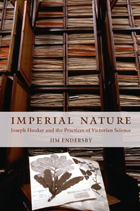
Joseph Dalton Hooker (1817–1911) was an internationally renowned botanist, a close friend and early supporter of Charles Darwin, and one of the first—and most successful—British men of science to become a full-time professional. He was also, Jim Endersby argues, the perfect embodiment of Victorian science. A vivid picture of the complex interrelationships of scientific work and scientific ideas, Imperial Nature gracefully uses one individual’s career to illustrate the changing world of science in the Victorian era.
By analyzing Hooker’s career, Endersby offers vivid insights into the everyday activities of nineteenth-century naturalists, considering matters as diverse as botanical illustration and microscopy, classification, and specimen transportation and storage, to reveal what they actually did, how they earned a living, and what drove their scientific theories. What emerges is a rare glimpse of Victorian scientific practices in action. By focusing on science’s material practices and one of its foremost practitioners, Endersby ably links concerns about empire, professionalism, and philosophical practices to the forging of a nineteenth-century scientific identity.