
 A SCHOLARLY BOOK REPOSITORY
How did Albert Einstein's ideas shape the imaginations of twentieth-century artists and writers? Are there national differences between styles of scientific research? By what mechanisms is progress in science achieved despite the enormous diversity of individual, often conflicting, efforts?
These are just a few of the questions posed in The Advancement of Science, and Its Burdens. Gerald Holton, one of the century's leading historians of science, continues his analysis of how modern science works and how it influences our world, with particular emphasis on the role of the thematic elements--those often unconscious presuppositions that guide scientific work to success or failure. Many of the conclusions emerge from the author's extensive study of the contributions of Albert Einstein. Indeed, Holton's new introduction for this edition, "Einstein and the Cultural Roots of Modern Science," demonstrates that Einstein's daring main pursuit, the discovery of unity among seemingly disparate aspects of physics, was psychologically supported by a surprising ally: the high literary works in which he immersed himself, above all Goethe's. This case study alone may well be a classic example for studying the interaction of science and culture.
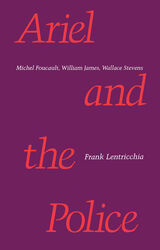
In Ariel and the Police, Frank Lentricchia searches through the totalizing desires for power that have built and help to maintain tangible and intangible structures of confinement and purification within, and sometimes as, the house of modernism. And what he finds, in his lyrical effort to redeem the subject for history, is that someone lives there, slyly, sometimes even playfully defiant.
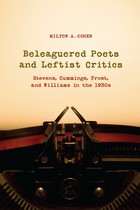
Different as they were as poets, Wallace Stevens, E. E. Cummings, Robert Frost, and Williams Carlos Williams grappled with the highly charged literary politics of the 1930s in comparable ways. As other writers moved sharply to the Left, and as leftist critics promulgated a proletarian aesthetics, these modernist poets keenly felt the pressure of the times and politicized literary scene. All four poets saw their reputations critically challenged in these years and felt compelled to respond to the new politics, literary and national, in distinct ways, ranging from rejection to involvement.
Beleaguered Poets and Leftist Critics closely examines the dynamics of these responses: what these four poets wrote—in letters, essays, lectures, fiction (for Williams), and most importantly, in their poems; what they believed politically and aesthetically; how critics, particularly leftist critics, reviewed their work; how these poets reacted to that criticism and to the broader milieu of leftism. Each poet’s response and its subsequent impact on his poetic output is a unique case study of the conflicting demands of art and politics in a time of great social change.
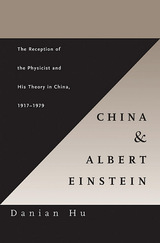
China and Albert Einstein is the first extensive study in English or Chinese of China’s reception of the celebrated physicist and his theory of relativity. Tracing the influence of Jesuit missionaries in the seventeenth century and Western missionaries and educators in the nineteenth and twentieth centuries, as they introduced key concepts of Western physical science and paved the way for Einstein’s radical new ideas, Danian Hu shows us that Chinese receptivity was fostered by the trickle of Chinese students sent abroad for study beginning in the mid-nineteenth century and by the openness of the May Fourth Movement (1916–1923).
In a series of biographical studies of Chinese physicists, Hu describes the Chinese assimilation of relativity and explains how Chinese physicists offered arguments and theories of their own. Hu’s account concludes with the troubling story of the fate of foreign ideas such as Einstein’s in the Chinese Cultural Revolution (1966–1976), when the theory of relativity was denigrated along with Einstein’s ideas on democracy and world peace.
China and Albert Einstein is an important contribution to Einstein studies and a landmark work in the history of Chinese science.

Concentrating on poems published between 1915 and 1935—but moving occasionally into later poems, as well as letters and essays—B. J. Leggett draws together texts of Stevens and Nietzsche to produce new and surprising readings of the poet's early work. This intertextual critique reveals previously undisclosed ideologies operating at the margins of Stevens's work, enabling Leggett to read aspects of the poetry that have until now been unreadable. Leggett's analysis demonstrates that the Nietzschean presence in Stevens brings with it certain assumptions that need to be made explicit if the form of the poetry is to be understood.
Though many critics have discussed the concept of intertextuality, few have attempted a truly intertextual reading of a particular poet. Early Stevens not only develops an exemplary model of such a reading; it also provides crucial insights into Stevens's notions of femininity, virility, and poetry and elucidates the notions of art, untruth, fiction, and interpretation in both Stevens and Nietzsche.

Stevens, Wolfe argues, is an ecological poet in the sense that his places, worlds, and environments are co-created by the life forms that inhabit them. Wolfe argues for a “nonrepresentational” conception of ecopoetics, showing how Stevens’s poems reward study alongside theories of system, environment, and observation derived from a multitude of sources, from Ralph Waldo Emerson and Niklas Luhmann to Jacques Derrida and Stuart Kauffman. Ecological Poetics is an ambitious interdisciplinary undertaking involving literary criticism, contemporary philosophy, and theoretical biology.
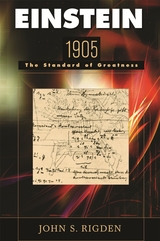
For Albert Einstein, 1905 was a remarkable year. It was also a miraculous year for the history and future of science. In six short months, from March through September of that year, Einstein published five papers that would transform our understanding of nature. This unparalleled period is the subject of John Rigden's book, which deftly explains what distinguishes 1905 from all other years in the annals of science, and elevates Einstein above all other scientists of the twentieth century.
Rigden chronicles the momentous theories that Einstein put forth beginning in March 1905: his particle theory of light, rejected for decades but now a staple of physics; his overlooked dissertation on molecular dimensions; his theory of Brownian motion; his theory of special relativity; and the work in which his famous equation, E = mc2, first appeared. Through his lucid exposition of these ideas, the context in which they were presented, and the impact they had--and still have--on society, Rigden makes the circumstances of Einstein's greatness thoroughly and captivatingly clear. To help readers understand how these ideas continued to develop, he briefly describes Einstein's post-1905 contributions, including the general theory of relativity.
One hundred years after Einstein's prodigious accomplishment, this book invites us to learn about ideas that have influenced our lives in almost inconceivable ways, and to appreciate their author's status as the standard of greatness in twentieth-century science.
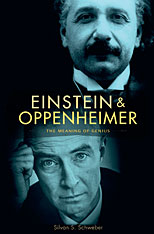
Albert Einstein and J. Robert Oppenheimer, two iconic scientists of the twentieth century, belonged to different generations, with the boundary marked by the advent of quantum mechanics. By exploring how these men differed—in their worldview, in their work, and in their day—this book provides powerful insights into the lives of two critical figures and into the scientific culture of their times. In Einstein’s and Oppenheimer’s philosophical and ethical positions, their views of nuclear weapons, their ethnic and cultural commitments, their opinions on the unification of physics, even the role of Buddhist detachment in their thinking, the book traces the broader issues that have shaped science and the world.
Einstein is invariably seen as a lone and singular genius, while Oppenheimer is generally viewed in a particular scientific, political, and historical context. Silvan Schweber considers the circumstances behind this perception, in Einstein’s coherent and consistent self-image, and its relation to his singular vision of the world, and in Oppenheimer’s contrasting lack of certainty and related non-belief in a unitary, ultimate theory. Of greater importance, perhaps, is the role that timing and chance seem to have played in the two scientists’ contrasting characters and accomplishments—with Einstein’s having the advantage of maturing at a propitious time for theoretical physics, when the Newtonian framework was showing weaknesses.
Bringing to light little-examined aspects of these lives, Schweber expands our understanding of two great figures of twentieth-century physics—but also our sense of what such greatness means, in personal, scientific, and cultural terms.
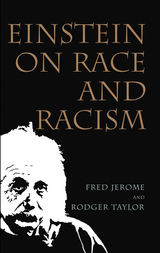
Nearly fifty years after his death, Albert Einstein remains one of America's foremost cultural icons. A thicket of materials, ranging from scholarly to popular, have been written, compiled, produced, and published about his life and his teachings. Among the ocean of Einsteinia-scientific monographs, biographies, anthologies, bibliographies, calendars, postcards, posters, and Hollywood films-however, there is a peculiar void when it comes to the connection that the brilliant scientist had with the African American community. Nowhere is there any mention of his close relationship with Paul Robeson, despite Einstein's close friendship with him, or W.E.B. Du Bois, despite Einstein's support for him.
This unique volume is the first to bring together a wealth of writings by the scientist on the topic of race. Although his activism in this area is less well known than his efforts on behalf of international peace and scientific cooperation, Einstein spoke out vigorously against racism both in the United States and around the world. Fred Jerome and Rodger Taylor suggest that one explanation for this historical amnesia is that Einstein's biographers avoided "controversial" topics, such as his friendships with African Americans and his political activities, including his involvement as co-chair of an antilynching campaign, fearing that mention of these details may tarnish the feel-good impression his image lends topics of science, history, and America.
Combining the scientist's letters, speeches, and articles with engaging narrative and historical discussions that place his public statements in the context of his life and times, this important collection not only brings attention to Einstein's antiracist public activities, but also provides insight into the complexities of antiracist culture in America. The volume also features a selection of candid interviews with African Americans who knew Einstein as children.
For a man whose words and reflections have influenced so many, it is long overdue that Einstein's thoughts on this vital topic are made easily accessible to the general public.
What is the relationship between religious belief and the study of nature, between theology and science? This is the fundamental preoccupation of the three different studies in Einstein, Polanyi, and the Laws of Nature.
By exploring the highly original yet little-known thought of Michael Polanyi, Jaeger highlights the inherent personal investment in any quest for knowledge, including the scientific enterprise, thus raising the question of the objectivity of human knowledge. Considered to be the most incredible mind of the twentieth century, Albert Einstein saw scientific research as the fruit of the “cosmic religion.” His response to the question of the relationship between faith and science also receives the close analysis it deserves. Finally, Jaeger is interested in science’s propensity to use the concept of laws of nature, an idea also found in the Bible. She paves the way for interdisciplinary dialogue by examining the similarities and differences.
The synthesis of these three complementary studies brings out the collaboration between belief and knowledge, thus establishing a bridge between two noble human activities: faith and scientific research. It will interest all serious followers of the ongoing science and religion dialogue.
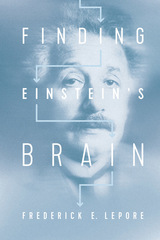
Following his death in 1955, Einstein’s brain was removed and preserved, but has never been fully or systematically studied. In fact, the sections are not even all in one place, and some are mysteriously unaccounted for! In this compelling tale, Frederick E. Lepore delves into the strange, elusive afterlife of Einstein’s brain, the controversy surrounding its use, and what its study represents for brain and/or intelligence studies.
Carefully reacting to the skepticism of 21st century neuroscience, Lepore more broadly examines the philosophical, medical, and scientific implications of brain-examination. Is the brain simply a computer? If so, how close are we to artificially creating a human brain? Could scientists create a second Einstein? This “biography of a brain” attempts to answer these questions, exploring what made Einstein’s brain anatomy exceptional, and how “found” photographs--discovered more than a half a century after his death--may begin to uncover the nature of genius.
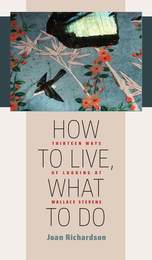
How to Live, What to Do is an indispensable introduction to and guide through the work of a poet equal in power and sensibility to Shakespeare and Milton. Like them, Stevens shaped a new language, fashioning an instrument adequate to describing a completely changed environment of fact, extending perception through his poems to align what Emerson called our “axis of vision” with the universe as it came to be understood during his lifetime, 1879–1955, a span shared with Albert Einstein. Projecting his own imagination into spacetime as “a priest of the invisible,” persistently cultivating his cosmic consciousness through reading, keeping abreast of the latest discoveries of Einstein, Max Planck, Niels Bohr, Louis de Broglie, and others, Stevens pushed the boundaries of language into the exotic territories of relativity and quantum mechanics while at the same time honoring the continuing human need for belief in some larger order. His work records how to live, what to do in this strange new world of experience, seeing what was always seen but never seen before.
Joan Richardson, author of the standard two-volume critical biography of Stevens and coeditor with Frank Kermode of the Library of America edition of the Collected Poetry and Prose, offers concise, lucid captures of Stevens’s development and achievement. Over the ten years of researching her Stevens biography, Richardson read all that he read, as well as his complete correspondence, journals, and notebooks. She weaves the details drawn from this deep involvement into the background of American cultural history of the period. This fabric is further enlivened by her preparation in philosophy and the sciences, creating in these thirteen panels a contemporary version of a medieval tapestry sequence, with Stevens in the place of the unicorn, as it were, holding our attention and eliciting, as necessary angel, individual solutions to the riddles of our existence on this planet spinning and hissing around its cooling star at 18.5 miles per second.

Bevis addresses the most puzzling and least studied aspect of Wallace Stevens’ poetry: detachment. Stevens’ detachment, often associated by readers with asceticism, bareness, or withdrawal, is one of the distinguishing and pervasive characteristics of Stevens’ poetic work. Bevis agues that this detachment is meditative and therefore experiential in origin. Moreover, the meditative Stevens of spare syntax and clear image is in constant tension with the romantic, imaginative Stevens of dazzling metaphors and exuberant flight. Indeed, for Bevis, Stevens is a poet not of imagination and reality, but of imagination and reality, but of imagination and meditation in relation to reality.
Gyorgyi Voros focuses on three governing metaphors in Stevens' poems—Nature as house, Nature as body, and Nature as self. She argues that Stevens' youthful wilderness experience yielded his primary subject—the relationship between human beings and nonhuman nature—and that it spurred his shift from a romantic to a phenomenological understanding of nature. Most important, it prompted him to reject his culture's narrow humanism in favor of a singular vision that in today's terms would he deemed ecological.
Though Wallace Stevens’ shorter poems are perhaps his best known, his longer poems, Helen Vendler suggests in this book, deserve equal fame and equal consideration. Stevens’ central theme—the worth of the imagination—remained with him all his life, and Mrs. Vendler therefore proposes that his development as a poet can best be seen, not in description—which must be repetitive—of the abstract bases of his work, but rather in a view of his changing styles.
The author presents here a chronological account of fourteen longer poems that span a thirty-year period, showing, through Stevens’ experiments in genre, diction, syntax, voice, imagery, and meter, the inventive variety of Stevens’s work in long forms, and providing at the same time a coherent reading of these difficult poems. She concludes, “Stevens was engaged in constant experimentation all his life in an attempt to find the appropriate vehicle for his expansive consciousness; he found it in his later long poems, which surpass in value the rest of his work.”
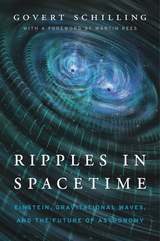
It has already been called the scientific breakthrough of the century: the detection of gravitational waves. Einstein predicted these tiny ripples in the fabric of spacetime nearly a hundred years ago, but they were never perceived directly until now. Decades in the making, this momentous discovery has given scientists a new understanding of the cataclysmic events that shape the universe and a new confirmation of Einstein’s theory of general relativity. Ripples in Spacetime is an engaging account of the international effort to complete Einstein’s project, capture his elusive ripples, and launch an era of gravitational-wave astronomy that promises to explain, more vividly than ever before, our universe’s structure and origin.
The quest for gravitational waves involved years of risky research and many personal and professional struggles that threatened to derail one of the world’s largest scientific endeavors. Govert Schilling takes readers to sites where these stories unfolded—including Japan’s KAGRA detector, Chile’s Atacama Cosmology Telescope, the South Pole’s BICEP detectors, and the United States’ LIGO labs. He explains the seeming impossibility of developing technologies sensitive enough to detect waves from two colliding black holes in the very distant universe, and describes the astounding precision of the LIGO detectors. Along the way Schilling clarifies concepts such as general relativity, neutron stars, and the big bang using language that readers with little scientific background can grasp.
Ripples in Spacetime provides a window into the next frontiers of astronomy, weaving far-reaching predictions and discoveries into a gripping story of human ambition and perseverance.
A Physics Today Best Book of the Year
A Forbes “For the Physics and Astronomy Lover in Your Life” Selection
“Succinct, accessible, and remarkably timely… This book is a rare find.”
—Physics Today
“Belongs on the shelf of anyone interested in learning the scientific, historical, and personal stories behind some of the most incredible scientific advances of the 21st century.”
—Forbes
The detection of gravitational waves has already been called the scientific breakthrough of the century. Einstein predicted these tiny ripples in the fabric of spacetime over a hundred years ago, but they were only recently perceived directly for the first time. Ripples in Spacetime is an engaging account of the international effort to complete Einstein’s project, capture his elusive ripples, and launch an era of gravitational-wave astronomy that promises to explain, more vividly than ever before, our universe’s structure and origin.
“Schilling’s deliciously nerdy grand tour takes us through compelling backstory, current research, and future expectations.”
—Nature
“A lively and readable account… Schilling underlines that this discovery is the opening of a new window on the universe, the beginning of a new branch of science.”
—Graham Farmelo, The Guardian
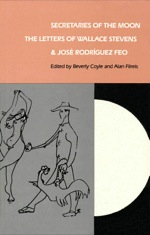
Coyle and Filreis present the entire extant correspondence between the two men. The fifty-one Rodriguez Feo letters and ten of the numerous Stevens letters are printed here for the first time, and the exchange between the two is unusually complete. The work includes a critical introduction and complete annotation of the letters.

"What really led Einstein . . . to renounce the new quantum order? For those interested in this question, this book is compulsory reading."—Harvey R. Brown, American Journal of Physics
"Fine has successfully combined a historical account of Einstein's philosophical views on quantum mechanics and a discussion of some of the philosophical problems associated with the interpretation of quantum theory with a discussion of some of the contemporary questions concerning realism and antirealism. . . . Clear, thoughtful, [and] well-written."—Allan Franklin, Annals of Science
"Attempts, from Einstein's published works and unpublished correspondence, to piece together a coherent picture of 'Einstein realism.' Especially illuminating are the letters between Einstein and fellow realist Schrödinger, as the latter was composing his famous 'Schrödinger-Cat' paper."—Nick Herbert, New Scientist
"Beautifully clear. . . . Fine's analysis is penetrating, his own results original and important. . . . The book is a splendid combination of new ways to think about quantum mechanics, about realism, and about Einstein's views of both."—Nancy Cartwright, Isis
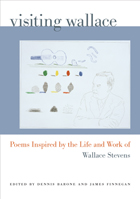
Whether whimsical or serious, solemn or light, the poems in Dennis Barone and James Finnegan’s Visiting Wallace are sure to inspire delight and thought. Alan Filreis’s brilliant foreword asks us to consider whether there is another modern poet who means as much to contemporary verse as Stevens: “seventy-six poems giving us seventy-six distinct Stevenses to follow and succeed.”

This study begins with an examination of the textual and generic issues surrounding apocalypse, culminating in the idea of apocalyptic language as a form of “discursive mastery” over the mayhem of events. Woodland provides an informative religious/historical discussion of apocalypse and, engaging with such critics as Parker, Derrida, and Fowler, sets forth the paradoxes and complexities that eventually challenge any clear dualities between apocalyptic and antiapocalyptic thinking.
Woodland then examines some of Stevens’s wartime essays and poems and describes Stevens’s efforts to salvage a sense of self and poetic vitality in a time of war, as well as his resistance to the possibility of cultural collapse. Woodland discusses the major postwar poems “Credences of Summer” and “The Auroras of Autumn” in separate chapters, examining the interaction of (anti)apocalyptic modes with, respectively, pastoral and elegy.
The final chapter offers a perspective on Stevens’s place in literary history by examining the work of a contemporary poet, Jorie Graham, whose poetry quotes from Stevens’s oeuvre and shows other marks of his influence. Woodland focuses on Graham's 1997 collection The Errancy and shows that her antiapocalyptic poetry involves a very different attitude toward the possibility of a radical break with a particular cultural or aesthetic stance.
Wallace Stevens and the Apocalyptic Mode, offering a new understanding of Stevens’s position in literary history, will greatly interest literary scholars and students.
Wallace Stevens and the Critical Schools reveals a field marked by conflict and contradiction, both within and among critical works in their attempts to explicate and appropriate this major American poet. Stevens’ changing reception among the critical schools reveals much about the shifting nature of American literature and criticism in this century and illuminates the often polemical process of literary canon formation. Each chapter of this book examines a particular aspect of the 20th-century critical involvement with Wallace Stevens’ poetry, introduced by a discussion of the poet’s work as an arena for the convergence of modern critical tendencies and concerns.
First, the author examines the avant-garde milieu of early 20th-century modernism, which implicated Stevens in its melee of affiliations and enmities and which influenced critics’ ambivalent responses to his early work. She traces the critical controversies of the poet’s emergence before and during the 1920s, specifically the clash between New Humanism and aestheticism, and demonstrates how the quality of irony in Stevens’ work became a part of the critics’ general repertoire in their assessment of this poet.
The 1930s, 1940s, and 1950s were decades during which Stevens criticism became dominated by the New Critical ideology. The turn toward deconstruction in Stevens criticism stands in part as a response to the New Critical dilemma, seen in the manner in which such critics as J. Hillis Miller and Joseph Riddel appropriated the concept of “decreation” to explain the sense of rupture in Stevens’ late poetry yet brought that concept to its logical end in a deconstructive paradigm.
Finally, Schaum identifies four major theoretical approaches to Stevens in the past two decades that continue to inform and direct the field of critical dissent and exploration in the 1980s. Such theories as Bloomian misprision, versions of hermeneutic criticism, redefinitions of the deconstructive enterprise, and the contemporary call for a new historicism continue the battle to appropriate Stevens as the “hard prize” of critical aims and investigations.
Wallace Stevens was not only one of America's outstanding modernist poets but also a successful insurance lawyer--a fact that continues to intrigue many readers. Though Stevens tried hard to separate his poetry from his profession, legal theorist Thomas Grey shows that he did not ultimately succeed. After stressing how little connection appears on the surface between the two parts of Stevens's life, Grey argues that in its pragmatic account of human reasoning, the poetry distinctively illuminates the workings of the law.
In this important extension of the recent law-and-literature movement, Grey reveals Stevens as a philosophical poet and implicitly a pragmatist legal theorist, who illustrates how human thought proceeds through "assertion, qualification, and qualified reassertion," and how reason and passion fuse together in the act of interpretation. Above all, Stevens's poetry proves a liberating antidote to the binary logic that is characteristic of legal theory: one side of a case is right, the other wrong; conduct is either lawful or unlawful.
At the same time as he discovers in Stevens a pragmatist philosopher of law, Grey offers a strikingly new perspective on the poetry itself. In the poems that develop Stevens's "reality-imagination complex"--poems often criticized as remote, apolitical, and hermetic--Grey finds a body of work that not only captivates the reader but also provides a unique instrument for scrutinizing the thought processes of lawyers and judges in their exercise of social power.
READERS
Browse our collection.
PUBLISHERS
See BiblioVault's publisher services.
STUDENT SERVICES
Files for college accessibility offices.
RECENTLY PUBLISHED




UChicago Accessibility Resources
home | accessibility | search | about | contact us
BiblioVault ® 2001 - 2024
The University of Chicago Press