
 A SCHOLARLY BOOK REPOSITORY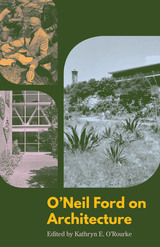
Winner, Publication Award, Southeastern Chapter of the Society of Architectural Historians (SESAH), 2019
Acclaimed for his designs of the Trinity University campus, the Little Chapel in the Woods, the Texas Instruments Semiconductor Components Division Building, and numerous private houses, O’Neil Ford (1905–1982) was an important twentieth-century architect and a pioneer of modernism in Texas. Collaborating with artists, landscape architects, and engineers, Ford created diverse and enduringly rich works that embodied and informed international developments in modern architecture. His buildings, lectures, and teaching influenced a generation of Texas architects.
O’Neil Ford on Architecture brings together Ford’s major professional writings and speeches for the first time. Revealing the intellectual and theoretical underpinnings of his distinctive modernism, they illuminate his fascination with architectural history, his pioneering uses of new technologies and construction systems, his deep concerns for the landscape and environment, and his passionate commitments to education and civil rights. An interlocutor with titans of the twentieth century, including Louis Kahn and J. Robert Oppenheimer, Ford understood architecture as inseparable from the social, political, and scientific developments of his day. An introductory essay by Kathryn E. O’Rourke provides a critical assessment of Ford’s essays and lectures and repositions him in the history of US architectural modernism. As some of his most important buildings turn sixty, O’Neil Ford on Architecture demonstrates that this Texas modernist deserves to be ranked among the leading midcentury American architects.

The Roman Catholic Church has played a unique role in the history of Poland in the twentieth century: the people and the Church drew closer and closer together during Nazi rule, the Stalinist period and the somewhat milder, though strongly anti-religious and repressive Gomulka regime (1956-1970). The power struggle between the Church and the communist government did in fact play a role in shaping world politics, the Polish Church having been the force behind the opposition movement in Poland. Against this background, a Polish pope appeared and made a major contribution to the collapse of communism.
The Seeds of Triumph, the most comprehensive recent book on the opposition of Church and State in post-war Poland, compares the characteristics and consequences of this relationship during three different periods: the first and second periods of Gomulka's rule, and the Stalinist era between the two Gomulka periods. It examines the balance of power, studying to what degree the Church and other factors in the political environment influenced governmental policy-making. The author disproves the common stereotype, held at the time, that domestic conditions played only a marginal role. In examining the regime's policies, she covers the legal background, the general policy characteristics, the specific policies implemented during the period, and the role of the individual actors, most notably the pivotal role of the two main protagonists, Cardinal Wyszynski and Wladislaw Gomulka.
In her landmark study, Diskin makes a significant contribution to the study of authoritarian systems and greatly enhances our understanding of the centrality of the Church in recent Polish history.

READERS
Browse our collection.
PUBLISHERS
See BiblioVault's publisher services.
STUDENT SERVICES
Files for college accessibility offices.
RECENTLY PUBLISHED



UChicago Accessibility Resources
home | accessibility | search | about | contact us
BiblioVault ® 2001 - 2025
The University of Chicago Press