Results by title
3 books match the query '1930-2014'
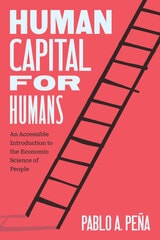
Human Capital for Humans
An Accessible Introduction to the Economic Science of PeoplePablo A. Peña
University of Chicago Press, 2025
University of Chicago economist Gary Becker won the Nobel Prize largely for his advancement of human capital theory—the idea that investing in a person’s knowledge and skills has a wide range of economic effects. Becker’s writing on the subject was technical, but his teaching, especially in his famous doctoral course at Chicago, remains legendary for its accessibility, brilliance, and applications to everyday life.
In Human Capital for Humans, economist and former Becker student Pablo A. Peña channels this classroom approach to produce an accessible, essential guide to understanding the science that has become synonymous with modern life and the economy. With an illustrative and immersive style, Peña unpacks the human capital approach to domains such as parenting, aging, marriage, health, and household labor. The result is not only intellectually elevated, but an essential introduction for learners and teachers of this subject across business, management, economics, policy, and beyond.
Robert Ashley
Kyle Gann
University of Illinois Press, 2012
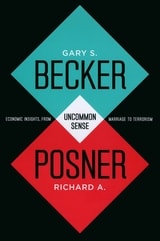
Uncommon Sense
Economic Insights, from Marriage to TerrorismGary S. Becker and Richard A. Posner
University of Chicago Press, 2009
On December 5, 2004, the still-developing blogosphere took one of its biggest steps toward mainstream credibility, as Nobel Prize–winning economist Gary S. Becker and renowned jurist and legal scholar Richard A. Posner announced the formation of the Becker-Posner Blog.
In no time, the blog had established a wide readership and reputation as a reliable source of lively, thought-provoking commentary on current events, its pithy and profound weekly essays highlighting the value of economic reasoning when applied to unexpected topics. Uncommon Sense gathers the most important and innovative entries from the blog, arranged by topic, along with updates and even reconsiderations when subsequent events have shed new light on a question. Whether it’s Posner making the economic case for the legalization of gay marriage, Becker arguing in favor of the sale of human organs for transplant, or even the pair of scholars vigorously disagreeing about the utility of collective punishment, the writing is always clear, the interplay energetic, and the resulting discussion deeply informed and intellectually substantial.
To have a single thinker of the stature of a Becker or Posner addressing questions of this nature would make for fascinating reading; to have both, writing and responding to each other, is an exceptionally rare treat. With Uncommon Sense, they invite the adventurous reader to join them on a whirlwind intellectual journey. All they ask is that you leave your preconceptions behind.