
 A SCHOLARLY BOOK REPOSITORY
Results by Title
2 books about 1936 - 1943
2 books about 1936 - 1943
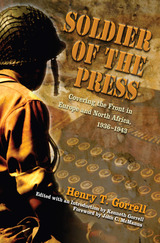
Soldier of the Press
Covering the Front in Europe and North Africa, 1936-1943
Henry T. Gorrell, Edited & Intro by Kenneth Gorrell, & Foreword by John C. McManus
University of Missouri Press, 2009
Threatened by each side in the Spanish Civil War with death as a suspected spy, decorated for saving an airman’s life in a bullet-ridden B-24 Liberator over Greece, war correspondent Henry “Hank” Gorrell often found himself in the thick of the fighting he had been sent to cover. And in reporting on some of the world’s most dangerous stories, he held newspaper readers spellbound with his eyewitness accounts from battlefields across Europe, Africa, and the Middle East.
An “exclusive” United Press correspondent, Gorrell saw more than his share of war, even more than most reporters, as his beat took him from the siege of Madrid to the sands of North Africa. His memoir, left in an attic trunk for sixty years, is presented here in its entirety for the first time. As he risks life and limb on the front lines, Gorrell gives us new perspectives on the overall conflict—including some of World War II’s lesser-known battles—as well as insights into behind-the-lines intrigue.
Gorrell’s account first captures early Axis intervention in Spain and their tests of new weaponry and blitzkrieg tactics at the cost of millions of Spanish lives. While covering the Spanish Civil War, he was captured by forces from each side and saw many brave men die disillusioned, and his writings offer a contrast to other views of that conflict from writers like Hemingway. But Spain was just Hank’s training ground: before America even entered World War II, he was embedded with Allied forces from seven nations.
When war broke out, Gorrell was sent to Hungary, where in Budapest he witnessed pro-Axis enthusiasts toast the victory of Fascist armies. Later in Romania he watched Stalin kick over the Axis apple cart with his invasion of Bessarabia—forcing the Germans to deal with the Russian menace before they had planned. Then he saw twenty Italian divisions mauled in the mountains of Albania, marking the beginning of the end for Mussolini.
Combining the historian’s accuracy with the journalist’s on-the-spot reportage, Gorrell provides eyewitness impressions of what war looked, sounded, and felt like to soldiers on the ground. Soldier of the Press weaves personal adventures into the larger fabric of world events, plunging modern readers into the heat of battle while revealing the dangers faced by war correspondents in that bygone era.
[more]
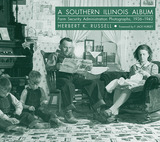
A Southern Illinois Album
Farm Security Administration Photographs, 1936-1943
Herbert K. Russell. Foreword by F. Jack Hurley
Southern Illinois University Press, 1990
Life on the road was anything but glamorous for Farm Security Administration photographers traveling through southern Illinois in the mid-1930s. Often their most promising subjects lived at the end of the worst roads, many of which lacked bridges, drainage ditches, or gravel. Outfitted with three government-issue cameras, flashbulbs, tripods, and film-processing chemicals, their job was to help "explain America to Americans" by seeking out and photographing the one-third of the nation FDR described as "ill-housed, ill-clad, and ill-nourished." Featured in this book are more than one hundred photographs from the collection of a quarter of a million taken by FSA photographers between 1935 and 1943. These pictures capture life during the Great Depression as viewed in the coal-mining towns of Herrin, West Frankfort, and Zeigler; the river communities of Shawneetown, Cairo, and Grayville; the farming regions near McLeansboro, Newton, and Harrisburg—more than two dozen southern Illinois county seats, hamlets, and landings. Together they comprise a photographic portrait of the determination, hard work, and capacity to find ways to celebrate life exemplified by the people of southern Illinois during one of the most difficult periods of American history. FSA photographers helped to invent and popularize the "documentary style," a type of photography in which pictures and their arrangement carry much of the information in a story. Intended to document the success of a government project, these pictures survived to preserve for later generations the story of the people of southern Illinois and how they endured the difficult times of the Great Depression.
[more]
READERS
Browse our collection.
PUBLISHERS
See BiblioVault's publisher services.
STUDENT SERVICES
Files for college accessibility offices.
RECENTLY PUBLISHED





UChicago Accessibility Resources
home | accessibility | search | about | contact us
BiblioVault ® 2001 - 2026
The University of Chicago Press