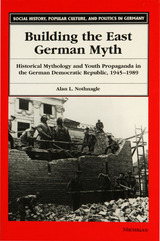
front cover of Building the East German Myth
Building the East German Myth
Historical Mythology and Youth Propaganda in the German Democratic Republic, 1945-1989
Alan L. Nothnagle
University of Michigan Press, 1999
Ten years after the fall of the Berlin Wall, the political and economic structures of the former German Democratic Republic are largely understood, yet many questions remain. What actually motivated the East Germans themselves? What common goals and values kept GDR society going and, until its unexpected collapse in 1989, seemed to make it into a relative success story? Building the East German Myth examines the East German communist party's propagandistic treatment of German high culture, antifascism, "German-Soviet" friendship, and the German nationalist tradition. In this pathbreaking study, Alan Nothnagle argues that the party's mass events and indoctrination campaigns were not mere propaganda, but rather an ingenious program of mythbuilding by which young people were instilled with a dynamic and nearly inescapable mythology. Using a wealth of previously unexplored sources, Nothnagle shows this mythology was as essential to the GDR's existence as the Wall of the Soviet occupation and, as its leaders discovered in 1989, the GDR could not survive without it. Alongside the economic and human costs this book demonstrates, the loss of honesty, subtlety, and a sense of proportion may represent the most devastating legacy of the East German experience. Written to appeal to both specialists and non-specialists, Building the East German Myth will prove essential reading for those interested in German and European history, communism, political propaganda, and Cold War culture.
[more]


logo for Duke University Press
Economic Knowledge in Socialism, 1945–1989
Till Düppe and Ivan Boldyrev, issue editors
Duke University Press
This cross-disciplinary special issue focuses on economic knowledge in social countries during the second half of the twentieth century. Through a series of historical case studies, the issue embraces a wide variety of perspectives on the ways economy and society were conceptualized behind the Iron Curtain. Contributors explored the entanglement of ideology and economic discourse, the political dimensions of cybernetic technocracy, and the various faces of Cold War rationality of socialism.

Contributors. Oleg Ananyin, Johanna Bockman, Ivan Boldyrev, Till Düppe, Richard Ericson, Yakov Feygin, Olessia Kirtchik, Martha Lampland, Adam Leeds, Denis Melnik, Chris Miller, György Peteri, Eglė Rindzevičiūtė, Vítězslav Sommer, Joachim Zweynert
[more]

logo for Central European University Press
Women in Poland, 1945–1989
Modernity, Equality, Communism
Katarzyna Stanczak-Wislicz
Central European University Press, 2026
Women in Poland 1945–1989: Modernity, Equality, Communism offers a compelling and deeply researched exploration of women’s lives under state socialism in Poland. The book reveals how communist promises of emancipation intersected with everyday reality – shaping work, family life, political participation, and personal identity. It examines women’s political engagement, experiences of work in both urban factories and rural fields, the management of household and family life, childhood and education, as well as biopolitics and the evolving culture of beauty. Juxtaposing the Polish experience with developments across Europe in the second half of the twentieth century, this insightful study uncovers the ambitions, contradictions, and lived realities of communist projects directed at women.
[more]


Send via email Share on Facebook Share on Twitter