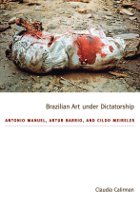
front cover of Brazilian Art under Dictatorship
Brazilian Art under Dictatorship
Antonio Manuel, Artur Barrio, and Cildo Meireles
Claudia Calirman
Duke University Press, 2012
Brazilian Art under Dictatorship is a sophisticated analysis of the intersection of politics and the visual arts during the most repressive years of Brazil's military regime, from 1968 until 1975. Raised in Rio de Janeiro during the dictatorship, the curator and art historian Claudia Calirman describes how Brazilian visual artists addressed the political situation and opened up the local art scene to new international trends. Focusing on innovative art forms infused with a political undertone, Calirman emphasizes the desire among Brazilian artists to reconcile new modes of art making with a concern for local politics. Ephemeral works, such as performance art, media-based art, and conceptualism, were well suited to the evasion of censorship and persecution. Calirman examines the work and careers of three major artists of the period, Antonio Manuel, Artur Barrio, and Cildo Meireles. She explores the ways that they negotiated the competing demands of Brazilian politics and the international art scene, the efficacy of their political critiques, and their impact on Brazilian art and culture. Calirman suggests that the art of the late 1960s and early 1970s represented not just the artists' concerns with politics, but also their anxieties about overstepping the boundaries of artistic expression.
[more]

front cover of Freedom Sun in the Tropics
Freedom Sun in the Tropics
Ana Maria Machado, Translated by Renata R. M. Wasserman
Tagus Press, 2020
Based upon the author's own experiences of life, exile, and return under the dictatorship that gripped Brazil in the 1960s and 1970s, Freedom Sun in the Tropics follows Lena, a journalist, as she resists violence and political repression, and decides to flee to Paris. Upon her eventual return, Lena soon discovers that the dictatorship's prison walls have enclosed private lives and hold strong even after the collapse of authoritarianism. With friendship, truth, and family broken, she struggles to make the difficult return to freedom and regain a sense of life—and simple decency—on the other side of trauma. Originally published in 1988, Ana Maria Machado's novel vividly captures one of the darkest periods in recent Brazilian history.
[more]

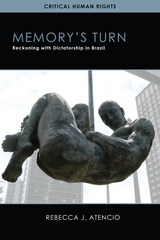
front cover of Memory’s Turn
Memory’s Turn
Reckoning with Dictatorship in Brazil
Rebecca J. Atencio
University of Wisconsin Press, 2014
After twenty-one years of military dictatorship, Brazil returned to democratic rule in 1985. Yet over the following two decades, the country largely ignored human rights crimes committed by state security agents, crimes that included the torture, murder, and disappearance of those who opposed the authoritarian regime.
            In clear and engaging prose, Rebecca J. Atencio tells the story of the slow turn to memory in Brazil, a turn that has taken place in both politics and in cultural production. She shows how testimonial literature, telenovelas, literary novels, theatrical plays, and memorials have interacted with policies adopted by the Brazilian state, often in unexpected ways. Under the right circumstances, official and cultural forms of reckoning combine in Brazil to produce what Atencio calls cycles of cultural memory. Novel meanings of the past are forged, and new cultural works are inspired, thus creating the possibility for further turns in the cycle.
            The first book to analyze Brazil’s reckoning with dictatorship through both institutional and cultural means, Memory’s Turn is a rich, informative exploration of the interplay between these different modes of memory reconstruction.

Winner, Alfred B. Thomas Award, Southeastern Council of Latin American Studies

Honorable Mention, Roberto Reis Book Prize, Brazilian Studies Association
[more]

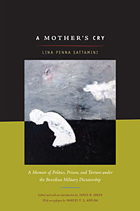
front cover of A Mother's Cry
A Mother's Cry
A Memoir of Politics, Prison, and Torture under the Brazilian Military Dictatorship
Lina Penna Sattamini
Duke University Press, 2010
During the late 1960s and early 1970s, Brazil’s dictatorship arrested, tortured, and interrogated many people it suspected of subversion; hundreds of those arrested were killed in prison. In May 1970, Marcos P. S. Arruda, a young political activist, was seized in São Paulo, imprisoned, and tortured. A Mother’s Cry is the harrowing story of Marcos’s incarceration and his family’s efforts to locate him and obtain his release. Marcos’s mother, Lina Penna Sattamini, was living in the United States and working for the U.S. State Department when her son was captured. After learning of his arrest, she and her family mobilized every resource and contact to discover where he was being held, and then they launched an equally intense effort to have him released. Marcos was freed from prison in 1971. Fearing that he would be arrested and tortured again, he left the country, beginning eight years of exile.

Lina Penna Sattamini describes her son’s tribulations through letters exchanged among family members, including Marcos, during the year that he was imprisoned. Her narrative is enhanced by Marcos’s account of his arrest, imprisonment, and torture. James N. Green’s introduction provides an overview of the political situation in Brazil, and Latin America more broadly, during that tumultuous era. In the 1990s, some Brazilians began to suggest that it would be best to forget the trauma of that era and move on. Lina Penna Sattamini wrote her memoir as a protest against historical amnesia. First published in Brazil in 2000, A Mother’s Cry is testimonial literature at its best. It conveys the experiences of a family united by love and determination during years of political repression.
[more]

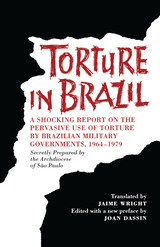
front cover of Torture in Brazil
Torture in Brazil
A Shocking Report on the Pervasive Use of Torture by Brazilian Military Governments, 1964-1979, Secretly Prepared by the Archiodese of São Paulo
Archdiocese of São Paulo, Brazil
University of Texas Press, 1998

Winner, A Choice Outstanding Academic Book

From 1964 until 1985, Brazil was ruled by a military regime that sanctioned the systematic use of torture in dealing with its political opponents. The catalog of what went on during that grim period was originally published in Portuguese as Brasil: Nunca Mais (Brazil: Never Again) in 1985.

The volume was based on the official documentation kept by the very military that perpetrated the horrific acts. These extensive documents include military court proceedings of actual trials, secretly photocopied by lawyers associated with the Catholic Church and analyzed by a team of researchers. Their daring project—known as BNM for Brasil: Nunca Mais—compiled more than 2,700 pages of testimony by political prisoners documenting close to three hundred forms of torture.

The BNM project proves conclusively that torture was an essential part of the military justice system and that judicial authorities were clearly aware of the use of torture to extract confessions. Still, it took more than a decade after the publication of Brasil: Nunca Mais for the armed forces to admit publicly that such torture had ever taken place. Torture in Brazil, the English version of the book re-edited here, serves as a timely reminder of the role of Brazil's military in past repression.
[more]

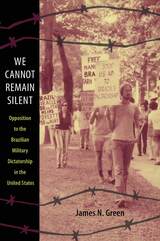
front cover of We Cannot Remain Silent
We Cannot Remain Silent
Opposition to the Brazilian Military Dictatorship in the United States
James N. Green
Duke University Press, 2010
In 1964, Brazil’s democratically elected, left-wing government was ousted in a coup and replaced by a military junta. The Johnson administration quickly recognized the new government. The U.S. press and members of Congress were nearly unanimous in their support of the “revolution” and the coup leaders’ anticommunist agenda. Few Americans were aware of the human rights abuses perpetrated by Brazil’s new regime. By 1969, a small group of academics, clergy, Brazilian exiles, and political activists had begun to educate the American public about the violent repression in Brazil and mobilize opposition to the dictatorship. By 1974, most informed political activists in the United States associated the Brazilian government with its torture chambers. In We Cannot Remain Silent, James N. Green analyzes the U.S. grassroots activities against torture in Brazil, and the ways those efforts helped to create a new discourse about human-rights violations in Latin America. He explains how the campaign against Brazil’s dictatorship laid the groundwork for subsequent U.S. movements against human rights abuses in Chile, Uruguay, Argentina, and Central America.

Green interviewed many of the activists who educated journalists, government officials, and the public about the abuses taking place under the Brazilian dictatorship. Drawing on those interviews and archival research from Brazil and the United States, he describes the creation of a network of activists with international connections, the documentation of systematic torture and repression, and the cultivation of Congressional allies and the press. Those efforts helped to expose the terror of the dictatorship and undermine U.S. support for the regime. Against the background of the political and social changes of the 1960s and 1970s, Green tells the story of a decentralized, international grassroots movement that effectively challenged U.S. foreign policy.

[more]


Send via email Share on Facebook Share on Twitter