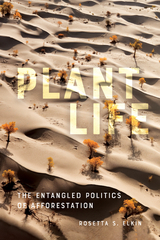
front cover of Plant Life
Plant Life
The Entangled Politics of Afforestation
Rosetta S. Elkin
University of Minnesota Press, 2022

How afforestation reveals the often-concealed politics between humans and plants

In Plant Life, Rosetta S. Elkin explores the procedures of afforestation, the large-scale planting of trees in otherwise treeless environments, including grasslands, prairies, and drylands. Elkin reveals that planting a tree can either be one of the ultimate offerings to thriving on this planet, or one of the most extreme perversions of human agency over it. 

Using three supracontinental case studies—scientific forestry in the American prairies, colonial control in Africa’s Sahelian grasslands, and Chinese efforts to control and administer territory—Elkin explores the political implications of plant life as a tool of environmentalism. By exposing the human tendency to fix or solve environmental matters by exploiting other organisms, this work exposes the relationship between human and plant life, revealing that afforestation is not an ecological act: rather, it is deliberately political and distressingly social. 

Plant Life ultimately reveals that afforestation cannot offset deforestation, an important distinction that sheds light on current environmental trends that suggest we can plant our way out of climate change. By radicalizing what conservation protects and by framing plants in their total aliveness, Elkin shows that there are many kinds of life—not just our own—to consider when advancing environmental policy. 

[more]

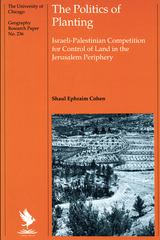
front cover of The Politics of Planting
The Politics of Planting
Israeli-Palestinian Competition for Control of Land in the Jerusalem Periphery
Shaul Ephraim Cohen
University of Chicago Press, 1993
On the open landscape of Israel and the West Bank, where pine and cypress forests grow alongside olive groves, tree planting has become symbolic of conflicting claims to the land. Palestinians cultivate olive groves as a vital agricultural resource, while the Israeli government has made restoration of mixed-growth forests a national priority. Although both sides plant for a variety of purposes, both have used tree planting to assert their presence on—and claim to—disputed land.

Shaul Ephraim Cohen has conducted an unprecedented study of planting in the region and the control of land it signifies. In The Politics of Planting, he provides historical background and examines both the politics behind Israel's afforestation policy its consequences. Focusing on the open land surrounding Jerusalem and four Palestinian villages outside the city, this study offers a new perspective on the conflict over land use in a region where planting has become a political tool.

For the valuable data it presents—collected from field work, previously unpublished documents, and interviews—and the insight it provides into this political struggle, this will be an important book for anyone studying the Israeli-Palestinian conflict.
[more]


Send via email Share on Facebook Share on Twitter