
 A SCHOLARLY BOOK REPOSITORY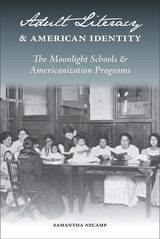
The release of U.S. census data in 1910 sparked rhetoric declaring the nation had a literacy crisis and proclaiming illiterate citizens a threat to democratic life. While newspaper editors, industrialists, and officials in the federal government frequently placed the blame on newly arrived immigrants, a smaller but no less vocal group of rural educators and clubwomen highlighted the significant number of native-born illiterate adults in the Appalachian region. Author Samantha NeCamp looks at the educational response to these two distinct literacy narratives—the founding of the Moonlight Schools in eastern Kentucky, focused on native-born nonliterate adults, and the establishment of the Americanization movement, dedicated to the education of recent immigrants.
Drawing on personal correspondence, conference proceedings, textbooks, and speeches, NeCamp demonstrates how the Moonlight Schools and the Americanization movement competed for public attention, the interest of educators, and private and governmental funding, fueling a vibrant public debate about the definition of literacy. The very different pedagogical practices of the two movements—and how these practices were represented to the public—helped shape literacy education in the United States. Reading the Moonlight Schools and the Americanization movement in relation to one another, Adult Literacy and American Identity expands the history and theory of literacy and literacy education in the United States. This book will be of interest to scholars in literacy, Appalachian studies, and rhetoric and composition.


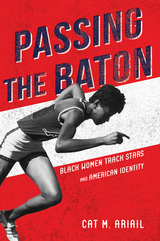
A rare exploration of African American women athletes and national identity, Passing the Baton reveals young Black women as active agents in the remaking of what it means to be American.
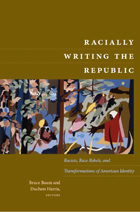
The contributors analyze Thomas Jefferson’s legacy in light of his sexual relationship with his slave, Sally Hemings; the way that Samuel Gompers, the first president of the American Federation of Labor, rallied his organization against Chinese immigrant workers; and the eugenicist origins of the early-twentieth-century birth-control movement led by Margaret Sanger. They draw attention to the writing of Sarah Winnemucca, a Northern Piute and one of the first published Native American authors; the anti-lynching activist Ida B. Wells-Barnett; the Filipino American writer Carlos Bulosan; and the playwright Lorraine Hansberry, who linked civil rights struggles in the United States to anticolonial efforts abroad. Other figures considered include Alexis de Tocqueville and his traveling companion Gustave de Beaumont, Juan Nepomuceno Cortina (who fought against Anglo American expansion in what is now Texas), Abraham Lincoln, Theodore Roosevelt, and W. E. B. Du Bois. In the afterword, George Lipsitz reflects on U.S. racial politics since 1965.
Contributors. Bruce Baum, Cari M. Carpenter, Gary Gerstle, Duchess Harris, Catherine A. Holland, Allan Punzalan Isaac, Laura Janara, Ben Keppel, George Lipsitz, Gwendolyn Mink, Joel Olson, Dorothy Roberts, Patricia A. Schechter, John Kuo Wei Tchen, Jerry Thompson

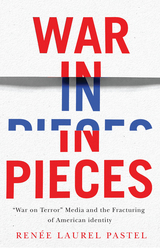
War in Pieces considers media representations of the first phase of the “War on Terror,” set between 2001 and 2013. The book argues that the central figures around which narratives of the conflicts cohered—the war journalist, the active-duty service member, the veteran, and the military family—served to mask the loss of the myth of a unified American national identity and embodied the negotiation of cultural anxieties. Offering a theory of narrative figuration that draws into conversation repetitions and differences across media forms (fiction and nonfiction films, television shows, and online videos), this book breaks down how these figures contributed to a continued sense of unified national identity even as different audiences came away with divergent understandings. This book frames these questions in terms of how US media packaged the “War on Terror” for future cultural memory even as the conflicts continued.
READERS
Browse our collection.
PUBLISHERS
See BiblioVault's publisher services.
STUDENT SERVICES
Files for college accessibility offices.
RECENTLY PUBLISHED



UChicago Accessibility Resources
home | accessibility | search | about | contact us
BiblioVault ® 2001 - 2026
The University of Chicago Press