
 A SCHOLARLY BOOK REPOSITORY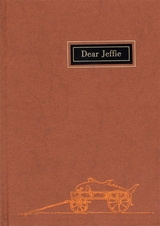
Jeffries Wyman (1814–74), a pioneer anthropologist of nineteenth-century America and one of its great comparative anatomists, was the Hersey Professor of Anatomy at Harvard University and, later, a trustee of the Peabody Museum and professor of American Archaeology and Ethnology.
Wyman wrote the 59 letters in this volume to his only son Jeffie. Dating from 1866, when Jeffie was two, until Wyman’s death in 1874, when Jeffie was ten, the letters reveal a great scientist trying to instill in his son the concepts of acute observation and wonder. Wyman’s charming, quizzical drawings embellish the text, which will be appreciated by children and adults alike.
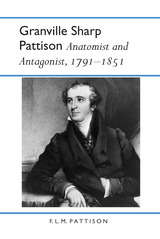
The stormy life of one of the most colorful and complex characters in early 19th-century medicine
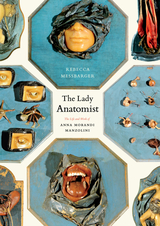
Anna Morandi Manzolini (1714-74), a woman artist and scientist, surmounted meager origins and limited formal education to become one of the most acclaimed anatomical sculptors of the Enlightenment. The Lady Anatomist tells the story of her arresting life and times, in light of the intertwined histories of science, gender, and art that complicated her rise to fame in the eighteenth century.
Examining the details of Morandi’s remarkable life, Rebecca Messbarger traces her intellectual trajectory from provincial artist to internationally renowned anatomical wax modeler for the University of Bologna’s famous medical school. Placing Morandi’s work within its cultural and historical context, as well as in line with the Italian tradition of anatomical studies and design, Messbarger uncovers the messages contained within Morandi’s wax inscriptions, part complex theories of the body and part poetry. Widely appealing to those with an interest in the tangled histories of art and the body, and including lavish, full-color reproductions of Morandi’s work, The Lady Anatomist is a sophisticated biography of a true visionary.
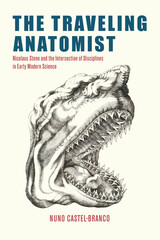
Nicolaus Steno (1638–1686) was a renowned anatomist in his lifetime. He reformed the anatomical understanding of glands, argued that the heart was a muscle, renamed the so-called female testicles as ovaries, and developed a mathematical model for understanding muscle contraction—discoveries that were fundamental to the fields of anatomy and physiology. However, other aspects of Steno’s life have come to define him: his claim that mountains’ strata reveal the history of the Earth and his conversion to Catholicism as a practicing scientist. This excessive attention to his geological discoveries and to asking whether science and religion are compatible, Nuno Castel-Branco argues, has obscured his significant accomplishments as an anatomist. The Traveling Anatomist thus restores Steno to his rightful place as a crucial figure in early modern science.
Using Steno’s extensive travels as a framework, this book depicts him as an active participant in the Republic of Letters. Castel-Branco traverses Leiden, Paris, Copenhagen, Florence, and Rome as he follows Steno in his sojourns through different scientific academies, courts, and artisanal workshops. There he developed new friends, some of whom were women, with whom he researched and exchanged ideas. Drawing on Steno’s books, correspondence, and novel archival material, Castel-Branco invites us to approach Steno and his accomplishments in anatomy, mathematics, and geology through the eyes of his contemporaries. Doing so, Castel-Branco reconstructs the rich and overlapping worlds of scientific disciplines that shaped Steno’s work, revealing the richness of interdisciplinary research in early modern intellectual life. And through Steno, he illustrates larger developments and new networks of significance in mid-seventeenth-century science. By focusing on ideas, scientific genres, institutions, and friendships, Castel-Branco offers a way others might also productively study science from the early modern period until today.
READERS
Browse our collection.
PUBLISHERS
See BiblioVault's publisher services.
STUDENT SERVICES
Files for college accessibility offices.
RECENTLY PUBLISHED



UChicago Accessibility Resources
home | accessibility | search | about | contact us
BiblioVault ® 2001 - 2026
The University of Chicago Press