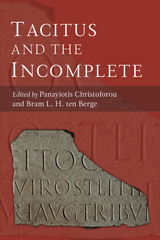
front cover of Tacitus and the Incomplete
Tacitus and the Incomplete
Edited by Panayiotis Christoforou and Bram L. H. ten Berge
University of Michigan Press, 2026

Widely regarded as ancient Rome’s greatest historian, Tacitus has shaped much of early modern and modern thought on Rome and its emperors. Substantial portions of his major historical works Histories and Annals, however, have not survived, depriving us of his account of crucial episodes and developments in Rome's early imperial history. This first-of-its-kind volume seeks to fill those gaps, using a range of historical and linguistic approaches to reconstruct the missing portions of Tacitus’ work. The volume offers reconstructions of the fragmentary Tacitean emperors (Augustus, Caligula, Nero, Vespasian, Titus, and Domitian) and of important lost episodes such as the destruction of the Temple of Jerusalem and the eruption of Mt. Vesuvius.

By utilizing the concept of incompleteness as a narrative tool, Tacitus and the Incomplete provides novel insights into what Tacitus’ oeuvre might have been like if the lost books had survived, and also expands on recent work on counterfactual historiography, the influence of hindsight on historical writing, the use of prolepsis and other narrative techniques, and on the limitations of historiography in the imperial period.


[more]

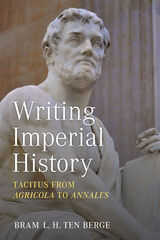
front cover of Writing Imperial History
Writing Imperial History
Tacitus from Agricola to Annales
Bram L. H. ten Berge
University of Michigan Press, 2023
The late first- and early second-century Roman senator and historian Cornelius Tacitus, whom Edward Gibbon described as “the first of the historians who applied the science of philosophy to the study of facts,” shaped the development of the modern understanding of history as a crucial vehicle for social analysis. The breadth of his thinking is fully revealed only through analysis of how the political, geographical, and rhetorical theories expounded in his early works influenced his later narrative of the evolution of the Roman monarchy. Tacitus, who was one of the oratorical luminaries of his time, produced a collection of works widely recognized as offering the most authoritative account of Rome’s early imperial history. His oeuvre traditionally is divided into the so-called minor and major works. Writing Imperial History offers the first comprehensive analysis of Tacitus’ five texts and their interconnections and serves to confront longstanding assumptions that have led to a fundamental misunderstanding of the nature and development of his oeuvre and historical thinking. Tracing many of the enduring themes and concerns that Tacitus explores across his works, the book shows how the vision articulated in his earlier texts persists in his later ones and how he used the former as sources for the latter.
[more]


Send via email Share on Facebook Share on Twitter