
 A SCHOLARLY BOOK REPOSITORY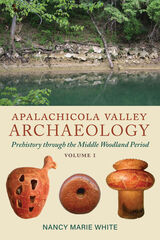
The definitive archaeological record and what is known or speculated about the ancient Apalachicola and lower Chattahoochee Valley region of northwest Florida, southeast Alabama, and southwest Georgia.
In this meticulously researched volume, Nancy Marie White provides a major holistic synthesis of the archaeological record and what is known or surmised about the peoples of the Apalachicola and lower Chattahoochee Valley region of northwest Florida, southeast Alabama, and southwest Georgia. White transforms a neglected research area into a lively saga that spans the time of the first human settlement, around 14,000 years ago, through the Middle Woodland period, ending about AD 700.
White reveals that Paleoindian habitation was more extensive than once surmised. Archaic sites were widespread, and those societies persisted when the Ice Age ended 10,000 years ago. Pottery appeared in the Late Archaic period (before 4000 BP), and Early Woodland–period burial mounds demonstrate a flowering of religious and ritual systems. Middle Woodland societies expanded this mortuary ceremony, and the complex pottery of the Swift Creek and the early Weeden Island ceramic series show an increased fascination with the ornate and unusual. Yet, basic Native American lifeways continued with gathering-fishing-hunting subsistence traditions similar to those of their ancestors.
This volume and its companion form the definitive work on the Apalachicola–lower Chattahoochee Valley region for both scholars and general readers interested in Native Americans of the Southeast.
A comprehensive synthesis tracing 1,300 years of cultural transformation in the Apalachicola–lower Chattahoochee Valley, from Late Woodland societies to the modern era.
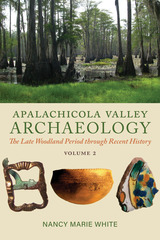
Apalachicola Valley Archaeology: The Late Woodland Period through Recent History, Volume 2, synthesizes the archaeology and history of the Native Americans, African Americans, and Euro-Americans of the Apalachicola–lower Chattahoochee Valley region of northwest Florida, southeast Alabama, and southwest Georgia from about 1300 years ago until the present. The region extends from Columbia, Alabama, to the Gulf of Mexico. It is culturally and environmentally distinct but little known archaeologically because it crosses historic political boundaries at the frontier.
Early chapters overview the environment and archaeology. Coverage then surveys time periods, from the Late Woodland to present. Topics include settlement, archaeological findings and material culture, subsistence and seasonality, history, sociopolitical systems, and peoples.
White’s prodigious work reveals that the prehistoric Late Woodland cultures who developed maize agriculture developed into Fort Walton chiefdoms. Post-invasion and Spanish and British colonization, these peoples were replaced by consolidated groups of Native American survivors and maroons moving around the region. These multiethnic societies with blended material cultures developed new identities, living at the edges of colonial territories. Creek societies, many becoming Seminoles, fought on all sides of European and American conflicts until most Indians were forcibly removed in the 1830s. Then the region became important for cotton, cattle, and timber, which were often produced by enslaved labor and transported by steamboat. Later expansion of agriculture and silviculture, as well as turpentine, tupelo honey, and other industries, left material evidence. The usefulness of the information to modern society is noted. Copious illustrations enhance the scientific analyses and the telling of the human stories.
A Dan Josselyn Memorial Publication
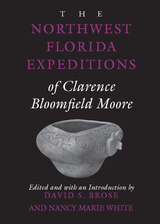
This comprehensive compilation of Moore's archaeological reports on northwest Florida and southern Alabama and Georgia presents the earliest documented investigations of this region.
When Clarence Bloomfield Moore cruised the rivers of Florida in search of prehistoric artifacts a century ago, he laid the groundwork for archaeological investigations to follow. This volume reflects Moore's fieldwork along the northwest Florida coast, the most archaeologically rich area of the state, as well as Southern Alabama and Georgia.
Here readers will share Moore's first look at the area in 1901-1903 and additional observations made in 1918 during what was to be his last field season. Moore's works reveal ceramics, tools, skeletal remains, and exotic artifacts excavated from the earthen mounds and shell middens built by native peoples over the last two millennia.
In the introduction to this edition, David Brose and Nancy Marie White place Moore's investigations within the context of the science, natural history, and antiquarianism of his day. They document what happened to the sites he explored, tell how his findings fit into the body of his research, and explain how those findings should be interpreted in the context of Southeastern culture history and modern archaeological theory.
Moore was the most knowledgeable Southeastern archaeologist of his time; his writings are a benchmark for anyone studying those areas today.
READERS
Browse our collection.
PUBLISHERS
See BiblioVault's publisher services.
STUDENT SERVICES
Files for college accessibility offices.
RECENTLY PUBLISHED




UChicago Accessibility Resources
home | accessibility | search | about | contact us
BiblioVault ® 2001 - 2026
The University of Chicago Press