
 A SCHOLARLY BOOK REPOSITORY
Results by Title
3 books about Apocryphal books (New Testament)
3 books about Apocryphal books (New Testament)
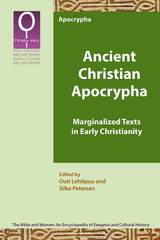
Ancient Christian Apocrypha
Marginalized Texts in Early Christianity
Outi Lehtipuu
SBL Press, 2022
This latest volume in the Bible and Women series examines ancient noncanonical Christian texts for what they reveal about women, their engagement with Scripture, and attitudes toward them in texts dating to the second to eighth century. Three sections include once-forgotten texts rediscovered in locations such as Nag Hammadi, those that have been in continuous use through the centuries, and works written by women that are traditionally excluded from discussions of noncanonical texts. Contributors Bernadette J. Brooten, María José Cabezas Cabello, Anna Carfora, Ute E. Eisen, Judith Hartenstein, Ursula Ulrike Kaiser, Karen L. King, Outi Lehtipuu, Heidrun Mader, Antti Marjanen, Silvia Pellegrini, Silke Petersen, Uwe-Karsten Plisch, Cristina Simonelli, Anna Rebecca Solevåg, M. Dolores Martin Trutet, and Carmen Bernabé Ubieta examine a range of texts, including noncanonical gospels and acts, poems, prophecy, and grave inscriptions.
[more]
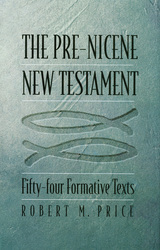
The Pre-Nicene New Testament
Fifty-four Formative Texts
Robert M. Price
Signature Books, 2006
In this monumental work, Professor Price offers an inclusive New Testament canon with twenty-seven additional sacred books from the first three centuries of Christianity, including a few of the Dead Sea Scrolls and Nag Hammadi writings. Price also reconstructs the Gospel of Marcion and the lost Gospel according to the Hebrews. Here, for the first time, is a canon representing all major factions of the early church.
As an interpretive translation, Price’s text is both accurate and readable and is tied more closely to the Greek than most previous translations. Price conveys the meanings of words in context, carefully choosing the right phrase or idiom to convey their sense in English. For words that had a specific theological import when first written, Price leaves the Greek transliteration, giving readers archons for the fallen angels thought to be ruling the world, paraclete for encourager, andpleroma for the Gnostic godhead.
Within the collection, each book is introduced with comments about the cultural setting, information about when a document was probably written, and significant textual considerations, which together form a running commentary that continues into the footnotes. The findings of scholars, documented and summarized by Price, will come as a surprise to some readers. It appears, as Price suggests, that most of what is known about Jesus came by way of revelation to Christian oracles rather than by word of mouth as historical memory. In addition, the major characters in the New Testament, including Peter, Stephen, and Paul, appear to be composites of several historical individuals each, their stories comprising a mix of events, legend, and plot themes borrowed from the Old Testament and Greek literature.
In the New Testament world, theology developed gradually along different trajectories, with tension between the charismatic ascetics such as Marcion and Thecla, as examples, and the emerging Catholic orthodoxy of such clergy as Ignatius and Polycarp. The tension is detectable in the texts themselves, many of which represent “heretical” points of view: Gnostic, Jewish-Christian, Marcionite, and proto-orthodox, and were later edited, sometimes clumsily, in an attempt to harmonize all into one consistent theology.
What may occur to many readers, among the more striking aspects of the narratives, is that the earliest, most basic writings, such as Mark’s Gospel in inarticulate Greek, are ultimately more impressive and inspirational than the later attempts by more educated Christians to appeal to sophisticated readers with better grammar and more allusions to classical mythology and apologetic embellishments.
The critical insights and theories on display in these pages have seldom been incorporated into mainstream conservative Bible translations, and in many ways, Price has made the New Testament a whole new book for readers, allowing them, by virtue of the translation, to comprehend the meaning of the text where it is obscured by the traditional wording. Whatever usefulness teachers, students, and clergy may find here in terms of pedagogical and inspirational value, The Pre-Nicene New Testament is guaranteed to provoke further thought and conversation among the general public—hopefully toward the goal of more personal study and insights.
As an interpretive translation, Price’s text is both accurate and readable and is tied more closely to the Greek than most previous translations. Price conveys the meanings of words in context, carefully choosing the right phrase or idiom to convey their sense in English. For words that had a specific theological import when first written, Price leaves the Greek transliteration, giving readers archons for the fallen angels thought to be ruling the world, paraclete for encourager, andpleroma for the Gnostic godhead.
Within the collection, each book is introduced with comments about the cultural setting, information about when a document was probably written, and significant textual considerations, which together form a running commentary that continues into the footnotes. The findings of scholars, documented and summarized by Price, will come as a surprise to some readers. It appears, as Price suggests, that most of what is known about Jesus came by way of revelation to Christian oracles rather than by word of mouth as historical memory. In addition, the major characters in the New Testament, including Peter, Stephen, and Paul, appear to be composites of several historical individuals each, their stories comprising a mix of events, legend, and plot themes borrowed from the Old Testament and Greek literature.
In the New Testament world, theology developed gradually along different trajectories, with tension between the charismatic ascetics such as Marcion and Thecla, as examples, and the emerging Catholic orthodoxy of such clergy as Ignatius and Polycarp. The tension is detectable in the texts themselves, many of which represent “heretical” points of view: Gnostic, Jewish-Christian, Marcionite, and proto-orthodox, and were later edited, sometimes clumsily, in an attempt to harmonize all into one consistent theology.
What may occur to many readers, among the more striking aspects of the narratives, is that the earliest, most basic writings, such as Mark’s Gospel in inarticulate Greek, are ultimately more impressive and inspirational than the later attempts by more educated Christians to appeal to sophisticated readers with better grammar and more allusions to classical mythology and apologetic embellishments.
The critical insights and theories on display in these pages have seldom been incorporated into mainstream conservative Bible translations, and in many ways, Price has made the New Testament a whole new book for readers, allowing them, by virtue of the translation, to comprehend the meaning of the text where it is obscured by the traditional wording. Whatever usefulness teachers, students, and clergy may find here in terms of pedagogical and inspirational value, The Pre-Nicene New Testament is guaranteed to provoke further thought and conversation among the general public—hopefully toward the goal of more personal study and insights.
[more]
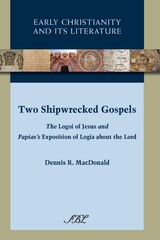
Two Shipwrecked Gospels
The Logoi of Jesus and Papias's Exposition of Logia about the Lord
Dennis R. MacDonald
SBL Press, 2012
With characteristic boldness and careful reassessment of the evidence, MacDonald offers an alternative reconstruction of Q and an alternative solution to the Synoptic Problem: the Q+/Papias Hypothesis. To do so, he reconstructs and interprets two lost books about Jesus: the earliest Gospel, which was used as a source by the authors of Mark, Matthew, and Luke; and the earliest commentary on the Gospels, by Papias of Hierapolis, who apparently knew Mark, Matthew, and the lost Gospel, which he considered to be an alternative Greek translation of a Semitic Matthew. MacDonald also explores how these two texts, well known into the fourth century, shipwrecked with the canonization of the New Testament and the embarrassment at outmoded eschatologies in both the lost Gospel and Papias’s Exposition.
[more]
READERS
Browse our collection.
PUBLISHERS
See BiblioVault's publisher services.
STUDENT SERVICES
Files for college accessibility offices.
RECENTLY PUBLISHED


UChicago Accessibility Resources
home | accessibility | search | about | contact us
BiblioVault ® 2001 - 2026
The University of Chicago Press