
 A SCHOLARLY BOOK REPOSITORY

Drawing on a newly developed theoretical definition of “missed opportunity,” Chances for Peace uses extensive sources in English, Hebrew, and Arabic to systematically measure the potentiality levels of opportunity across some ninety years of attempted negotiations in the Arab-Israeli conflict. With enlightening revelations that defy conventional wisdom, this study provides a balanced account of the most significant attempts to forge peace, initiated by the world’s superpowers, the Arabs (including the Palestinians), and Israel. From Arab-Zionist negotiations at the end of World War I to the subsequent partition, the aftermath of the 1967 War and the Sadat Initiative, and numerous agreements throughout the 1980s and 1990s, concluding with the Annapolis Conference in 2007 and the Abu Mazen-Olmert talks in 2008, pioneering scholar Elie Podeh uses empirical criteria and diverse secondary sources to assess the protagonists’ roles at more than two dozen key junctures.
A resource that brings together historiography, political science, and the practice of peace negotiation, Podeh’s insightful exploration also showcases opportunities that were not missed. Three agreements in particular (Israeli-Egyptian, 1979; Israeli-Lebanese, 1983; and Israeli-Jordanian, 1994) illuminate important variables for forging new paths to successful negotiation. By applying his framework to a broad range of power brokers and time periods, Podeh also sheds light on numerous incidents that contradict official narratives. This unique approach is poised to reshape the realm of conflict resolution.
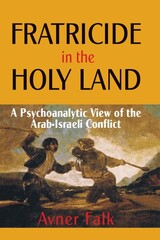
Falk suggests that a way to understand and explain such irrational matters is to examine the unconscious aspects of the conflict. He examines large-group psychology, nationalism, group narcissism, psychogeography, the Arab and Israeli minds, and suicidal terrorism, and he offers psychobiographical studies of Ariel Sharon and Yasser Arafat, two key players in this tragic conflict today.

From Coexistence to Conquest seeks to explain how the Arab-Israeli conflict developed by looking beyond strict legalism to the men behind the policies adopted by the Great Powers at the dawn of the twentieth century. It controversially argues that Zionism was adopted by the British Government in its 1917 Balfour Declaration primarily as an immigration device and that it can be traced back to the 1903 Royal Commission on Alien Immigration and the Alien’s Act 1905.
The book places the violent reaction of the Palestine Arabs to mass Jewish immigration in the context of Zionism, highlighting the findings of several British commissions of inquiry which recommended that Britain abandon its policy. The book also revisits the controversies over the question of self-determination, and the partition of Palestine.
The Chapter on the 1948 conflict seeks to update international lawyers on the scholarship of Israel’s ‘new’ historians and reproduces some of the horrific accounts of the atrocities that took place. The penultimate chapter argues that Israel was created through an act of conquest or subjugation. The book concludes with a sobering analysis of the conflict arguing that neither Jews nor Arabs were to blame for starting it.
READERS
Browse our collection.
PUBLISHERS
See BiblioVault's publisher services.
STUDENT SERVICES
Files for college accessibility offices.
RECENTLY PUBLISHED




UChicago Accessibility Resources
home | accessibility | search | about | contact us
BiblioVault ® 2001 - 2026
The University of Chicago Press