
 A SCHOLARLY BOOK REPOSITORY
Results by Title
2 books about Arbitration (International law)
2 books about Arbitration (International law)

Beyond Confrontation
Learning Conflict Resolution in the Post-Cold War Era
John A. Vasquez, Sanford Jaffe, James Turner Johnson, and Linda Stamato, Editors
University of Michigan Press, 1996
The post-Cold War era has given rise to new issues and disputes. Ethnic and nationalist violence disturb the peace and pose special problems for the strongest states and the United Nations. Beyond Confrontation: Learning Conflict Resolution in the Post-Cold War Era gives an overview of possible conflict resolution techniques that can be used to help manage and prevent these kinds of disputes in today's new world order. It outlines how to go beyond power politics and establish a politics of resolution. During the Cold War, traditional techniques of conflict resolution were neglected since they were thought to be irrelevant and generally inapplicable to the relations between states. In the meantime, a vast literature and practice on conflict resolution has grown up on the domestic level that has been largely ignored by international politics specialists. The contributors to this volume cull this literature for the insights it can shed on the process of developing worldwide stability. Moreover, they go beyond traditional discipline boundaries and bring to bear the best current work in political science, social psychology, law, management, sociology, and ethics on the important task of creating a more peaceful world order. Contributors include James Turner Johnson, John A. Vasquez, Robert A. Baruch Bush, Ronald J. Fisher, Deborah M. Kolb, Eileen E Babbitt, Louis Kriesberg, Dean G. Pruitt, John W. Burton, and Charles E Doran.
[more]
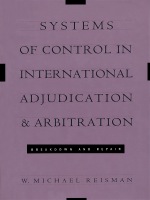
Systems of Control in International Adjudication and Arbitration
Breakdown and Repair
W. Michael Reisman
Duke University Press, 1992
In a world where nations are increasingly interdependent and where their problems--whether environmental, economic, or military--have a global dimension, the resolution of international disputes has become critically important. In Systems of Control in International Adjudication and Arbitration, W. Michael Reisman, one of America's foremost scholars and practitioners of international law, examines the controls that govern arbitration—a method of alternative, private, and relatively unsupervised dispute resolution—and shows how these controls have broken down.
Reisman considers three major forms of international arbitration: in the International Court; under the auspices of the World Bank; and under the New York Convention of 1958. He discusses the unique structures of control in each situation as well as the stresses they have sustained. Drawing on extensive research and his own experience as a participant in the resolution of some of the disputes discussed, Reisman analyzes recent key decisions, including: Australia and New Zealand's attempt to stop France's nuclear testing in Muroroa; AMCO vs. Republic of Indonesia, concerning the construction of a large tourist hotel in Asia; and numerous others.
Reisman explores the implications of the breakdown of control systems and recommends methods of repair and reconstruction for each mode of arbitration. As a crucial perspective and an invaluable guide, this work will benefit both scholars and practitioners of international dispute resolution.
Reisman considers three major forms of international arbitration: in the International Court; under the auspices of the World Bank; and under the New York Convention of 1958. He discusses the unique structures of control in each situation as well as the stresses they have sustained. Drawing on extensive research and his own experience as a participant in the resolution of some of the disputes discussed, Reisman analyzes recent key decisions, including: Australia and New Zealand's attempt to stop France's nuclear testing in Muroroa; AMCO vs. Republic of Indonesia, concerning the construction of a large tourist hotel in Asia; and numerous others.
Reisman explores the implications of the breakdown of control systems and recommends methods of repair and reconstruction for each mode of arbitration. As a crucial perspective and an invaluable guide, this work will benefit both scholars and practitioners of international dispute resolution.
[more]
READERS
Browse our collection.
PUBLISHERS
See BiblioVault's publisher services.
STUDENT SERVICES
Files for college accessibility offices.
RECENTLY PUBLISHED



UChicago Accessibility Resources
home | accessibility | search | about | contact us
BiblioVault ® 2001 - 2026
The University of Chicago Press