Results by title
3 books match the query 'Ariel'
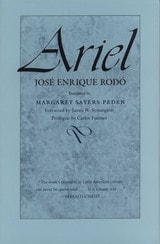
Ariel
By José Enrique Rodó
University of Texas Press, 1988
"Irritating, insufferable, admirable, stimulating, disappointing Rodó: . . . you are part of our family quarrels, and must bear with your disrespectful, equally disappointed, intuitive, incomplete nephews, living in a world that you helped define for us, and offered unto our revolt." —from the Prologue by Carlos Fuentes
First published in 1900 Uruguay, Ariel is Latin America's most famous essay on esthetic and philosophical sensibility, as well as its most discussed treatise on hemispheric relations. Though Rodó protested the interpretation, his allegorical conflict between Ariel, the lover of beauty and truth, and Caliban, the evil spirit of materialism and positivism, has come to be regarded as a metaphor for the conflicts and cultural differences between Latin America and the United States. Generations of statesmen, intellectuals, and literary figures have been formed by this book, either in championing its teachings or in reacting against them. This edition of Ariel, prepared especially with teachers and students in mind, contains a reader's guide to names, places, and important movements, as well as notes and a comprehensive annotated English/Spanish bibliography.
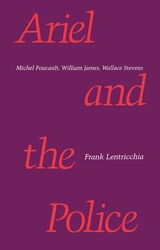
Ariel and the Police
Frank Lentricchia
University of Wisconsin Press, 1989
In Ariel and the Police, Frank Lentricchia searches through the totalizing desires for power that have built and help to maintain tangible and intangible structures of confinement and purification within, and sometimes as, the house of modernism. And what he finds, in his lyrical effort to redeem the subject for history, is that someone lives there, slyly, sometimes even playfully defiant.
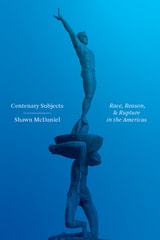
Centenary Subjects
Race, Reason, and Rupture in the AmericasShawn McDaniel
Vanderbilt University Press, 2021
Arielismo takes its name from José Enrique Rodó’s foundational essay Ariel (1900), a wide‑ranging gospel dedicated to Latin American youth that incited a cultural awakening under the banner of the spirit throughout the Americas at an ominous juncture—when the US co-opted the Cuban War of Independence in 1898, effectively rebranding it as the Spanish‑American War. Rodó’s optimistic message of transcendence as an antidote to the encroaching empire quickly became one of the most pervasive and malleable paradigms of regional empowerment, reverberating throughout a range of Latin Americanist projects in the twentieth and twenty‑first centuries.
Centenary Subjects recovers a series of important but understudied essays penned by arielista writers, radicals, pedagogues, prophets, and politicians of diverse stripes in the early twentieth century, and analyzes how, under the auspices of the arielista platform, young people emerged as historical subjects invested with unprecedented cultural capital, increasing political power, and an urgent mandate to break with the past and transform the sociopolitical and cultural landscape of their countries. But their respective designs harbor racial, epistemological, aesthetic, and anarchistic strains that bring into sharper relief the conflicting signals that the centenary subject had to parse with respect to race, reason, and rupture.