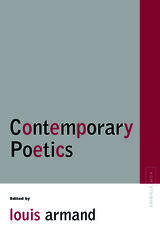
Exploring the boundaries of one of the most contested fields of literary study—a field that in fact shares territory with philology, aesthetics, cultural theory, philosophy, and even cybernetics—this volume gathers a body of critical writings that, taken together, broadly delineate a possible poetics of the contemporary. In these essays, the most interesting and distinguished theorists in the field renegotiate the contours of what might constitute "contemporary poetics," ranging from the historical advent of concrete poetry to the current technopoetics of cyberspace. Concerned with a poetics that extends beyond our own time, as a mere marker of present-day literary activity, their work addresses the limits of a writing "practice"—beginning with Stéphane Mallarmé in the late nineteenth century—that engages concretely with what it means to be contemporary.
Charles Bernstein's Swiftian satire of generative poetics and the textual apparatus, together with Marjorie Perloff's critical-historical treatment of "writing after" Bernstein and other proponents of language poetry, provides an itinerary of contemporary poetics in terms of both theory and practice. The other essays consider "precursors," recognizable figures within the histories or prehistories of contemporary poetics, from Kafka and Joyce to Wallace Stevens and Kathy Acker; "conjunctions," in which more strictly theoretical and poetical texts enact a concerted engagement with rhetoric, prosody, and the vicissitudes of "intelligibility"; "cursors," which points to the open possibilities of invention, from Augusto de Campos's "concrete poetics" to the "codework" of Alan Sondheim; and "transpositions," defining the limits of poetic invention by way of technology.