
 A SCHOLARLY BOOK REPOSITORY
9 start with A start with A
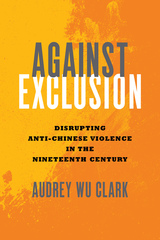
In Against Exclusion, Audrey Wu Clark dramatically reframes Asian American resistance via the lives of five early Chinese American public figures. In contrast to later activists who sought to defy stereotypes, Ah Toy, Mary Tape, Wong Chin Foo, Yan Phou Lee, and Yung Wing deployed the model minority and yellow peril tropes to make themselves visible during a period of rampant anti-Chinese violence and legal exclusion. In making themselves visible, they sought to expose and dismantle the contradictory exceptionalism of nineteenth-century US liberalism that both required and “disavowed” the deaths of Chinese Americans. In examining these figures and the ways in which they fought their exclusion as Chinese Americans—via court cases, autobiographical writings, journalism, and other forms of activism—Clark contributes to prevailing scholarly conversations about stereotypes of Asian Americans but contextualizes them in the nineteenth century. She traces the twinned emergences of the model minority and the yellow peril, excavating the exceptionalism with which Chinese Americans were racialized and subject to death—whether by lynching, other forms of driving out, or loss of citizenship or rights—and mapping its reverberations into the present day.
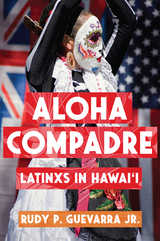
Aloha Compadre: Latinxs in Hawaiʻi is the first book to examine the collective history and contemporary experiences of the Latinx population of Hawaiʻi. This study reveals that contrary to popular discourse, Latinx migration to Hawaiʻi is not a recent event. In the national memory of the United States, for example, the Latinx population of Hawaiʻi is often portrayed as recent arrivals and not as long-term historical communities with a presence that precedes the formation of statehood itself. Historically speaking, Latinxs have been voyaging to the Hawaiian Islands for over one hundred and ninety years. From the early 1830s to the present, they continue to help shape Hawaiʻi’s history, yet their contributions are often overlooked. Latinxs have been a part of the cultural landscape of Hawaiʻi prior to annexation, territorial status, and statehood in 1959. Aloha Compadre also explores the expanding boundaries of Latinx migration beyond the western hemisphere and into Oceania.
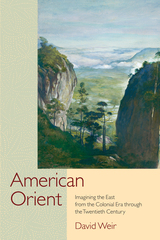
Surveying the American fascination with the Far East since the mid-eighteenth century, this book explains why the Orient had a fundamentally different meaning in the United States than in Europe or Great Britain. David Weir argues that unlike their European counterparts, Americans did not treat the East simply as a site of imperialist adventure; on the contrary, colonial subjugation was an experience that early Americans shared with the peoples of China and India.
In eighteenth-century America, the East was, paradoxically, a means of reinforcing the enlightenment values of the West: Franklin, Jefferson, and other American writers found in Confucius a complement to their own political and philosophical beliefs. In the nineteenth century, with the shift from an agrarian to an industrial economy, the Hindu Orient emerged as a mystical alternative to American reality. During this period, Emerson, Thoreau, and other Transcendentalists viewed the “Oriental” not as an exotic other but as an image of what Americans could be, if stripped of all the commercialism and materialism that set them apart from their ideal. A similar sense of Oriental otherness informed the aesthetic discoveries of the early twentieth century, as Pound, Eliot, and other poets found in Chinese and Japanese literature an artistic purity and intensity absent from Western tradition. For all of these figures the Orient became a complex fantasy that allowed them to overcome something objectionable, either in themselves or in the culture of which they were a part, in order to attain some freer, more genuine form of philosophical, religious, or artistic expression.
A monumental account of one migrant community’s everyday lives, struggles, and aspirations
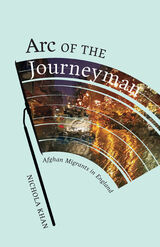
Forty years of continuous war and conflict have made Afghans the largest refugee group in the world. In this first full-scale ethnography of Afghan migrants in England, Nichola Khan examines the imprint of violence, displacement, kinship obligations, and mobility on the lives and work of Pashtun journeyman taxi drivers in Britain. Khan’s analysis is centered in the county of Sussex, site of Brighton’s orientalist Royal Pavilion and the former home of colonial propagandist Rudyard Kipling. Her nearly two decades of relationships and fieldwork have given Khan a deep understanding of the everyday lives of Afghan migrants, who face unrelenting pressures to remit money to their struggling relatives in Pakistan and Afghanistan, adhere to traditional values, and resettle the wives and children they have left behind.
This kaleidoscopic narrative is enriched by the migrants’ own stories and dreams, which take on extra significance among sleep-deprived taxi drivers. Khan chronicles the way these men rely on Pashto poems and aphorisms to make sense of what is strange or difficult to bear. She also attests to the pleasures of local family and friends who are less demanding than kin back home—sharing connection and moments of joy in dance, excursions, picnics, and humorous banter. Khan views these men’s lives through the lenses of movement—the arrival of friends and family, return visits to Pakistan, driving customers, even the journey to remit money overseas—and immobility, describing the migrants who experience “stuckness” caused by unresponsive bureaucracies, chronic insecurity, or struggles with depression and other mental health conditions.
Arc of the Journeyman is a deeply humane portrayal that expands and complicates current perceptions of Afghan migrants, offering a finely analyzed description of their lives and communities as a moving, contingent, and fully contemporary force.

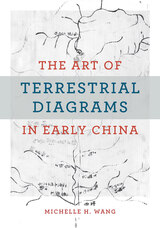
This is the first English-language monograph on the early history of maps in China, centering on those found in three tombs that date from the fourth to the second century BCE and constitute the entire known corpus of early Chinese maps (ditu). More than a millennium separates them from the next available map in the early twelfth century CE. Unlike extant studies that draw heavily from the history of cartography, this book offers an alternative perspective by mobilizing methods from art history, archaeology, material culture, religion, and philosophy. It examines the diversity of forms and functions in early Chinese ditu to argue that these pictures did not simply represent natural topography and built environments, but rather made and remade worlds for the living and the dead. Wang explores the multifaceted and multifunctional diagrammatic tradition of rendering space in early China.
READERS
Browse our collection.
PUBLISHERS
See BiblioVault's publisher services.
STUDENT SERVICES
Files for college accessibility offices.
RECENTLY PUBLISHED





UChicago Accessibility Resources
home | accessibility | search | about | contact us
BiblioVault ® 2001 - 2025
The University of Chicago Press